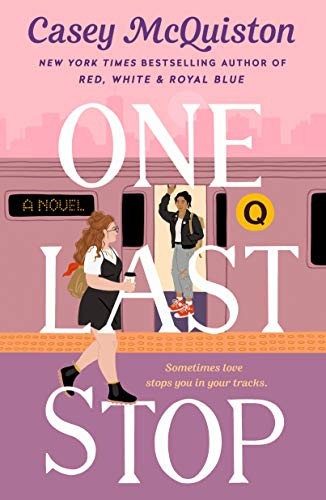
One Last Stop
by Casey McQuiston
★ Top 25 book of 2021 · #20 on Best Books of 2021
Cynical August moves to New York expecting nothing magical, then meets Jane on her subway commute. Jane turns out to be displaced in time from the 1970s, and August must work to save her.
Best for: Readers who love a magical, big-hearted queer romance with a time-travel twist
One Last Stop is #20 on BookWard's Best Books of 2021, out of 60 2021 books that cleared our data bar.
What One Last Stop is about
August Landry is twenty-three, cynical, and newly arrived in New York City with a plan to leave her old life behind. She doesn't believe in love or friendship, and she wants to escape her mother's obsessive search for August's missing uncle, which consumed her life. She works at a 24-hour pancake diner and shares an apartment with queer roommates.
Then she meets Jane Su on the subway and develops a crush. Jane is a punk butch lesbian from the 1970s, misplaced in time and stuck on the train, and she knows her own name only because it was written inside her jacket. August turns her detective skills toward finding a way to get Jane back to her own time, while also trying to save the diner from gentrification. Witty, romantic and warm, this queer love story suits readers who like a little time-bending mystery alongside their romance.
One Last Stop on the Best Books of 2021
One Last Stop came out in 2021. Of the 60 books first published in 2021 that met BookWard's data bar, it ranks #20 on our Best Books of 2021 list.
Why it made the list: 394 readers have shelved it on Open Library; readers rate it 4.2 out of 5 (22 ratings). The list ranks each year’s books on how many readers have picked them up, how highly readers rate them, and how many are reading them right now.
Nearby on the 2021 list
- The Hawthorne Legacy Jennifer Lynn Barnes, #18
- The Hating Game Sally Thorne, #19
- Heartstopper, Volume Five Alice Oseman, #21
- She Drives Me Crazy Kelly Quindlen, #22
See all Best Books of 2021 Best books by year
More years: Best Books of 2020 Best Books of 2022.
The numbers behind it
- Readers: 351 want to read it, 15 are reading it now and 28 have read it, according to Open Library.
- Ratings: 4.2 out of 5 from 22 Open Library ratings.
| Signal | This book (0 to 100) | Weight |
|---|---|---|
| Reach | 57 | 55% |
| Reader love | 82 | 25% |
| Being read right now | 55 | 20% |
Questions about One Last Stop
When was One Last Stop published?
One Last Stop by Casey McQuiston was first published in 2021.
Was One Last Stop one of the best books of 2021?
One Last Stop is #20 on BookWard's Best Books of 2021, out of 60 2021 books that cleared our data bar. 394 readers have shelved it on Open Library; readers rate it 4.2 out of 5 (22 ratings).
Why is One Last Stop on the Best Books of 2021 list?
394 readers have shelved it on Open Library; readers rate it 4.2 out of 5 (22 ratings).
More of the best books of 2021
- The Love Hypothesis Ali Hazelwood, #1
- Twisted Games Ana Huang, #2
- Project Hail Mary Andy Weir, #3
- As Good as Dead Holly Jackson, #4
- You've Reached Sam Dustin Thao, #5
- Twisted Love Ana Huang, #6
See the full Best Books of 2021, the Top 100, or new books on Rising.
How we know
This page uses public data: Open Library reader counts and ratings, and Wikipedia page views for recent years. The description is paraphrased from real source text. Rankings reflect reading interest, not quality or sales, and can be affected by data gaps. Lists update monthly.
Best suited to older teens and adults who enjoy contemporary romance.
Depends on the edition you pick.
A time-slip subway romance with real heart and a sharp wit. 55% taste match
 BookWard’s take
A time-slip subway romance with real heart and a sharp wit
August is 23, cynical and determined to prove that love and magic don't exist, until a woman on her subway line turns out to be displaced from the 1970s. That premise gives the book an immediate hook, and it earns its keep early: the central mystery is on the page almost at once. The romance beats are well-worn even when the setup is fresh, so the originality is a mixed story, strong in the concept and more familiar in the execution. The tone is warm and funny, and the outlook tilts firmly hopeful. Character depth comes from August's guarded history with her mother's search for a missing uncle. It is more sentimental than I tend to like, but the dialogue-heavy, character-led approach and the sustained momentum make it an easy recommendation.
A full-sized novel with a lot of plot and cast to carry, so it runs longer than BookWard's taste for tight and short.
Momentum stays up through the mystery and the romance, close to BookWard's preference for brisk reading.
The subway-bound time traveler is a fresh angle on a well-loved romance shape, though the genre beats are recognizable.
Clean, conversational and easy rather than ornate, a touch plainer than the ornate end of the scale.
The emotional arc of August opening up drives the book as much as the mystery of Jane's displacement.
Warm, optimistic and deliberately uplifting, a little more sunny than BookWard's own leaning.
A conventional, linear romance structure with a speculative premise on top, nothing formally experimental.
It is witty and banter-filled throughout, comfortably on the funny side of BookWard's taste.
Mostly light in tone, with some gravity around loss and the missing uncle, but gentle overall.
Longing, tenderness and joy come through strongly, though it stays buoyant.
See all 50 dialsEvery position, side by side with this book
Where it lines up
- EndingBookWard 8 · book 8
- Story or ideasBookWard 3 · book 3
- PaceBookWard 8 · book 7
Where it pulls apart
- LengthBookWard 1 · book 6
- Familiar tropesBookWard 10 · book 5
- Internal logicBookWard 10 · book 5
A full-sized novel with a lot of plot and cast to carry, so it runs longer than BookWard's taste for tight and short.
A girl on the subway who is stuck in the 1970s is a premise that pulls you in right away, which BookWard loves.
The romance structure is familiar, though the time-slip subway setup and the found-family cast keep it from feeling stock.
The time-displacement rules are built to serve the romance and mystery rather than to hold up under close scrutiny, looser than BookWard prefers.
Momentum stays up through the mystery and the romance, close to BookWard's preference for brisk reading.
The subway-bound time traveler is a fresh angle on a well-loved romance shape, though the genre beats are recognizable.
August's guardedness and her family history give her real depth, and the roommates and Jane are drawn with affection and specificity.
It closes its romantic and mystery threads in a satisfying way, which suits BookWard's liking for resolution.
It leans openly into big feelings and swoony romance, warmer and more sentimental than BookWard's restrained taste.
Its darker notes, like the missing uncle and a displaced life, are handled with care rather than used for effect.
Not applicable to a romance novel.
McQuiston's playful, bright, quippy narration is unmistakable and fits BookWard's love of distinctive voices.
The story and relationships lead, with the time-travel idea serving the romance rather than the other way around.
Backstory and the time-slip premise come through scene and conversation more than lecture, in line with BookWard's taste.
The plot has enough threads, from the romance to the investigation to the diner, to keep the middle moving.
Clean, conversational and easy rather than ornate, a touch plainer than the ornate end of the scale.
The emotional arc of August opening up drives the book as much as the mystery of Jane's displacement.
Warm, optimistic and deliberately uplifting, a little more sunny than BookWard's own leaning.
A conventional, linear romance structure with a speculative premise on top, nothing formally experimental.
It is witty and banter-filled throughout, comfortably on the funny side of BookWard's taste.
An accessible, fast-reading romance that asks little of the reader beyond openness to the premise.
The story stays close to August's perspective rather than moving among multiple narrators.
The present-day story is told straight, even though the premise involves someone from another decade.
A time-displacement conceit sits inside an otherwise realistic New York setting, so it is partly fantastical.
August's roommates, coworkers and Jane give it a lively ensemble, somewhat larger than BookWard's average.
The stakes are personal and local, centered on one relationship, one diner and one subway line.
It balances August's inner guardedness with the outward action of investigation and community.
Banter and conversation carry a great deal of the book, which BookWard enjoys.
The central love story between August and Jane is the engine of the novel.
Contemporary New York, subway life and a queer found family make for a familiar, easy-to-enter setting.
Mostly set in the present day, with Jane bringing the 1970s into it.
A time-bending love story with a durable emotional core, though it has some contemporary references.
August narrates in a candid, reliable way, with her flaws and cynicism visible on the surface.
The book sides plainly with love, honesty and community, so its moral picture is clear.
New York details, from the diner to the train, are evoked with warmth but without heavy description.
Not applicable to a novel.
Not applicable to a novel.
A standalone novel that wraps up on its own.
The mystery of Jane's displacement and August's uncle gives it some reveals, though the arc is mostly predictable.
A comforting, reassuring read that rewards the reader's hopes rather than testing them.
Mostly light in tone, with some gravity around loss and the missing uncle, but gentle overall.
Longing, tenderness and joy come through strongly, though it stays buoyant.
Quippy and playful but not slapstick, a mix of dry wit and warm, broad comedy.
Little violence on the page, as it is a character-focused romance.
It is described as sexy, with some on-page intimacy, but the book centers feeling over explicit content.
Queer identity and gentrification are woven through the story, giving it a clear social stance without being a lecture.
Contemporary, conversational English that reads very easily.
August's voice is full of attitude and personality, narrating with clear opinions.
Rooted in the past through Jane, but ultimately about building a future for August.
It argues for hope, love and found community over cynicism.
Review written by BookWard, dial version 1, November 2026.
Who is One Last Stop right for?
Best suited to older teens and adults who enjoy contemporary romance. It includes sexual content and themes of loss, so it is not aimed at younger readers.
An accessible, fast-reading romance that asks little of the reader beyond openness to the premise.
Mostly light in tone, with some gravity around loss and the missing uncle, but gentle overall.
Longing, tenderness and joy come through strongly, though it stays buoyant.
Little violence on the page, as it is a character-focused romance.
Book CompanionOne Last Stop: ideas, characters, themes
A cynical young woman who has given up on love meets a woman lost in time on the subway, and learns to believe in people and in magic again.
- The subway meet. August moves to New York and develops a crush on Jane, a woman she keeps encountering on her train line.
- A woman out of time. Jane reveals she is from the 1970s and only knows her name because it was written inside her jacket.
- Finding home in New York. August lands a job at Pancake Billy's House of Pancakes and moves in with a group of queer roommates.
- The weight of the past. August is also trying to move on from her mother's obsessive search for her missing uncle.
- Two missions. August must use her detective instincts to get Jane back to her own time and to save the diner from gentrification.
Characters
August Landry
Protagonist
A bisexual, cynical 23-year-old who moves to New York to leave her old life behind and does not believe in love or friendship.
Jane Su
Love interest
A punk butch lesbian from the 1970s who is displaced in time and trapped on the subway.
Themes
The book argues that letting people in is worth the risk.
August's roommates and coworkers become the community she thought she did not need.
Jane's situation raises questions about belonging and what it means to be out of place.
The threat to the diner stands in for the loss of beloved, community-shaped spaces.
August's arc is a shift from disbelief toward cautious faith in magic and connection.
Discussion questions
- Why does August believe so firmly that love and friendship are not for her?
- How does Jane's being from the 1970s change the way the book talks about queer history?
- What does the diner represent, and why does saving it matter to the story?
- Is the time-travel conceit best read as literal magic or as a metaphor?
- How does August's family history shape the way she approaches Jane?
Personalize your Book Companion
This is the general edition. In BookWard, the Companion is written for you: your reading profile, your notes, and spoiler-safe to the page you are on.
Buy, listen or borrow One Last Stop
Each link opens a search for this book on that store, in a new tab.
Read on a device
Borrow
Reviews and community
If you liked One Last Stop
A forced-proximity farm romance with a lottery-winner twist
A Witch's Guide to Magical InnkeepingSangu MandannaA cozy witchy inn story with a thawing historian
Holding Up the UniverseJennifer NivenTwo teens, one secret each, and a love story with real feeling
The Hating GameSally ThorneOffice enemies, petty games, and a kiss that complicates everything
Find your own best books
Add what you have read, rate it, and BookWard will recommend what to read next.
Free to start. No credit card needed.