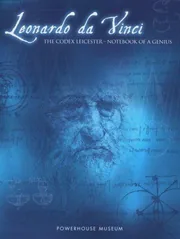
Leonardo
by Leonardo da Vinci, Kunster · 1946
Suits curious teens and adults who enjoy art, science and history.
140 pages, about 2 to 3.5 hours.
Leonardo's own pages, mirror-script and margin sketches, put before you. 51% taste match
What it covers
This book centers on Leonardo da Vinci, who lived from 1452 to 1519, and on the notebooks and drawings that record his work. First published in 1946, it falls under biography and memoir and draws on material connected to Windsor Castle, the Biblioteca Ambrosiana and the Alte Pinakothek in Munich. Its range covers engineering, hydraulics, inventions, human anatomy, proportion in art and the pursuit of knowledge, with settings across Italy, England, Russia and the city of Turin.
One edition grew out of an exhibition at Australia's Powerhouse Museum, which was organized around the Codex Leicester, a manuscript Bill Gates bought in 1994 for $30.8 million. The pages reproduce Leonardo's mirror-script Italian along with marginal sketches, and a discussion of each page faces the reproduction without offering a translation. An introduction to Leonardo's life is included, and the book has no index. Giorgio Castelfranco and Paolo D'Ancona also appear among the names connected to the work. Roughly 140 pages in length, it has appeared in 89 editions.
If anyone fits the description 'Renaissance man' it is Leonardo da Vinci.
Characters
House of WindsorPaolo D'Ancona
Setting
ItalyEnglandSaint PetersburgLondonRussia (Federation)
Period
15th century
Themes
ExhibitionsKnowledgeEarly works to 1800Windsor CastleBiblioteca ambrosianaCatalogsEngineeringHydraulics
- Want to read 1,016
- Reading now 76
- Read 46
Most people shelving it are saving it for later.
Of 1138 readers who put it on a shelf, 89% want to read it, 7% are reading it now, 4% have finished it and 0% stopped before the end.
By the numbers
- The median edition runs 140 pages. Counting about 275 words a page and an adult reading pace of 250 words a minute, that is about 2.6 hours of reading.
- Open Library tracks 89 editions from 67 publishers, the earliest dated 1946 and the latest 2014, across 7 languages.
- On reader demand it ranks in the top 1% of the classic books in our catalog (8,749 of them).
- Libraries shelve it under Dewey 759.5 and Library of Congress class ND-0623.00000000.L5 A4 1998a.
 BookWard’s take
Leonardo's own pages, mirror-script and margin sketches, put before you
This is less a life story than a look at the working notebooks themselves. The pages reproduce Leonardo's mirror-script Italian with sketches jotted in the margins, and a discussion on the facing side explains each one without translating it. That makes it idea-led rather than story-led, and the book is built around exposition: it explains what the pages contain rather than dramatizing a life. The range is wide, from fossils and astronomy to hydraulics, anatomy and proportion in art, so the subject matter stays fresh and original page to page. There is an introduction to Leonardo's life, but no index, so this is a book to wander through rather than look things up in. At about 140 pages, it stays tight. Expect a browse more than a binge.
At around 140 pages, it is compact and never overstays, which suits BookWard's taste for short books.
Page-by-page viewing moves at a browsing speed, steady but not driven by momentum.
Seeing the original mirror-script pages with margin sketches is a rare approach, well above the usual biography.
There is no plot to drive it; interest comes from the mind on the page.
It reads as a celebration of curiosity and knowledge, mostly upbeat in outlook.
Facing-page reproduction and commentary is an unusual layout compared with a standard biography.
This is serious scholarly material with little room for humor.
The subjects are fossils, water and anatomy, with nothing grim in tone.
The tone is intellectual and calm, with little emotional intensity.
See all 50 dialsEvery position, side by side with this book
Where it lines up
- OriginalityBookWard 9 · book 9
- Shock for effectBookWard 9 · book 9
- LengthBookWard 1 · book 2
Where it pulls apart
- OpeningBookWard 10 · book 6
- Story or ideasBookWard 3 · book 9
- ExpositionBookWard 2 · book 7
At around 140 pages, it is compact and never overstays, which suits BookWard's taste for short books.
Reproducing a thinker's own notebook pages avoids the tropes of the usual biography, which BookWard values.
Each reproduced page is paired with a discussion, so the book is orderly, though the notebook ideas wander by nature.
Page-by-page viewing moves at a browsing speed, steady but not driven by momentum.
Seeing the original mirror-script pages with margin sketches is a rare approach, well above the usual biography.
The man emerges through his own observations and drawings rather than through drawn-out portraiture.
A collection of pages has no real conclusion, so it closes by simply running out of pages.
The material is observation and diagrams, so it is restrained and unsentimental, matching BookWard's preference.
Nothing here leans on shock; the subject is inquiry into fossils, water and the body.
The pages are primary-source reproductions with a discussion alongside, which is strong on rigor, though it has no index.
Leonardo's own hand and curiosity give it a distinctive presence even through a companion volume.
It is about ideas and observations, with no story arc, which sits further toward ideas than BookWard usually likes.
The facing-page discussions explain what each page contains, so it leans on outright explanation over scene.
Short and made of discrete pages, it holds attention without a middle to sag.
There is no plot to drive it; interest comes from the mind on the page.
It reads as a celebration of curiosity and knowledge, mostly upbeat in outlook.
Facing-page reproduction and commentary is an unusual layout compared with a standard biography.
This is serious scholarly material with little room for humor.
Mirror-script pages and scientific topics ask for some patience, though the commentary helps.
It is anchored to one man's perspective, with commentary to guide you.
The pages are taken in sequence of presentation rather than as a time-jumping narrative.
It documents real observations, inventions and anatomy, so it is firmly grounded.
The focus stays on Leonardo, with only a few other names appearing at the edges.
It ranges across astronomy and engineering but stays an intimate look at one notebook's pages.
It centers on observation of the world more than on private reflection.
It contains no dialogue; the content is notes, sketches and commentary.
Romance does not feature in this scientific notebook material.
The 15th-century Italian setting and mirror-script are unfamiliar territory for most readers.
The material dates from the 15th century and is firmly historical.
Leonardo's curiosity is long lasting, and the notebooks remain compelling centuries on.
The commentary reports plainly, and Leonardo's own notes are direct observation.
It makes no moral claims, so clarity is not really in question here.
Drawings and the written descriptions of nature and anatomy make it fairly rich visually.
It mixes introductory narrative on his life with analytical commentary on the pages.
The hand-written pages are personal, while the commentary adds a measured outside view.
A notebook collection offers discoveries rather than plot surprises.
It asks you to engage with unfamiliar scripts and scientific thinking, a mild intellectual challenge.
The subjects are fossils, water and anatomy, with nothing grim in tone.
The tone is intellectual and calm, with little emotional intensity.
Little humor appears, and what there is stays dry.
Violence is essentially absent from this material.
Sexual content is absent.
It is concerned with science and art, not politics.
Mirror-script Italian with no translation makes the originals dense, though commentary is plain.
The commentary explains the pages without pushing a strong viewpoint.
It looks back at a 15th-century mind, though its ideas pointed ahead of their time.
It celebrates inquiry and learning, leaning toward an idealistic view of knowledge.
Review written by BookWard, dial version 1, November 2026.
Who is Leonardo right for?
Suits curious teens and adults who enjoy art, science and history. Nothing in it is sensitive, though the anatomy drawings may interest some readers more than others.
Mirror-script pages and scientific topics ask for some patience, though the commentary helps.
The subjects are fossils, water and anatomy, with nothing grim in tone.
The tone is intellectual and calm, with little emotional intensity.
Violence is essentially absent from this material.
Book CompanionLeonardo: ideas, characters, themes
Leonardo's notebook pages, in mirror-script with margin sketches, show a mind probing nature, engineering and the human body.
- The pages come first. Each right-hand page reproduces one of Leonardo's pages in mirror-script Italian with sketches in the margins.
- Commentary without translation. A discussion appears on the facing side of each page, but it does not translate the Italian.
- A wide range of subjects. The material covers engineering, hydraulics, inventions, human anatomy, proportion in art and the pursuit of knowledge.
- A manuscript with a famous owner. One edition grew from a Powerhouse Museum exhibition built around the Codex Leicester, which Bill Gates bought in 1994 for $30.8 million.
- An introduction but no index. It includes an introduction to Leonardo's life but no index, so it suits browsing over lookup.
Characters
Leonardo da Vinci
Author and subject
The 15th-century thinker whose notebooks and drawings are the heart of the book.
Bill Gates
Owner of the Codex Leicester
Bought the manuscript in 1994 and loaned it to the Powerhouse Museum for the exhibition.
Giorgio Castelfranco
Connected name
One of the people tied to the work in its subject listing.
Paolo D'Ancona
Connected name
Another figure associated with the work in its subject listing.
Themes
A restless drive to observe and ask how the world works.
Knowledge built from careful looking, drawing and recording.
Proportion, anatomy and engineering treated as one inquiry.
How notebooks survive, are rebound, copied and displayed centuries later.
Discussion questions
- Why might the book pair each page with commentary but not a translation?
- How do the margin sketches change the way you read a page of text?
- What links fossils, hydraulics and anatomy in one mind?
- What does it mean that this manuscript was bought and then loaned for an exhibition?
- How is browsing notebook pages different from reading a conventional biography?
Personalize your Book Companion
This is the general edition. In BookWard, the Companion is written for you: your reading profile, your notes, and spoiler-safe to the page you are on.
Buy, listen or borrow Leonardo
Each link opens a search for this book on that store, in a new tab.
Read on a device
Borrow
Reviews and community
If you liked Leonardo
A compact look at Klee, from Blaue Reiter to the Bauhaus
La PoeticaAristotleAristotle's compact blueprint for how poetry and drama work
Discours de la méthodeRené DescartesDescartes reasons from doubt to certainty in a short, brisk essay
CodeCharles PetzoldFlashlights to microprocessors: how computers actually work, built from nothing
Sources: Open Library.
Track Leonardo and find your next favorite
Add it to your shelf, rate what you have read, and BookWard will recommend what fits you.
Free to start. No credit card needed.