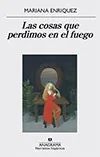
Las cosas que perdimos en el fuego
by Mariana Enríquez · 2016
Best suited to adult readers and mature older teens comfortable with dark material.
202 pages, about 3 to 4.5 hours.
Twelve Argentine horror stories where the monsters are social realities. 66% taste match
What is inside
Las cosas que perdimos en el fuego is a short story collection by Mariana Enríquez, first published in 2016 by Editorial Anagrama. It contains twelve stories set in Argentina in the twenty-first century, all written within the horror genre. One of them, "The Dirty Kid," opens with a narrator who lives in her late grandparents' old family house in Constitución, much to the dismay of her relatives.
The stories draw on social realities, among them depression, poverty, eating disorders, inequality and gender violence, and place them in everyday Argentine life. The collection takes its title from the 2001 album Things We Lost in the Fire by the American band Low, whom Enríquez follows as a fan. Megan McDowell translated the book into English in 2017. It has appeared in a dozen editions and runs to roughly 200 pages in its usual printing, and it sits alongside other Argentine short fiction and Hispanic and Latino literary fiction.
My family thinks I'm crazy, and all because I choose to live in our old family home in Constitucion, in the house that once belonged to my paternal grandparents. -The Dirty Kid
Setting
Argentina
Themes
Argentine Short storiesCuentos argentinosHorrorShort StoriesVida social y costumbresFiccionShort stories, Argentine
- Want to read 102
- Reading now 8
- Read 15
Most people shelving it are saving it for later.
Of 125 readers who put it on a shelf, 82% want to read it, 6% are reading it now, 12% have finished it and 0% stopped before the end.
By the numbers
- The median edition runs 202 pages. Counting about 275 words a page and an adult reading pace of 250 words a minute, that is about 3.7 hours of reading.
- Open Library tracks 12 editions from 10 publishers, the earliest dated 2016 and the latest 2023, across 5 languages.
- On reader demand it ranks in the top 8% of the recent books in our catalog (6,647 of them).
- Libraries shelve it under Dewey 863.7 and Library of Congress class PQ-7798.15000000.N75.
 BookWard’s take
Twelve Argentine horror stories where the monsters are social realities
Mariana Enríquez's 2016 collection runs twelve stories, all horror, all set in twenty-first-century Argentina. What sets it apart is where the dread comes from: poverty, depression, eating disorders, inequality and gender violence sit at the center of the fear. It avoids the genre's stock machinery by rooting its unease in real places and real pressures. The openings serve it well, too. "The Dirty Kid" begins with a narrator living in her late grandparents' house in Constitución, and the unease starts in the setting itself. At about 200 pages, the book stays tight and short, with no room to sag. Each story is its own self-contained piece, so you can read one and stop.
About 200 pages for twelve stories, so each piece stays compact, which suits BookWard's taste for the short and tight.
Short forms keep things moving, though the dread builds by degrees rather than racing, a close fit for BookWard's quick-leaning taste.
Framing depression, poverty and gender violence as horror gives the genre a fresh footing, which BookWard rewards.
The language serves the dread with some lyrical touches, a bit more ornate than BookWard's plainer leaning.
Stories balance events with the inner lives of those caught in them, landing close to the middle, slightly character-leaning.
Poverty, violence and despair dominate, and hope is scarce, well below BookWard's mildly hopeful outlook.
A conventional collection of separate stories, with no formal gimmicks, sitting near the middle of the dial.
This is serious, dread-driven horror with little room for jokes, far from BookWard's lean toward the funny.
Horror built on poverty, depression and gender violence puts this near the dark end of the scale.
The stories hit hard but through unease and dread more than overt emotional release.
See all 50 dialsEvery position, side by side with this book
Where it lines up
- Authorial voiceBookWard 9 · book 9
- Sagging middleBookWard 8 · book 8
- LengthBookWard 1 · book 2
Where it pulls apart
- Internal logicBookWard 10 · book 6
- EndingBookWard 8 · book 4
- OpeningBookWard 10 · book 8
About 200 pages for twelve stories, so each piece stays compact, which suits BookWard's taste for the short and tight.
Stories like "The Dirty Kid" set their strange, uneasy scene in the first lines, which matches BookWard's love of an immediate pull.
Horror here grows out of Argentine social life rather than stock genre furniture, which BookWard prizes.
Each story builds its own uncanny rules; some leave edges unexplained, a little looser than BookWard's airtight preference.
Short forms keep things moving, though the dread builds by degrees rather than racing, a close fit for BookWard's quick-leaning taste.
Framing depression, poverty and gender violence as horror gives the genre a fresh footing, which BookWard rewards.
Short stories give each narrator limited room, so characters are drawn sharply but briefly, a touch lighter than BookWard likes.
Horror stories often close on unease rather than neat resolution, so endings lean open, short of BookWard's fully resolved preference.
The collection is cold-eyed about suffering and refuses consolation, which BookWard values as restraint.
The darkness is tied to real social ills, so it reads as earned, though some images are meant to jolt.
A fiction collection, so this dial does not apply.
Enríquez's blend of social realism and horror gives the book a distinctive, recognizable stance that BookWard admires.
Social themes drive the collection, but each piece is delivered as story, which sits near BookWard's story-led side.
The dread arrives through scene and situation rather than explanation, which suits BookWard's show-don't-tell leaning.
Twelve self-contained stories keep the energy up across the book, since no single arc has room to go slack.
The language serves the dread with some lyrical touches, a bit more ornate than BookWard's plainer leaning.
Stories balance events with the inner lives of those caught in them, landing close to the middle, slightly character-leaning.
Poverty, violence and despair dominate, and hope is scarce, well below BookWard's mildly hopeful outlook.
A conventional collection of separate stories, with no formal gimmicks, sitting near the middle of the dial.
This is serious, dread-driven horror with little room for jokes, far from BookWard's lean toward the funny.
The prose is accessible but the subject matter is heavy, making it a moderately demanding read.
Each story brings a different narrator and situation, so the book as a whole carries many viewpoints.
Stories are set in the present-day period and follow their own events in a mostly straightforward order.
Horror elements bend reality, but they are planted in recognizable Argentine settings, so the fantastical is real but anchored.
Twelve stories mean many different people across the book, though each piece stays small in scope.
Stories stay with individuals, families and neighborhoods rather than sweeping events, so the scale is intimate.
Dread comes both from what characters feel and from what happens around them, balanced roughly evenly.
Scenes mix speech with narration in moderate proportions, neither dialogue-heavy nor sparse.
Love is not the engine of these stories, and romance stays peripheral.
Contemporary Argentina, including places like Constitución, is likely to feel unfamiliar to many English-language readers, and that suits BookWard's appetite for new settings.
Set in the twenty-first century, the book reads as very much a present-day work.
Its concerns with inequality, poverty and violence give it lasting relevance beyond its moment.
The book offers little tidy moral guidance and leaves judgment to the reader, a more ambiguous stance than BookWard's own.
Places, houses and city streets are rendered vividly, making the settings feel atmospheric and rich.
A standalone collection, not part of any series.
Horror stories carry some turns, but the effect is built on mounting unease more than on reversals.
The subject matter pushes readers into uncomfortable territory, well above the comforting end and in line with BookWard's taste for challenge.
Horror built on poverty, depression and gender violence puts this near the dark end of the scale.
The stories hit hard but through unease and dread more than overt emotional release.
Gender violence and horror both appear on the page, so the violence is considerable.
Some sexual content appears within the dark material, but it is not the focus.
Inequality and poverty are baked into the horror, giving the book a clear social and political undercurrent.
Translated into plain English by Megan McDowell, the language is approachable, with moderate density.
The stories show rather than preach, with a point of view carried by situation more than commentary.
The book looks at present conditions and what they cost, neither backward nor boldly forward.
The worldview is unflinching and pessimistic about society, far toward the cynical end.
Review written by BookWard, dial version 1, November 2026.
Who is Las cosas que perdimos en el fuego right for?
Best suited to adult readers and mature older teens comfortable with dark material. It deals with gender violence, depression, eating disorders and disturbing horror imagery.
The prose is accessible but the subject matter is heavy, making it a moderately demanding read.
Horror built on poverty, depression and gender violence puts this near the dark end of the scale.
The stories hit hard but through unease and dread more than overt emotional release.
Gender violence and horror both appear on the page, so the violence is considerable.
Book CompanionLas cosas que perdimos en el fuego: ideas, characters, themes
Enríquez uses horror to make visible the quiet violences of everyday Argentine life, from poverty and depression to eating disorders and gender violence.
- Twelve stories, one nation. The collection gathers twelve separate horror stories set in twenty-first-century Argentina.
- Horror as social lens. Social issues like inequality and poverty are not background but the source of the dread.
- Domestic starting points. "The Dirty Kid" opens with a narrator living in her late grandparents' old house in Constitución.
- A borrowed title. The collection takes its name from the 2001 album Things We Lost in the Fire by the band Low, whom Enríquez follows as a fan.
- Translated for English readers. Megan McDowell's English translation appeared in 2017, a year after the Spanish original from Editorial Anagrama.
Themes
How economic hardship shapes lives and frames the book's horrors.
The threat and reality of violence against women as a recurring source of fear.
Mental suffering treated as an unsettling presence in its own right.
The body as a site of harm and horror.
Houses and neighborhoods carrying history, as with the family home in Constitución.
Discussion questions
- Why might Enríquez use horror, rather than realism, to write about poverty and violence?
- How does the Argentine setting shape the way fear works in these stories?
- Which story stayed with you longest, and what made it linger?
- How do the stories treat the line between the real and the supernatural?
- What does the title suggest about loss across the collection?
Personalize your Book Companion
This is the general edition. In BookWard, the Companion is written for you: your reading profile, your notes, and spoiler-safe to the page you are on.
Buy, listen or borrow Las cosas que perdimos en el fuego
Each link opens a search for this book on that store, in a new tab.
Read on a device
Borrow
Reviews and community
If you liked Las cosas que perdimos en el fuego
Twelve Argentine horror stories where the ordinary city turns monstrous
Bat EaterKylie Lee BakerA Chinatown crime scene cleaner, a murdered sister, and hungry ghosts
The End of EverythingM. John HarrisonA strange Kent tideline, and an object that won't hold still
The HoundingXenobe PurvisA village turns on four odd sisters, told through five voices
Sources: Open Library.
Track Las cosas que perdimos en el fuego and find your next favorite
Add it to your shelf, rate what you have read, and BookWard will recommend what fits you.
Free to start. No credit card needed.