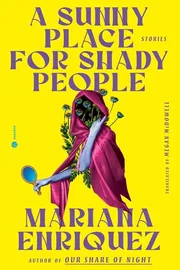
A Sunny Place for Shady People
by Mariana Enríquez · 2024
Suited to adult readers comfortable with horror and unsettling themes.
232 pages, about 3.5 to 5.5 hours.
Twelve Argentine horror stories where the ordinary city turns monstrous. 67% taste match
The story
A Sunny Place for Shady People is a collection of twelve horror stories by Mariana Enríquez, first published in 2024 and written in Spanish. It belongs to the horror and gothic tradition, and the stories turn on the presence of evil and of monsters that appear within ordinary reality, whether in large cities or in small, remote towns. The book runs to roughly 232 pages in its median edition.
Buenos Aires, Argentina, anchors part of the collection. One story follows a woman who keeps ghosts at bay in a neighborhood on the city's outskirts, among them the dead of her own family and of the street. Another sends a couple to a rented house in a town that has been emptying out since the trains stopped running, where a local artist's paintings are on display in the abandoned station. A further story involves volunteers from an organization that distributes food in poor neighborhoods. Together the tales place the supernatural alongside everyday settings and contemporary life.
Setting
Buenos Aires (Argentina)
By the numbers
- The median edition runs 232 pages. Counting about 275 words a page and an adult reading pace of 250 words a minute, that is about 4.3 hours of reading.
- Open Library tracks 3 editions from 3 publishers, across 2 languages.
- On reader demand it ranks in the top 12% of the recent releases books in our catalog (1,627 of them).
- Libraries shelve it under Library of Congress class PQ-7798.15000000.N75S8 2024.
 BookWard’s take
Twelve Argentine horror stories where the ordinary city turns monstrous
Mariana Enríquez's 2024 collection gathers twelve horror stories set in Buenos Aires, remote emptied-out towns and beyond. At 232 pages it is short, which is a point in its favor. A story collection also means a fresh opening every dozen pages, which suits a reader who wants to be hooked early and often. Where it may frustrate is in exposition: horror this grounded in everyday settings works by letting dread build in scene, and internal logic matters less than mood in this tradition. The ghosts, paintings and abandoned stations feel drawn from a distinctive authorial voice rather than stock Gothic furniture. Expect an outlook closer to bleak than hopeful, and content that sits firmly on the dark side.
At 232 pages across twelve stories, it is compact, which matches BookWard's preference for tight books.
Placing ghosts and monsters in Buenos Aires outskirts and food-distribution rounds gives the genre a fresh local texture BookWard values.
The writing is literary and atmospheric without being ornate, sitting a bit above BookWard's plainer center.
Situations and hauntings drive these stories about as much as their characters do, near the middle of the dial.
Evil and monsters lurk throughout, so the outlook is bleak, further from BookWard's mild hopefulness.
A twelve-story collection is a familiar shape, with each piece telling itself conventionally.
The book is built to unsettle, so humor is scarce, which is below BookWard's lightly funny taste.
It is a dedicated horror collection about evil and monstrous things, well past BookWard's mid-range content comfort.
Fear and dread run strongly through the stories, giving moderately intense emotion.
See all 50 dialsEvery position, side by side with this book
Where it lines up
- Authorial voiceBookWard 9 · book 9
- ExpositionBookWard 2 · book 2
- Sagging middleBookWard 8 · book 8
Where it pulls apart
- Internal logicBookWard 10 · book 6
- EndingBookWard 8 · book 4
- OpeningBookWard 10 · book 8
At 232 pages across twelve stories, it is compact, which matches BookWard's preference for tight books.
Short stories have to grab quickly, and a horror premise like the emptied-out town does that at once, which BookWard rewards.
It works inside the gothic tradition but sets it in contemporary Argentine life, which keeps familiar ghosts from feeling stock.
Horror stories rely on dread over strict rules, so the internal logic is looser than BookWard's airtight preference.
Placing ghosts and monsters in Buenos Aires outskirts and food-distribution rounds gives the genre a fresh local texture BookWard values.
Each story gives its people limited room, so characters are sketched more sharply than deeply, a little under BookWard's bar.
Horror collections tend to close on unease rather than neat resolution, so endings sit more open than BookWard likes.
The horror is rooted in real social unease rather than gore for its own sake, though some stories surely push hard.
Enríquez is known for a distinctive, recognizable voice in horror, which BookWard prizes.
These are story-led pieces built on scenes and encounters more than argument, close to BookWard's story-first taste.
Horror of this kind shows its dread in scene instead of explaining it, which BookWard prefers.
Short stories leave little room for a middle to sag, so energy stays sustained across the book.
The writing is literary and atmospheric without being ornate, sitting a bit above BookWard's plainer center.
Situations and hauntings drive these stories about as much as their characters do, near the middle of the dial.
Evil and monsters lurk throughout, so the outlook is bleak, further from BookWard's mild hopefulness.
A twelve-story collection is a familiar shape, with each piece telling itself conventionally.
The book is built to unsettle, so humor is scarce, which is below BookWard's lightly funny taste.
The stories read accessibly even when unsettling, so effort is moderate, near BookWard's comfort zone.
Twelve separate stories mean many different perspectives, which BookWard enjoys.
Ghosts, monsters and haunted places make the supernatural central, more fantastical than BookWard's middle ground.
Each story has a small group, though twelve stories add up to a fairly wide gallery of people overall.
The stories are intimate encounters in neighborhoods and small towns rather than epic in scope.
Dread blends inner unease with outward encounters, balancing thought and action evenly.
Scenes mix conversation with description in a balanced way, close to BookWard's dialogue-leaning taste.
Romance is incidental here, with horror taking all the center space.
Buenos Aires outskirts and abandoned stations are settings many readers will find unfamiliar, matching BookWard's liking for new places.
The stories belong to contemporary life, including internet-era legends, and sit close to the present.
Fear of the monstrous in ordinary places is enduring, though these tales are rooted in a specific time.
Evil lurks without tidy lessons, leaving moral judgments murky, in line with BookWard's taste for ambiguity.
Atmosphere matters in horror, so settings and menace are drawn with richness, above BookWard's middle.
This is a standalone collection, matching BookWard's lean toward self-contained books.
Horror stories often hinge on reveals, such as who painted the canvases, so surprises are fairly frequent.
The book unsettles on purpose, more challenging than comforting, in line with BookWard's taste.
It is a dedicated horror collection about evil and monstrous things, well past BookWard's mid-range content comfort.
Fear and dread run strongly through the stories, giving moderately intense emotion.
Humor is minimal and, where present, dry, in line with BookWard's middle position.
Sexual content is not a focus here, sitting below BookWard's middle.
The stories touch on poor neighborhoods and social unease, bringing politics moderately forward.
Narration stays mostly observational, neutral rather than preaching.
Stories dwell on haunted pasts, the dead and decline, looking back more than forward.
The worldview is cynical, with evil lurking everywhere, far from BookWard's slightly idealistic side.
Review written by BookWard, dial version 1, November 2026.
Who is A Sunny Place for Shady People right for?
Suited to adult readers comfortable with horror and unsettling themes. It involves death, menace and troubling situations, so sensitive readers should proceed with care.
The stories read accessibly even when unsettling, so effort is moderate, near BookWard's comfort zone.
It is a dedicated horror collection about evil and monstrous things, well past BookWard's mid-range content comfort.
Fear and dread run strongly through the stories, giving moderately intense emotion.
Book CompanionA Sunny Place for Shady People: ideas, characters, themes
Horror does not need a faraway castle, because monsters and ghosts can surface in ordinary neighborhoods, small towns and everyday work.
- Twelve stories. The book is a collection of twelve horror stories about evil and monstrous presences.
- Ghosts of the periphery. One story follows a woman who keeps ghosts at bay in a Buenos Aires outskirts neighborhood, among them the dead of her family and street.
- The emptied-out town. A couple rents a house in a town that has lost residents since the trains stopped, and visits paintings shown in the abandoned station.
- Aid work and fear. Volunteers who distribute food in poor neighborhoods are central to another tale.
- Tradition renewed. The collection draws on gothic horror while exploring new directions for the genre.
Themes
Monstrous things breaking into ordinary life.
The dead remaining present among the living.
Places and communities emptying out over time.
The strain of life in marginal neighborhoods.
Stories that spread and take on a life of their own.
Discussion questions
- Why might horror hit harder in ordinary settings than in remote gothic ones?
- How do the stories use place, such as outskirts and emptied towns, to build dread?
- Which story's central threat felt most real to you, and why?
- How does a collection change the experience of horror compared with a novel?
- What do the ghosts in these stories seem to represent?
Personalize your Book Companion
This is the general edition. In BookWard, the Companion is written for you: your reading profile, your notes, and spoiler-safe to the page you are on.
Buy, listen or borrow A Sunny Place for Shady People
Each link opens a search for this book on that store, in a new tab.
Read on a device
Borrow
Reviews and community
If you liked A Sunny Place for Shady People
Twelve Argentine horror stories where the monsters are social realities
Bat EaterKylie Lee BakerA Chinatown crime scene cleaner, a murdered sister, and hungry ghosts
The End of EverythingM. John HarrisonA strange Kent tideline, and an object that won't hold still
The HoundingXenobe PurvisA village turns on four odd sisters, told through five voices
Sources: Open Library.
Track A Sunny Place for Shady People and find your next favorite
Add it to your shelf, rate what you have read, and BookWard will recommend what fits you.
Free to start. No credit card needed.