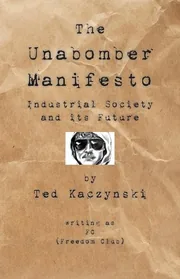
Industrial Society and Its Future
by Theodore Kaczynski · 1995
Best suited to adult readers and mature older teens who can handle dense political argument.
112 pages, about 2 to 2.5 hours.
A short, rigorous-sounding case against technology, with a violent history. 39% taste match
What it covers
Industrial Society and Its Future is an essay by Theodore Kaczynski, first published in 1995 and better known as the Unabomber Manifesto. It belongs to the shelves of political history, philosophy and political ideologies, with a focus on technology, radicalism and anarchism. The text opens with the claim that the Industrial Revolution and what followed from it have been a disaster for the human race. From there it makes a case against technological society, arguing that industrial development damages the natural world and that making people fit the demands of machinery produces a social and political order that limits human freedom and potential.
The author was a mathematician who, in 1971, left modern life behind and settled in a remote cabin in Montana. Over about two decades he mailed bombs to professors and executives, attacks that killed three people and caused more than twenty casualties. He wrote the essay under the name FC, for Freedom Club, and offered to stop the bombings if a major publication printed it in full. It ran in the New York Times, and his brother later recognized the writing, which led to his arrest. The work is set in the United States in the late 20th century. It runs to roughly 112 pages and has appeared in 24 editions.
The Industrial Revolution and its consequences have been a disaster for the human race.
Setting
United States
Period
20th century
Themes
RadicalismSocial aspectsSocial aspects of TechnologyTechnologyLuddismTerrorismAnarchismBombers (Terrorists)
- Want to read 107
- Reading now 9
- Read 27
Most people shelving it are saving it for later.
Of 143 readers who put it on a shelf, 75% want to read it, 6% are reading it now, 19% have finished it and 0% stopped before the end.
By the numbers
- The median edition runs 112 pages. Counting about 275 words a page and an adult reading pace of 250 words a minute, that is about 2.1 hours of reading.
- Open Library tracks 24 editions from 20 publishers, the earliest dated 1995 and the latest 2024, across 5 languages.
- On reader demand it ranks in the top 10% of the modern books in our catalog (15,152 of them).
- Libraries shelve it under Library of Congress class T--0014.50000000.K33 2018.
 BookWard’s take
A short, rigorous-sounding case against technology, with a violent history
This is a 112-page essay arguing that the Industrial Revolution was a disaster, and that bending people to the demands of machinery limits human freedom and potential. It is driven by ideas rather than story, and it lays out its case directly instead of dramatizing it in scene, which is not the way I usually like to be argued with. The pace is brisk and the length is tight, and I do appreciate both. The real trouble is rigor. The argument is built to look systematic, yet it reads as polemic more than evidence. It is also impossible to read apart from the author's bombing campaign, which makes any engagement with it genuinely uncomfortable. Read it as a document to understand, not a guide.
At 112 pages it is a compact essay, which suits BookWard's taste for short, tight books.
It moves briskly through numbered points, though the sheer density of argument slows it in places.
The critique of technological society has older roots, so the ideas feel more assembled than new.
The prose is plain and functional, built to make a case rather than to ornament.
The essay frames industrial society as a catastrophe with little consolation, a bleak outlook against BookWard's mild hopefulness.
It follows a conventional numbered-essay structure, with paragraphs laid out as an argument.
It is wholly humorless and serious in intent.
The text itself is argumentative, and the darkness comes from its violent backstory.
The tone stays cold and analytical, with little overt emotion on the page.
See all 50 dialsEvery position, side by side with this book
Where it lines up
- LengthBookWard 1 · book 1
- SentimentBookWard 8 · book 9
- OpeningBookWard 10 · book 8
Where it pulls apart
- ExpositionBookWard 2 · book 10
- Familiar tropesBookWard 10 · book 5
- Story or ideasBookWard 3 · book 10
At 112 pages it is a compact essay, which suits BookWard's taste for short, tight books.
It opens by declaring the Industrial Revolution a disaster for humanity, a blunt claim that pulls you straight in.
Technology-skeptic arguments are well worn, though the author's framing is his own.
The argument is built step by step and looks systematic, but leaps and sweeping claims keep it short of airtight.
It moves briskly through numbered points, though the sheer density of argument slows it in places.
The critique of technological society has older roots, so the ideas feel more assembled than new.
It is cold and analytical, with almost no appeal to sentiment, which BookWard appreciates.
Its darkness comes from the argument and the author's history, not from shock for effect.
It reads like a rigorous treatise, but the claims lean on assertion more than evidence, below what BookWard demands.
The author's tone is forceful and unmistakable, with a distinct, uncompromising point of view.
It is entirely an argument with no story, far toward ideas where BookWard leans toward story.
Everything is explained outright, point by point, the opposite of BookWard's preference for showing in scene.
The prose is plain and functional, built to make a case rather than to ornament.
The essay frames industrial society as a catastrophe with little consolation, a bleak outlook against BookWard's mild hopefulness.
It follows a conventional numbered-essay structure, with paragraphs laid out as an argument.
It is wholly humorless and serious in intent.
The ideas are dense and the argument sprawls across many claims, asking real attention from the reader.
Everything comes through a single argumentative voice, the author's own.
The argument moves forward in a straight line from the Industrial Revolution onward.
It is entirely grounded in real society and history.
There are no characters, only abstract groups like society and the individual.
It addresses all of industrial civilization and the human future, an epic canvas for a short essay.
It is a work of reasoning, focused on ideas and social forces rather than outward action.
As an essay it contains no dialogue.
Romance does not appear in the text.
It describes modern industrial society, a world most readers know well.
Written in the 1990s, it speaks to a late twentieth century that already feels like the past.
Its worries about technology and freedom keep getting rediscovered, so it reads as durable if uneasy.
The voice is direct and forceful, and reliable only if you accept the author's premises.
The argument seems clear, but its authorship by a killer leaves the moral picture genuinely fraught.
It stays on abstraction and argument, with very little scene-setting or description.
It is analytical argument all the way through, not narrative nonfiction.
It uses a detached, systematic voice for what is really a deeply personal conviction.
It is a single standalone essay.
It argues in a straight line, with few surprises beyond where the argument ends up.
The ideas are provocative and the context is disturbing, so it asks a lot of the reader.
The text itself is argumentative, and the darkness comes from its violent backstory.
The tone stays cold and analytical, with little overt emotion on the page.
The text argues rather than depicts, so violence stays offstage.
There is no sexual content.
It is political through and through, from its first claim to its last.
The language is plain and direct, with some academic phrasing.
It is a polemic that argues relentlessly for one position and shows no neutrality.
It looks back to the Industrial Revolution to explain a bleak future it fears.
It rejects modern society, but its picture of what to do about it is dark and unsparing.
Review written by BookWard, dial version 1, November 2026.
Who is Industrial Society and Its Future right for?
Best suited to adult readers and mature older teens who can handle dense political argument. It is set against real violence, including deaths and injuries from bombings, and the author's views are extreme and contested.
The ideas are dense and the argument sprawls across many claims, asking real attention from the reader.
The text itself is argumentative, and the darkness comes from its violent backstory.
The tone stays cold and analytical, with little overt emotion on the page.
The text argues rather than depicts, so violence stays offstage.
Book CompanionIndustrial Society and Its Future: ideas, characters, themes
Technological society, the author argues, forces people to fit machines instead of living freely, and so damages both nature and human potential.
- Industrial revolution as disaster. The essay opens by declaring the Industrial Revolution and its consequences a disaster for the human race.
- Technology harms nature. It argues that industrial development drives a harmful process of natural destruction.
- People adapt to machines. It claims that making humans adapt to machinery produces a social and political order that limits freedom.
- Human potential suppressed. The work contends that such a system suppresses what people could otherwise become.
- Written under a pseudonym. It was published under the name FC, for Freedom Club, as part of the author's bargain to stop the bombings.
Themes
Whether living by the demands of machines costs people their autonomy.
How industrial development is held to damage the natural world.
The pull of extreme positions against the existing social order.
How a text's argument is shadowed by the violence of its author.
Discussion questions
- Which of the essay's claims about technology seem persuasive, and which fall short of evidence?
- Does knowing the author's bombing campaign change how you read the argument?
- Is it possible to judge ideas separately from the person who wrote them?
- What do the tradeoffs between convenience and freedom look like in your own life?
- Was the decision to publish the essay in a major newspaper justified?
Personalize your Book Companion
This is the general edition. In BookWard, the Companion is written for you: your reading profile, your notes, and spoiler-safe to the page you are on.
Buy, listen or borrow Industrial Society and Its Future
Each link opens a search for this book on that store, in a new tab.
Read on a device
Borrow
Reviews and community
If you liked Industrial Society and Its Future
A short, sharp study of why people surrender to causes
The Road to SerfdomFriedrich A. von HayekHayek's 1944 warning that planning the economy endangers freedom itself
Amusing Ourselves to DeathNeil PostmanA short, sharp case against turning everything into a show
The Beauty MythNaomi WolfA landmark argument that beauty standards police women as they gain power
Sources: Open Library.
Track Industrial Society and Its Future and find your next favorite
Add it to your shelf, rate what you have read, and BookWard will recommend what fits you.
Free to start. No credit card needed.