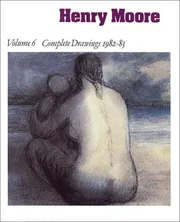
Henry Moore
by David Sylvester, Henry Moore · 1934
It suits adult and advanced student readers with an interest in art history or collecting.
119 pages, about 2 to 3 hours.
The index volume that ties Moore's drawings catalogue together. 36% taste match
What it covers
This book is part of the scholarly literature on Henry Moore, the British sculptor who lived from 1898 to 1986. It is credited to David Sylvester and falls within the biography and memoir shelf, though its contents are closer to reference work than to a life story. The material centers on Moore's drawings, and the volume serves as the closing installment in a multi-volume survey of them, tying the earlier volumes together.
Readers will find a unified set of finding aids for locating any single drawing, whatever period it comes from, whether by its title or by its HMF or AG number. A section of corrections and additions covers roughly 150 items, reflecting new information gathered since the series began in 1994. The book also records about 600 drawings Moore made during the last two years of his life, between 1984 and 1986, which remain in the archives of the Henry Moore Foundation. Around 50 of them are reproduced as illustrations.
The subject matter sits within twentieth century British and modern sculpture, with Moore's work in England, including his home at Perry Green, as the backdrop. Kenneth Clark also appears among the names connected with the book. It suits collectors, researchers and students of modern art.
Setting
EnglandGreat BritainPerry Green
Period
20th century
Themes
Sculpture, BritishCatalogues raisonnésMothers in artCoal miners in artInterviewsModern SculptureNetherlands OtterloArt collections
- Want to read 306
- Reading now 17
- Read 23
Most people shelving it are saving it for later.
Of 346 readers who put it on a shelf, 88% want to read it, 5% are reading it now, 7% have finished it and 0% stopped before the end.
By the numbers
- The median edition runs 119 pages. Counting about 275 words a page and an adult reading pace of 250 words a minute, that is about 2.2 hours of reading.
- Open Library tracks 147 editions from 109 publishers, the earliest dated 1934 and the latest 2006, across 10 languages.
- On reader demand it ranks in the top 5% of the classic books in our catalog (8,749 of them).
- Libraries shelve it under Dewey 741.942 and Library of Congress class NB-0497.00000000.M6 A8.
 BookWard’s take
The index volume that ties Moore's drawings catalogue together
This is the seventh and final volume of the Henry Moore drawings catalogue, and it works as a key to the other six. It gathers the index, concordance and list of exhibitions into one place, so any drawing can be found by title, HMF number or AG number. On length, it is compact at 119 pages. On rigor, it is built for precision, with about 150 corrections and additions since the series began in 1994. On hook, it does not open with a story; it opens with a tool. The real draw is the catalogue of roughly 600 unpublished drawings from Moore's last two years, about 50 of them illustrated. Treat it as a reference you consult, not a book you read through.
Entries and lists are read in short consultations, so it moves at the speed of lookup.
A catalogue's job is to organise known work, though the unpublished late drawings add something new.
The language is plain and functional, which suits a finding aid.
With no plot or characters, it is driven by the material, not by either.
A reference catalogue carries no emotional outlook, so the dial does not apply.
It follows the conventional layout of index, concordance and addenda.
A catalogue of drawings is entirely serious in tone.
Nothing in this catalogue is dark.
The register is dry and administrative, not emotional.
See all 50 dialsEvery position, side by side with this book
Where it lines up
- LengthBookWard 1 · book 1
- Internal logicBookWard 10 · book 9
- Rigor (nonfiction)BookWard 9 · book 10
Where it pulls apart
- OpeningBookWard 10 · book 1
- Authorial voiceBookWard 9 · book 2
- ExpositionBookWard 2 · book 8
It opens as a finding aid, not a narrative, so there is no pull to speak of.
A reference catalogue has no tropes to lean on or avoid, so the dial does not apply.
Its indexes, concordance and numbering systems exist to be exact and cross-referenced, which BookWard rates highly.
Entries and lists are read in short consultations, so it moves at the speed of lookup.
A catalogue's job is to organise known work, though the unpublished late drawings add something new.
There are no characters here, only an artist's body of work, so the dial does not apply.
It closes a series with reference tables, not a story, so resolution is not the point.
Catalogue entries and finding aids carry no sentimentality at all.
Nothing here is written for effect, so the dial does not apply.
Corrections, concordances and archive-based cataloguing make this about as rigorous as nonfiction gets.
Reference apparatus is functional and impersonal, so there is little distinctive authorial voice.
It is organised around information and access, not around any narrative.
Information is stated outright in lists and entries, not dramatised.
There is no narrative arc to sag, so the dial does not apply.
The language is plain and functional, which suits a finding aid.
With no plot or characters, it is driven by the material, not by either.
A reference catalogue carries no emotional outlook, so the dial does not apply.
It follows the conventional layout of index, concordance and addenda.
A catalogue of drawings is entirely serious in tone.
It asks for patience and some familiarity with the series, though it is not conceptually hard.
A single editorial and cataloguing perspective runs through it.
Entries are organised for lookup, not as a story that jumps in time.
It deals strictly with real drawings and real archives.
The names are few: Moore, his foundation and a handful of associated figures.
It is a specialist work concerned with one artist's drawings.
There is no action or inner thought to weigh, so the dial does not apply.
Reference tables contain no dialogue.
Romance does not figure in a drawings catalogue.
The setting of Moore's England and Perry Green is familiar to those who follow British art.
Its subject is twentieth century art, with Moore's life spanning 1898 to 1986.
Catalogues stay useful for scholars as long as the work they list matters.
The reference voice is neutral and straightforward.
There are no moral questions at stake, so the dial does not apply.
Its descriptions are brief catalogue entries, with some illustrations to support them.
It is analytical and organised for lookup, not a story told in sequence.
It is detached and institutional, not a personal account.
It is explicitly the seventh and final volume of a multi-volume survey.
A finding aid offers no surprises beyond the newly catalogued drawings.
It is not emotionally challenging, only specialist in its demands.
Nothing in this catalogue is dark.
The register is dry and administrative, not emotional.
There is no humour to speak of, so the dial does not apply.
Drawings catalogued here carry no violence on the page.
There is no sexual content in a reference of this kind.
Politics is absent from the catalogue.
The language is a little technical, with catalogue numbers and abbreviations.
Entries are neutral, with no editorial opinion pressed on the reader.
It looks back, recording and correcting a body of work already made.
Neither cynical nor idealistic, it simply records, so the dial does not apply.
Review written by BookWard, dial version 1, November 2026.
Who is Henry Moore right for?
It suits adult and advanced student readers with an interest in art history or collecting. Nothing in it is sensitive, though it is specialist and not meant for casual reading.
It asks for patience and some familiarity with the series, though it is not conceptually hard.
Nothing in this catalogue is dark.
The register is dry and administrative, not emotional.
Drawings catalogued here carry no violence on the page.
Book CompanionHenry Moore: ideas, characters, themes
A single volume unifies the finding aids for Moore's drawings catalogue and adds roughly 600 previously unpublished late works.
- A key to six volumes. This final volume gathers the index, concordance and list of exhibitions from the earlier six into one reference.
- Two ways to find a drawing. Any drawing can be located by title or by its HMF or AG number, whatever period it comes from.
- Corrections since 1994. A section of addenda and corrigenda covers about 150 items that came to light after the series began.
- Moore's last two years. About 600 unpublished drawings from 1984 to 1986 are catalogued here from the Henry Moore Foundation archives.
- A sample in pictures. Around 50 of the late drawings are illustrated to show the quality of Moore's output near the end of his life.
Characters
Henry Moore
Subject
The British sculptor (1898 to 1986) whose drawings the catalogue documents.
Kenneth Clark
Associated figure
A name connected with the book through its subject listings.
Henry Moore Foundation
Archive holder
The institution holding the unpublished late drawings catalogued here.
Themes
The careful work of recording and organising an artist's output so it can be found.
The art Moore kept producing as he approached the end of his life.
A book designed to be consulted, not read cover to cover.
The ongoing task of updating the record as new information appears.
Discussion questions
- How does a reference volume change the way we understand an artist's body of work?
- Why might an artist's final drawings deserve their own cataloguing effort?
- What makes a finding aid good: completeness, clarity or ease of use?
- How do corrections and additions affect trust in a scholarly catalogue?
- Who is a book like this really for, and who would never open it?
Personalize your Book Companion
This is the general edition. In BookWard, the Companion is written for you: your reading profile, your notes, and spoiler-safe to the page you are on.
Buy, listen or borrow Henry Moore
Each link opens a search for this book on that store, in a new tab.
Read on a device
Borrow
Reviews and community
If you liked Henry Moore
Aristotle's compact blueprint for how poetry and drama work
Nicomachean EthicsAristotleAristotle asks what the best human life is, and answers
The Economics of Money, Banking, and Financial MarketsFrederic S. MishkinThe standard money and banking textbook, thorough, structured, and built for coursework
How to Read a BookMortimer J. AdlerA method for reading seriously, taught step by step
Sources: Open Library.
Track Henry Moore and find your next favorite
Add it to your shelf, rate what you have read, and BookWard will recommend what fits you.
Free to start. No credit card needed.