Best suited to adult and older teen readers who enjoy slower, character-focused horror.
456 pages, about 7 to 10.5 hours.
A haunted-car story told as a slow, campfire-style oral history. 45% taste match
The story
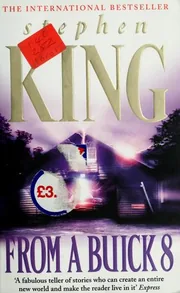
From a Buick 8 is a horror novel by Stephen King, first published in 2002. It is the second of his novels built around a car, and its title nods to Bob Dylan's song "From a Buick 6." The book runs to roughly 456 pages and is classed as a ghost story as well as police fiction.
The setting is Pennsylvania, where a Buick, an older model that looks to be in perfect shape, is left behind at a gas station in 1979 when its driver walks away and never returns. State police from Troop D take the car and store it in Shed B behind their barracks. Over the years it proves to be anything but an ordinary vehicle, and the troopers learn to live with it. Years later, in the autumn of 2001, Ned Wilcox, the son of Curtis Wilcox, an officer who died, starts spending time around the barracks and sets out to find out what the car is and what it had to do with his father. The story follows the officers and the teenage boy as they deal with the car and its history.
Characters
Ned WilcoxTroop DCurtis WilcoxBuick DriverBob Dylan
Setting
PennsylvaniaShed B
Period
19792001
Themes
Pennsylvania State Policeghost storydrunk drivingangel dustTeenage boysPoliceAbandonment of automobilesBuick automobile
- Want to read 190
- Reading now 9
- Read 74
Most people shelving it are saving it for later.
Of 273 readers who put it on a shelf, 70% want to read it, 3% are reading it now, 27% have finished it and 0% stopped before the end.
By the numbers
- The median edition runs 456 pages. Counting about 275 words a page and an adult reading pace of 250 words a minute, that is about 8.4 hours of reading.
- Open Library tracks 56 editions from 32 publishers, the earliest dated 2002 and the latest 2017, across 9 languages.
- On reader demand it ranks in the top 2% of the modern books in our catalog (15,152 of them).
- Libraries shelve it under Dewey 813.6 and Library of Congress class PS-3561.00000000 I483F74 2004.
 BookWard’s take
A haunted-car story told as a slow, campfire-style oral history
Stephen King's 2002 horror novel starts from a premise that sounds like pulp, a car left at a Pennsylvania gas station in 1979 that is not really a car, and builds it into something closer to a police-barracks oral history. The troopers of Troop D keep the Buick in Shed B, and years later a teenage boy, Ned Wilcox, comes asking about it. At 456 pages it is a long book, and pace is where a reader may feel some friction: the structure favors storytelling and character over speed. Familiar tropes are present but reworked, and the telling passes from voice to voice rather than staying with one narrator. It rewards patience more than it rushes you.
At 456 pages it is substantial for what is essentially one mystery, well past the tight end where BookWard sits.
The telling is unhurried and leans on anecdote and atmosphere, so it moves slower than BookWard prefers.
The car-as-mystery idea is familiar in horror, but the barracks-storytelling approach gives it some freshness.
King writes in a plain, colloquial register rather than ornate prose.
The story is driven as much by the people carrying the secret as by events.
The tone is shadowed by loss and unexplained menace, with only modest hope.
Told through layered recollection across two eras, it is more varied than a straight line.
There is some barracks banter, but the mood stays serious.
Deaths and an unexplained evil give it a real darkness.
Grief and the son's search for his father carry genuine feeling.
See all 50 dialsEvery position, side by side with this book
Where it lines up
- Authorial voiceBookWard 9 · book 9
- Character depthBookWard 8 · book 7
- Story or ideasBookWard 3 · book 4
Where it pulls apart
- LengthBookWard 1 · book 7
- Familiar tropesBookWard 10 · book 4
- Internal logicBookWard 10 · book 4
At 456 pages it is substantial for what is essentially one mystery, well past the tight end where BookWard sits.
The abandoned Buick is an intriguing setup, but the book takes its time before it grips hard.
A haunted car is well-worn horror territory, though King frames it through a police setting rather than the usual formula.
The car deliberately defies explanation, so the rules stay loose, which cuts against BookWard's wish for airtight logic.
The telling is unhurried and leans on anecdote and atmosphere, so it moves slower than BookWard prefers.
The car-as-mystery idea is familiar in horror, but the barracks-storytelling approach gives it some freshness.
The troopers and the grieving son are drawn with real texture, which suits BookWard's liking for deep characters.
The car's nature is never fully pinned down, so resolution is partial rather than complete.
Grief and fatherhood add feeling, and the book leans warmer than strictly restrained.
The supernatural events are strange and unsettling, with darkness that serves the story more than it shocks for show.
This is fiction, so the nonfiction rigor dial does not apply.
King's chatty, distinctive storytelling voice is unmistakable and a clear strength.
The book is story-led, built on a mystery and the people around it rather than an argument.
Much of the car's history is told by characters recounting it, so it explains more than BookWard's show-in-scene taste likes.
The middle leans on retelling and digression, and the momentum can loosen along the way.
King writes in a plain, colloquial register rather than ornate prose.
The story is driven as much by the people carrying the secret as by events.
The tone is shadowed by loss and unexplained menace, with only modest hope.
Told through layered recollection across two eras, it is more varied than a straight line.
There is some barracks banter, but the mood stays serious.
The prose is easy to read, though the layered telling asks for a little attention.
The story is passed among several voices as the troopers recount it.
It moves between 1979 and 2001, with the past told in retrospect.
A car that is not of this world places it firmly in the supernatural.
A barracks of troopers plus the son gives a sizeable ensemble.
The action stays contained around one barracks and one shed, so it is intimate.
Reflection and recounted memory outweigh outright action.
Much of the story comes through characters talking and telling stories.
Romance plays essentially no role in this story.
A state police barracks in Pennsylvania is an everyday American setting.
Set across 1979 and 2001, it looks back more than it sits in the present.
The police-station frame and human themes age reasonably well, though it is tied to its decades.
The recounting voices are largely straightforward rather than deceptive.
The car resists simple moral reading, leaving questions of meaning open.
King gives enough texture to ground the barracks and the car without lingering.
It is a standalone novel.
The mystery reveals itself gradually, with some surprises but few sharp reversals.
It is unsettling but not especially demanding to take in.
Deaths and an unexplained evil give it a real darkness.
Grief and the son's search for his father carry genuine feeling.
Any humor is dry, coming from cops trading stories.
There are deaths and eerie incidents, but they are not relentlessly graphic.
Sexual content is minimal.
Politics are largely absent.
The language is conversational and accessible.
The narration has an opinionated, storyteller's personality.
The book looks backward, digging into a past event.
The tone is wary and shadowed rather than idealistic.
Review written by BookWard, dial version 1, November 2026.
Who is From a Buick 8 right for?
Best suited to adult and older teen readers who enjoy slower, character-focused horror. It contains deaths, grief and unsettling supernatural events.
The prose is easy to read, though the layered telling asks for a little attention.
Deaths and an unexplained evil give it a real darkness.
Grief and the son's search for his father carry genuine feeling.
There are deaths and eerie incidents, but they are not relentlessly graphic.
Book CompanionFrom a Buick 8: ideas, characters, themes
A car left at a gas station turns out to be something else, and the troopers who guard it spend years learning to live beside what they cannot explain.
- The abandoned car. In 1979 a driver leaves a Buick at a Pennsylvania gas station and never comes back.
- Shed B. State police from Troop D store the car in a shed behind the barracks.
- Living with the unexplained. Over the years the troopers learn the car is not ordinary and adapt to it.
- The son's search. In autumn 2001 Ned Wilcox, son of Curtis Wilcox, an officer who died, starts hanging around the barracks.
- Two timelines. The story links 1979 and 2001 as the past is gradually told.
Characters
Ned Wilcox
Teenage son of a fallen trooper
He comes to the barracks in 2001 intent on understanding the car and his father's connection to it.
Curtis Wilcox
Trooper and Ned's father
His death is what draws his son to the barracks and to the mystery.
The troopers of Troop D
Keepers of the car
The officers who store the Buick and, over years, learn to live around it.
Themes
How a son carries the loss of his father and seeks answers.
Living alongside something that cannot be understood or solved.
How a community passes down a strange history by retelling it.
The pull of a mystery that people cannot leave alone.
What a parent leaves behind for the next generation to inherit.
Discussion questions
- Why do the troopers choose to live with the Buick rather than destroy or abandon it?
- Does the book need the car to be explained, or is the mystery the point?
- How does telling the story through retelling change how scary it feels?
- What drives Ned to dig into his father's past, and is it healthy?
- How does the move between 1979 and 2001 shape what the characters know?
Personalize your Book Companion
This is the general edition. In BookWard, the Companion is written for you: your reading profile, your notes, and spoiler-safe to the page you are on.
Buy, listen or borrow From a Buick 8
Each link opens a search for this book on that store, in a new tab.
Read on a device
Borrow
Reviews and community
If you liked From a Buick 8
A campus gothic where one thesis stirs an old haunting
Four Past MidnightStephen KingFour Stephen King novellas, each a different door into the uncanny
Duma KeyStephen KingStephen King's Florida horror about a painter who loses an arm
Just After SunsetStephen KingStephen King's short-story set: thirteen tales, mostly dark, mostly fast
Sources: Open Library.
Track From a Buick 8 and find your next favorite
Add it to your shelf, rate what you have read, and BookWard will recommend what fits you.
Free to start. No credit card needed.