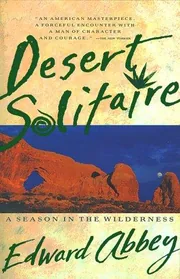
Desert solitaire
by Edward Abbey · 1968
Suits mature teens and adults who enjoy reflective, opinionated nature writing.
271 pages, about 4.5 to 6.5 hours.
Abbey's ranger season in Utah: gorgeous, cranky, and fiercely opinionated. 52% taste match
What it covers
Desert Solitaire is a memoir by Edward Abbey, first published in 1968. It draws on the author's time working as a park ranger at Arches National Monument in Utah, in the American Southwest during the 1950s. Abbey, who lived from 1927 to 1989 and is known as both an American novelist and an environmentalist, writes in the first person about the place where he was posted. The book opens with the line "This is the most beautiful place on earth," which sets the tone for what follows.
The subject matter centers on life in the desert and on the land that later became Arches National Park. It touches on desert biology and on the daily existence of a ranger working in a remote part of the United States. The book runs to roughly 271 pages in its typical edition and has appeared in 19 editions. It suits readers drawn to nature writing, memoirs of work in the outdoors, and accounts of twentieth-century life in the Utah canyon country.
This is the most beautiful place on earth.
Setting
Arches National ParkArches National Park (Utah)United StatesUtah
Period
20th century
Themes
American AuthorsAmerican NovelistsArches National MonumentAuthors, AmericanBiographyDesert biologyEnvironmentalistsNovelists, American
- Want to read 134
- Reading now 10
- Read 20
Most people shelving it are saving it for later.
Of 164 readers who put it on a shelf, 82% want to read it, 6% are reading it now, 12% have finished it and 0% stopped before the end.
By the numbers
- The median edition runs 271 pages. Counting about 275 words a page and an adult reading pace of 250 words a minute, that is about 5.0 hours of reading.
- Open Library tracks 19 editions from 10 publishers, the earliest dated 1968 and the latest 1998.
- On reader demand it ranks in the top 8% of the classic books in our catalog (8,749 of them).
- Libraries shelve it under Dewey 818.5403 and Library of Congress class PS-3551.00000000.B2Z463 1990.
 BookWard’s take
Abbey's ranger season in Utah: gorgeous, cranky, and fiercely opinionated
Abbey spent seasons as a ranger at Arches National Monument, and this book turns that life into a set of vivid, argumentative essays rather than a tidy chronicle. It opens with the line "This is the most beautiful place on earth," and the voice is the real draw: distinctive, funny, and never neutral. The narration is openly opinionated, which suits readers who like a strong companion but may irritate those wanting balance. The description is rich, and the prose is lyrical without turning ornate. The structure is looser than a standard memoir, so a sagging middle is less of a worry than the shift between lyrical and polemical passages. The rigor is more observation than data, which may frustrate readers who want hard evidence behind the arguments. It has real staying power.
At roughly 271 pages it is compact for its ambition, close to BookWard's preference for tight books.
It moves at the speed of the desert, contemplative and unhurried, slower than BookWard likes.
Abbey's blend of memoir, nature writing and polemic felt distinctive in 1968 and still does.
Rich and lyrical in the landscape passages, plainer when he argues or jokes.
There is no plot to speak of; the book is driven by Abbey's personality and perceptions.
Reverence for wild places is tempered by worry over their development and loss.
It follows a loose seasonal arc of essays and sketches rather than a strict memoir sequence.
Dry wit and cranky asides run through even the most reverent stretches.
Mostly serene and combative rather than grim, with some unease about human damage to the land.
Awe and anger both run strongly, expressed with energy but not melodrama.
See all 50 dialsEvery position, side by side with this book
Where it lines up
- OpeningBookWard 10 · book 9
- OriginalityBookWard 9 · book 8
- Authorial voiceBookWard 9 · book 10
Where it pulls apart
- Internal logicBookWard 10 · book 6
- Rigor (nonfiction)BookWard 9 · book 4
- Familiar tropesBookWard 10 · book 7
At roughly 271 pages it is compact for its ambition, close to BookWard's preference for tight books.
It opens with a bold declaration about the most beautiful place on earth, which grabs attention quickly.
Nature writing has well-worn habits, but Abbey's contrarian bite keeps it fresher than most, if not fully untrodden.
Essays hold together by argument and theme rather than strict reasoning, so it is firm but not airtight.
It moves at the speed of the desert, contemplative and unhurried, slower than BookWard likes.
Abbey's blend of memoir, nature writing and polemic felt distinctive in 1968 and still does.
Abbey draws himself vividly, with contradictions on show, though other people stay in the background.
A collection of seasonal pieces closes more by gathering mood than by resolving a plot.
He is deeply moved by the land but mixes it with gruff humor and irritation, avoiding syrup.
Its provocations come from conviction about wild places, not from shock used for effect.
Desert biology appears, but observation and personal opinion carry the book more than evidence.
Abbey's cantankerous, lyrical voice is the main reason the book endures; it is unmistakably his.
Ideas about wilderness and its defense drive the book more than any storyline.
Abbey often states his views outright, though he anchors them in scenes from ranger life.
Short essay-like chapters keep energy up, though shifts between lyric and argument vary the pull.
Rich and lyrical in the landscape passages, plainer when he argues or jokes.
There is no plot to speak of; the book is driven by Abbey's personality and perceptions.
Reverence for wild places is tempered by worry over their development and loss.
It follows a loose seasonal arc of essays and sketches rather than a strict memoir sequence.
Dry wit and cranky asides run through even the most reverent stretches.
The prose is accessible; the effort lies in sitting with its slower, meditative stretches.
Everything is filtered through Abbey's first-person view as ranger and observer.
Mostly anchored in his time at Arches, with reflection moving around within it.
This is a grounded account of real land, weather and wildlife.
Few people matter; the desert and its creatures dominate the page.
Intimate in setting, one man and one place, though its concerns about wilderness are large.
Abbey spends as much time on his own reflections as on events in the canyons.
Conversation is sparse; the book relies on narration and description.
Romance is not a focus; the great love here is the land.
The Utah canyon country is unfamiliar territory to most readers, and Abbey makes it vivid.
It reports on the 1950s and was published in 1968, so it reads as a period piece.
Its love of wild places and its alarm about their erosion keep it relevant.
Abbey is a candid narrator, though a self-mythologizing streak colors how he presents himself.
He takes firm stands, but personal contradictions add some complexity.
Landscape description is a defining strength, with sharp, sensory depictions of rock, sky and heat.
It reads as lived, narrative memoir more than structured analysis.
It is intensely personal, written from inside his own experience and opinions.
It stands alone as a single book.
Little in the way of surprise; interest comes from perception and voice, not plot.
It presses readers on development and wilderness, which can unsettle comfortable assumptions.
Mostly serene and combative rather than grim, with some unease about human damage to the land.
Awe and anger both run strongly, expressed with energy but not melodrama.
His humor leans sardonic and blustery, closer to dry than slapstick.
Little on the page beyond the occasional hard moment of nature or conflict.
Sexual content is minimal.
Environmental and anti-development views are central, and he states them forcefully.
The language is plain and conversational with occasional lyrical flourishes.
Abbey's narration is boldly opinionated and rarely pretends to be neutral.
It looks backward to a vanishing landscape and way of life.
Idealistic about wild places, though tempered by cynicism toward institutions.
Review written by BookWard, dial version 1, November 2026.
Who is Desert solitaire right for?
Suits mature teens and adults who enjoy reflective, opinionated nature writing. It contains strong political views and some salty language, but little graphic content.
The prose is accessible; the effort lies in sitting with its slower, meditative stretches.
Mostly serene and combative rather than grim, with some unease about human damage to the land.
Awe and anger both run strongly, expressed with energy but not melodrama.
Little on the page beyond the occasional hard moment of nature or conflict.
Book CompanionDesert solitaire: ideas, characters, themes
A ranger's seasons in the Utah desert become a passionate argument for loving and protecting wild places.
- A ranger's post. The book draws on Abbey's time working at Arches National Monument in Utah in the 1950s.
- An opening claim. It begins by declaring this the most beautiful place on earth, setting its devotional tone.
- Desert as subject. Desert biology and daily life in a remote corner of the United States anchor the narrative.
- A voice with edges. Abbey is as likely to be funny or combative as reverent, which gives the writing its character.
- Place over plot. The book follows impressions and reflections rather than a conventional storyline.
Characters
Edward Abbey
Narrator and park ranger
The author appears as himself, observing and arguing his way through the desert.
Themes
The value of wild land left undeveloped
What isolation reveals about a person
How a landscape shapes those who live in it
The case for protecting natural places
Speaking plainly against prevailing attitudes
Discussion questions
- What makes the book's opening claim about beauty effective, or does it overreach?
- How does Abbey's humor change the way his environmental arguments land?
- Does a lack of plot help or hurt a book like this?
- How do you weigh personal opinion against evidence in nature writing?
- What does the book suggest about the cost of making wild places accessible?
Personalize your Book Companion
This is the general edition. In BookWard, the Companion is written for you: your reading profile, your notes, and spoiler-safe to the page you are on.
Buy, listen or borrow Desert solitaire
Each link opens a search for this book on that store, in a new tab.
Read on a device
Borrow
Reviews and community
If you liked Desert solitaire
Jack London's candid, argumentative memoir of drink and his long struggle
Down and Out in Paris and LondonGeorge OrwellOrwell's first book, and a clear-eyed look at poverty
Black in BluesImani PerryA meditation on Blackness, told through one color
Kitchen ConfidentialAnthony BourdainBourdain's unfiltered, funny tour through the back of the house
Sources: Open Library.
Track Desert solitaire and find your next favorite
Add it to your shelf, rate what you have read, and BookWard will recommend what fits you.
Free to start. No credit card needed.