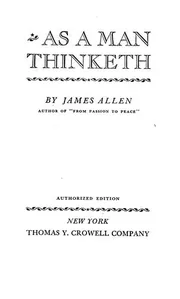
As a Man Thinketh
by James Allen · 1902
Suits teens and adults looking for a short, encouraging read on mindset.
44 pages, about 0.5 to 1 hours.
A 44-page argument that your thoughts build your life. 34% taste match
What it covers
James Allen's As a Man Thinketh is a short work of self-help and inspirational nonfiction, first issued in 1902. It belongs to the New Thought tradition and sits among books on the conduct of life, ethics, and personal philosophy. Its starting point is a proverb about a person's inner thoughts, which it takes as a guide to understanding a whole life and the conditions surrounding it.
The book looks at the relationship between thinking and character, and at how people shape themselves and their circumstances through the habits of the mind. It falls within the broader territory of self-actualization, body, mind and spirit, and religion and spirituality. At roughly 44 pages, it is a compact volume of the kind often described as a miniature book, and it has appeared in 658 editions. Readers interested in early twentieth-century thought on mindset, conduct, and personal growth will find it a brief point of entry.
The aphorism, "As a man thinketh in his heart so is he," not only embraces the whole of a man's being, but is so comprehensive as to reach out to every condition and circumstance of his life.
Themes
New ThoughtConduct of lifeMiniature booksSpecimensInspirationalBody, Mind & SpiritNew AgeInspirational - General
- Want to read 1,338
- Reading now 138
- Read 73
Most people shelving it are saving it for later.
Of 1549 readers who put it on a shelf, 86% want to read it, 9% are reading it now, 5% have finished it and 0% stopped before the end.
By the numbers
- The median edition runs 44 pages. Counting about 275 words a page and an adult reading pace of 250 words a minute, that is about 50 minutes of reading.
- Open Library tracks 658 editions from 136 publishers, the earliest dated 1902 and the latest 2024, across 6 languages.
- On reader demand it ranks in the top 1% of the classic books in our catalog (8,749 of them).
- Libraries shelve it under Dewey 289.9 and Library of Congress class BF-0639.00000000.A482 1988.
 BookWard’s take
A 44-page argument that your thoughts build your life
James Allen's As a Man Thinketh squeezes one idea into about 44 pages: that character and circumstance grow out of the habits of the mind. That brevity is a real virtue, and it suits a reader who prefers tight books over sprawling ones. The book is driven almost entirely by its idea, with next to no story, which cuts against a reader who usually wants narrative first. Allen explains his point outright rather than dramatizing it, and he argues by assertion and aphorism instead of evidence, so the rigor is slight. The outlook is hopeful and the tone earnest, which is easy to warm to if you lean toward optimism. Read it as a brief, influential New Thought document, not a researched case.
At roughly 44 pages it is about as short as a book gets, which suits BookWard's love of tight reads.
Brief sections move briskly from point to point, though the repeated message gives it a steady, reflective rhythm.
A founding text of its tradition, but its core claim now feels widely absorbed rather than fresh.
Its language is measured and somewhat formal, with a King James-like cadence that is elevated but not showy.
There is no plot, only a portrait of the mind's habits, so this dial sits in the middle.
Its whole message is that you can change your life by changing your thinking, firmly hopeful.
It follows a simple run of short themed chapters, thoroughly conventional.
It is wholly serious in tone, with no attempt at humor.
The content is gentle, centered on calm and self-mastery.
It aims for quiet resolve and peace rather than intense feeling.
See all 50 dialsEvery position, side by side with this book
Where it lines up
- LengthBookWard 1 · book 1
- Sagging middleBookWard 8 · book 8
- PaceBookWard 8 · book 6
Where it pulls apart
- Familiar tropesBookWard 10 · book 3
- Shock for effectBookWard 9 · book 1
- ExpositionBookWard 2 · book 10
At roughly 44 pages it is about as short as a book gets, which suits BookWard's love of tight reads.
It opens straight on its proverb and thesis, so you know the argument quickly, though without much drama.
Its ideas became staples of later self-help, so today they read as familiar, which BookWard marks down.
The chain from thought to character to circumstance is stated cleanly but rests on assertion, short of BookWard's airtight standard.
Brief sections move briskly from point to point, though the repeated message gives it a steady, reflective rhythm.
A founding text of its tradition, but its core claim now feels widely absorbed rather than fresh.
There are no characters to draw, only general figures like the thinker and the striver, so depth does not apply.
It closes by resolving its argument with a clear call toward peace and purpose, matching BookWard's taste for resolution.
It is earnest and uplifting without turning mawkish, landing in the middle of the dial.
There is no darkness for effect here, only calm exhortation, which sits fine with BookWard.
It argues by aphorism and conviction, not evidence, which falls well short of BookWard's rigor standard.
The tone is calm, devotional and recognizably Allen's, giving it more personality than generic self-help.
It is pure argument with no story, the opposite of BookWard's story-led lean.
It explains its ideas outright and tells you what to conclude, far from BookWard's show-in-scene preference.
At this length there is no middle to sag, and the focus holds all the way through.
Its language is measured and somewhat formal, with a King James-like cadence that is elevated but not showy.
There is no plot, only a portrait of the mind's habits, so this dial sits in the middle.
Its whole message is that you can change your life by changing your thinking, firmly hopeful.
It follows a simple run of short themed chapters, thoroughly conventional.
It is wholly serious in tone, with no attempt at humor.
Short, plain-spoken sections make it an easy read, even if the ideas invite reflection.
One authorial voice speaks throughout.
It moves in a single line of argument with no time shifts.
It deals in everyday conduct and inner life, firmly grounded.
There is no cast, only the general reader and thinker.
It stays with the individual mind and daily conduct, an intimate focus.
Its subject is thought and inner discipline, with action following from the mind.
It contains no dialogue; it is all direct address and reasoning.
Romance does not feature in this treatise on thought and conduct.
Its territory is the reader's own mind and habits, utterly familiar ground.
It dates from the early twentieth century, though its concerns are personal rather than period-bound.
Its enduring edition count shows the message keeps finding readers, even if the idiom dates it.
The author speaks directly and sincerely, with no unreliability.
It speaks with confident moral clarity about cause and effect in conduct, leaving little ambiguity.
Sparse on imagery, relying on argument and a few plain illustrations.
It reasons in a loose analytical way rather than telling a story.
The author speaks with warm, direct conviction, though little of his own life enters.
It stands alone as a complete short work.
The argument builds steadily with no surprises.
It nudges you toward self-examination but is largely comforting and affirming.
The content is gentle, centered on calm and self-mastery.
It aims for quiet resolve and peace rather than intense feeling.
Humor does not apply to this earnest work.
There is no violence.
There is no sexual content.
It keeps to personal conduct and avoids political argument.
The older phrasing takes a moment to tune into but is not dense.
It is relentlessly opinionated, advancing a single conviction about thought and character.
It urges the reader to build a better future through present habits of mind.
It is thoroughly idealistic, trusting that disciplined thought can remake a life.
Review written by BookWard, dial version 1, November 2026.
Who is As a Man Thinketh right for?
Suits teens and adults looking for a short, encouraging read on mindset. Its confident cause-and-effect view of circumstances may sit uneasily with readers facing hardship they did not choose.
Short, plain-spoken sections make it an easy read, even if the ideas invite reflection.
The content is gentle, centered on calm and self-mastery.
It aims for quiet resolve and peace rather than intense feeling.
There is no violence.
Book CompanionAs a Man Thinketh: ideas, characters, themes
A person's thoughts shape their character, and through character, their circumstances.
- Thought as the root. The book treats inner thinking as the source of a person's whole life and surroundings.
- Character and circumstance. Circumstances are presented as reflecting character instead of simply happening to a person.
- Habits of the mind. It focuses on the mental habits through which people shape themselves over time.
- Self-mastery. Self-improvement is framed as a matter of governing one's own thinking.
- A compact form. At about 44 pages, it delivers its case as a miniature book meant for repeated reading.
Themes
How the mind's habits become who we are.
The idea that we author our own circumstances.
Growing toward a purposeful, settled life.
Ethics as everyday discipline of mind and action.
An early twentieth-century current linking mind, spirit and success.
Discussion questions
- Do you accept that circumstances mirror character, and where does that idea feel too neat?
- How does the book's claim compare with modern self-help?
- What does the book leave out about luck and structural limits?
- Which habit of thought would you most want to change after reading it?
- Why do you think a 44-page work has reached so many editions?
Personalize your Book Companion
This is the general edition. In BookWard, the Companion is written for you: your reading profile, your notes, and spoiler-safe to the page you are on.
Buy, listen or borrow As a Man Thinketh
Each link opens a search for this book on that store, in a new tab.
Read on a device
Borrow
Reviews and community
If you liked As a Man Thinketh
Four short rules for living, delivered plainly and without padding
The Seven Spiritual Laws of SuccessDeepak ChopraSeven short principles for success, offered as spiritual practice rather than strategy
The 7 Habits of Highly Effective PeopleStephen R. CoveySeven habits, laid out plainly, with ideas ahead of story
How to live 365 days a yearJohn A. SchindlerA 1950s doctor's plain-spoken guide to wellbeing across the whole year
Sources: Open Library.
Track As a Man Thinketh and find your next favorite
Add it to your shelf, rate what you have read, and BookWard will recommend what fits you.
Free to start. No credit card needed.