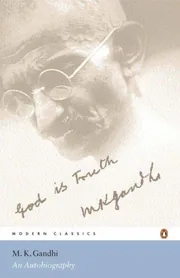
An autobiography
by Mohandas Karamchand Gandhi · 1927
Suits mature teens and adults who enjoy reflective, idea-driven reading.
420 pages, about 6.5 to 10 hours.
Gandhi's own account of his life as an experiment in truth. 47% taste match
What it covers
First published in 1927, this is the autobiography of Mohandas Karamchand Gandhi, who lived from 1869 to 1948. It is a work of biography and political history, and it is also known as The Story of My Experiments with Truth. Gandhi wrote it partway through his career, at a time when his campaigns of nonviolent resistance against racism, violence and colonial rule had already made him widely known.
The book moves between South Africa and India and touches on the years of the struggle for Indian independence, with attention to relations between races and communities. It begins with his family background and their standing in the Kathiawad States. Rather than a conventional chronicle of events, it presents his life as an account of his search for truth, grounded in his devotion to God. That search shaped his choices about simple living, diet, celibacy and a life free of violence, and he offers his experience as a guide for those who wish to follow a similar path. Running to roughly 420 pages in the typical edition, it has appeared in about 140 editions.
q
Setting
IndiaIndeSouth Africa
Period
1919-1947
Themes
Biography & AutobiographyBiographyStatesmenBiographiesPacifistesNationalistesHommes politiquesEstadistas
- Want to read 457
- Reading now 57
- Read 23
Most people shelving it are saving it for later.
Of 537 readers who put it on a shelf, 85% want to read it, 11% are reading it now, 4% have finished it and 0% stopped before the end.
By the numbers
- The median edition runs 420 pages. Counting about 275 words a page and an adult reading pace of 250 words a minute, that is about 7.7 hours of reading.
- Open Library tracks 140 editions from 87 publishers, the earliest dated 1927 and the latest 2021, across 11 languages.
- On reader demand it ranks in the top 2% of the classic books in our catalog (8,749 of them).
- Libraries shelve it under Dewey 923.254 and Library of Congress class DS-0481.00000000 G3 A35 1994.
 BookWard’s take
Gandhi's own account of his life as an experiment in truth
Gandhi wrote this partway through his career, and he treats it less as a chronicle than as a record of experiments in living truthfully. It is a long, full book, far from the tight reads I tend to prefer. It also explains itself outright, which cuts against my liking for scenes that show rather than tell. Still, the voice is unmistakable: plain, self-scrutinising and entirely his own. What he offers is personal testimony more than documentary proof, so the viewpoint is intimate rather than detached. And the outlook is hopeful in the way a man sure of his method is hopeful. It suits readers who want to hear an influential figure explain his own choices, imperfections included, in his own measured words.
At around 420 pages it runs long for a memoir, well past the short, tight shape BookWard favours.
He moves steadily through decades and two countries in a deliberate, reflective rhythm, slower than BookWard's usual preference.
Framing a life as a series of experiments with truth is a distinctive approach that sets it apart from conventional autobiography.
The writing is simple and unadorned, plainer than BookWard's slightly ornate lean.
What holds it together is one man's character and convictions rather than a plotted sequence of events.
It rests on faith that truth and nonviolence can change things, an optimistic view that matches BookWard's outlook.
It follows his life in roughly chronological order without formal experiment, so it is conventional in shape.
The tone is earnest and serious throughout, with little room for comedy.
It deals with racism and colonial rule but in a measured, mostly gentle register.
The feeling is controlled and inward rather than openly intense.
See all 50 dialsEvery position, side by side with this book
Where it lines up
- Character depthBookWard 8 · book 8
- Shock for effectBookWard 9 · book 9
- Authorial voiceBookWard 9 · book 9
Where it pulls apart
- OpeningBookWard 10 · book 3
- LengthBookWard 1 · book 7
- ExpositionBookWard 2 · book 8
At around 420 pages it runs long for a memoir, well past the short, tight shape BookWard favours.
It opens on family background and caste rather than a grabbing incident, a measured start that will not suit readers wanting an instant pull.
A founding figure of nonviolent resistance reflecting on his own life is far from stock memoir territory, and BookWard welcomes that.
Each experiment follows from his search for truth, so the reasoning holds together even where readers may disagree with it.
He moves steadily through decades and two countries in a deliberate, reflective rhythm, slower than BookWard's usual preference.
Framing a life as a series of experiments with truth is a distinctive approach that sets it apart from conventional autobiography.
He examines his own motives and failings candidly, giving a deeply drawn portrait of one man's inner life.
It closes partway through his career, so the story is open rather than neatly resolved, which cuts against BookWard's taste.
He tends toward plain self-assessment over emotional display, which sits well with BookWard's liking for restraint.
It earns any hard moments through honest confession rather than using them for effect, in line with BookWard's taste.
It is first-person testimony written from memory, so it is anecdotal rather than rigorously documented, short of what BookWard values in nonfiction.
His plain, self-questioning manner is unmistakably his own, exactly the distinctive voice BookWard rewards.
It is driven by the ideas he tests in his own life more than by plot, leaning toward the idea-led end.
He often states his reasoning and conclusions directly instead of dramatising them, running against BookWard's preference for showing in scene.
A long account of many years can wander in places, though the guiding thread of his search keeps it moving.
The writing is simple and unadorned, plainer than BookWard's slightly ornate lean.
What holds it together is one man's character and convictions rather than a plotted sequence of events.
It rests on faith that truth and nonviolence can change things, an optimistic view that matches BookWard's outlook.
It follows his life in roughly chronological order without formal experiment, so it is conventional in shape.
The tone is earnest and serious throughout, with little room for comedy.
The prose is clear, but the moral and spiritual argument asks for steady attention and some patience.
Everything is told from Gandhi's own point of view, giving a single perspective.
The account moves mostly forward through his life, with occasional looking back.
It is a grounded account of real places, people and events.
Over the years he meets many associates, opponents and communities, giving a fairly broad cast of real people.
It spans two countries and a national struggle for independence, though told through one man's life.
The weight falls on his reflections, motives and self-examination more than on outward events.
The telling is narration and reflection, with little exchanged conversation.
Marriage appears as part of his life, but romance is not what the book is about.
South Africa and India of his era will be unfamiliar ground to many readers.
It was published in 1927 and covers a life lived well before the present day.
Its questions about conscience, restraint and resistance to injustice keep it widely read decades after publication.
He aims at honest self-reporting and openly records his own faults, which makes him a reliable guide.
He argues from firm convictions about truth and nonviolence, so the moral stance is clear, even if readers dispute parts of it.
He describes places and events with economy, focusing on what mattered to his search rather than scenery.
Though built around his life story, it reads as an examination of lessons more than a straightforward narrative.
It is written in the first person about his own experience, as personal as nonfiction gets.
It stands alone as a single work.
It follows a life's progress and his own reflections, with few surprises of plot.
It questions comfort, appetite and violence, and asks the reader to do the same.
It deals with racism and colonial rule but in a measured, mostly gentle register.
The feeling is controlled and inward rather than openly intense.
It argues against violence and mostly keeps it off the page, though the struggles it describes carry its threat.
He discusses his marriage and his vow of celibacy, but the treatment is reflective rather than explicit.
Colonial rule, race relations and the independence struggle sit at the centre of his story.
The language is plain, with occasional unfamiliar terms from the settings.
He openly argues for his methods and convictions on nearly every page.
He writes mainly from experience but aims at guiding those who will follow, balancing past and future.
It is a deeply idealistic book, built on the belief that truth and nonviolence can reshape the world.
Review written by BookWard, dial version 1, November 2026.
Who is An autobiography right for?
Suits mature teens and adults who enjoy reflective, idea-driven reading. It discusses racism, colonial rule and his personal vows of celibacy and diet in a serious, non-graphic way.
The prose is clear, but the moral and spiritual argument asks for steady attention and some patience.
It deals with racism and colonial rule but in a measured, mostly gentle register.
The feeling is controlled and inward rather than openly intense.
It argues against violence and mostly keeps it off the page, though the struggles it describes carry its threat.
Book CompanionAn autobiography: ideas, characters, themes
Gandhi presents his life as a series of experiments in pursuing truth through simple living, discipline and nonviolence, offered as a guide to others.
- Life as experiment. He frames his choices as trials in living truthfully, treating his own life as the evidence.
- Truth rooted in devotion. His search for truth is tied to devotion to God rather than to politics alone.
- Simple living and discipline. Diet, simplicity and celibacy appear as ways of seeking purity and self-control.
- Nonviolence in practice. He describes his struggles against racism and colonial rule in South Africa and India through the lens of nonviolent resistance.
- A guide for followers. He writes partly to ensure his ideas are understood rather than merely admired.
Characters
Mohandas Karamchand Gandhi
Author and narrator
He tells his own story, from his family's standing in the Kathiawad States to his campaigns in South Africa and India.
Themes
The central aim of his life and the standard he holds himself to.
Resistance to injustice without harming others.
Control of appetite and desire as a path to purity.
Devotion to God as the root of his quest.
The relations between communities under colonial rule.
Discussion questions
- Why might Gandhi call his life a series of experiments rather than a history?
- How does his devotion to God shape his political choices?
- Do his demands for personal discipline strengthen or limit his message?
- What does the book gain and lose by stopping partway through his career?
- How far should a founder's personal practices guide those who follow him?
Personalize your Book Companion
This is the general edition. In BookWard, the Companion is written for you: your reading profile, your notes, and spoiler-safe to the page you are on.
Buy, listen or borrow An autobiography
Each link opens a search for this book on that store, in a new tab.
Read on a device
Borrow
Reviews and community
If you liked An autobiography
A restless young man's road from the world to a Trappist monastery
Up from SlaveryBooker T. WashingtonA formerly enslaved educator tells how he built Tuskegee
Agnes GreyAnne BrontëA governess's plain, unsparing account of wealthy households
VoskresenīeЛев ТолстойTolstoy's last novel puts a jury seat on a guilty conscience
Sources: Open Library.
Track An autobiography and find your next favorite
Add it to your shelf, rate what you have read, and BookWard will recommend what fits you.
Free to start. No credit card needed.