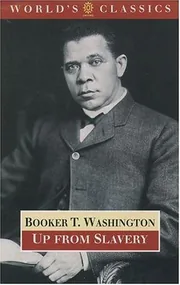
Up from Slavery
by Booker T. Washington · 1900
Suited to teens and adults, and widely read in schools and colleges.
192 pages, about 3 to 4.5 hours.
A formerly enslaved educator tells how he built Tuskegee. 59% taste match
What it covers
Up from Slavery is the autobiography of Booker T. Washington, first published in 1900. It follows his life from his birth into slavery on a plantation in Franklin County, Virginia, through the years of the Civil War and into the decades that came after. Washington was an American educator who lived from 1856 to 1915, and the book places his personal story within the larger history of African Americans in the United States during the nineteenth century.
The narrative traces his path from enslaved child to student at the Hampton Institute, where he worked to gain an education, and then to teacher and school founder. A central subject is his work building the Tuskegee Institute in Tuskegee, Alabama, a vocational school meant to give Black students practical skills they could put to use in earning a living. The book also touches on his public life as an orator and leader working for the advancement of African Americans in the post-Reconstruction South, with Atlanta, Georgia among the places it visits. It sits at the meeting point of memoir, history and the story of American education, and has appeared in around 430 editions.
I WAS born a slave on a plantation in Franklin County, Virginia.
Characters
Booker T. Washington
Setting
United StatesÉtats-UnisAtlantaGeorgiaTuskegee
Period
19th century
Themes
Washington, Booker T., 1856-1915African americans, biographyEducators, united statesTuskegee instituteBiographyEducatorsAfrican AmericansTuskegee Normal and Industrial Institute
- Want to read 190
- Reading now 18
- Read 19
Most people shelving it are saving it for later.
Of 227 readers who put it on a shelf, 84% want to read it, 8% are reading it now, 8% have finished it and 0% stopped before the end.
By the numbers
- The median edition runs 192 pages. Counting about 275 words a page and an adult reading pace of 250 words a minute, that is about 3.5 hours of reading.
- Open Library tracks 430 editions from 175 publishers, the earliest dated 1900 and the latest 2024, across 6 languages.
- On reader demand it ranks in the top 6% of the classic books in our catalog (8,749 of them).
- Libraries shelve it under Dewey 378.111 and Library of Congress class E--0185.97000000.W4 A3 2003.
Read it
The text of this edition is free to read online.
2 ebook providers carry it and a scanned copy is on the Internet Archive.
 BookWard’s take
A formerly enslaved educator tells how he built Tuskegee
Washington's autobiography runs a lean 192 pages, and the brevity serves it well. It opens with a flat declaration, "I was born a slave on a plantation in Franklin County, Virginia", and that directness hooks at once. The pace holds because the story keeps moving, from plantation to Hampton Institute to the founding of Tuskegee, so the middle does not sag. Washington is restrained about his own hardships, and the low sentiment is a strength. Where I part company with it is in outlook and argument: it is hopeful, and a man defending his own method is not a neutral narrator. It is a primary document of post-Reconstruction America, valuable as much for what it shows of its author's worldview as for the events it recounts.
At 192 pages it is compact and moves briskly, which BookWard's preference for short books rewards.
The narrative covers decades without lingering, though it is measured and not breathless.
Few autobiographies of its era come from someone born into slavery, which gives it real distinctiveness.
The writing is clear and plain, favoring plain directness over ornament.
The book is driven by one man's development and choices over the events around him.
The overall message is one of progress through effort, education and patience.
It runs as a conventional chronological autobiography with little formal experiment.
The tone is mostly earnest, with occasional gentle humor but little levity.
Slavery and its aftermath are present, though recounted with restraint.
The feeling runs steady and understated, never raw or melodramatic.
See all 50 dialsEvery position, side by side with this book
Where it lines up
- Shock for effectBookWard 9 · book 9
- LengthBookWard 1 · book 2
- EndingBookWard 8 · book 7
Where it pulls apart
- Familiar tropesBookWard 10 · book 6
- Rigor (nonfiction)BookWard 9 · book 4
- Internal logicBookWard 10 · book 7
At 192 pages it is compact and moves briskly, which BookWard's preference for short books rewards.
It opens by stating he was born a slave in Franklin County, Virginia, which grabs attention immediately.
The self-made-man arc is a familiar American shape, though the subject matter keeps it from feeling stock.
His account follows a clear chain from cause to effect, each step leading to the next, though it argues a case more than it tests one.
The narrative covers decades without lingering, though it is measured and not breathless.
Few autobiographies of its era come from someone born into slavery, which gives it real distinctiveness.
Washington is drawn from the inside, though he presents himself more as exemplar than as a conflicted individual.
The story arrives at his public standing and the established Tuskegee Institute, a settled, resolved close.
He recounts hardship plainly and avoids heavy emotional display, which BookWard prizes.
He does not dwell on cruelty for effect; the weight of slavery comes through plain statement.
It is a memoir with a personal slant, not a documented historical study, so evidence is anecdotal and self-reported.
His steady, measured, self-possessed tone is recognizably his own and carries the book.
The life story drives the book, though it is built to advance an argument about education and self-reliance.
He often explains his views and philosophy directly rather than dramatizing them in scene.
The structure follows his rise and keeps a purposeful forward drive to the end.
The writing is clear and plain, favoring plain directness over ornament.
The book is driven by one man's development and choices over the events around him.
The overall message is one of progress through effort, education and patience.
It runs as a conventional chronological autobiography with little formal experiment.
The tone is mostly earnest, with occasional gentle humor but little levity.
The prose is accessible, though the historical context and period attitudes ask for some thought.
Everything is seen through Washington's eyes alone.
It follows his life in order from birth onward.
The book is entirely grounded in real events and people.
A modest circle of teachers, benefactors and colleagues appears around Washington himself.
It is one life, though it touches on the wider story of African Americans after the Civil War.
It balances his reflections with the practical work of building schools and an institution.
Narration and summary carry most of the book, with little quoted conversation.
Romance plays almost no part in the story he chooses to tell.
The plantation, Reconstruction South and early Tuskegee are unfamiliar to most modern readers.
It was published in 1900 and describes the nineteenth century.
Its questions about education, opportunity and advancement keep it in print and in debate.
He narrates his own life and shapes it to a purpose, so his account invites scrutiny.
He presents a clear stance, though modern readers often dispute his accommodationist approach.
He describes places and people with moderate detail, serving the story more than painting scenes.
It reads as a story of a life, told in narrative form instead of through analysis.
It is a first-person account, centered on his own experience and conviction.
It stands as a single self-contained book.
A life story offers few surprises beyond the turns of his own fortunes.
Its views on race and progress prompt reflection and disagreement in modern readers.
Slavery and its aftermath are present, though recounted with restraint.
The feeling runs steady and understated, never raw or melodramatic.
Humor, where it appears, is mild and dry.
Brutality is acknowledged but not described at length on the page.
There is no sexual content in the book.
Race, labor and education policy sit at the center of the book's purpose.
The English is plain and period-appropriate, without heavy dialect.
Washington argues his case openly and expects the reader to be persuaded.
He is concerned with building a better future through education and work.
It rests on faith that effort, skill and education can open the way forward.
Review written by BookWard, dial version 1, November 2026.
Who is Up from Slavery right for?
Suited to teens and adults, and widely read in schools and colleges. It deals with slavery and racial injustice, and some period attitudes will prompt discussion.
The prose is accessible, though the historical context and period attitudes ask for some thought.
Slavery and its aftermath are present, though recounted with restraint.
The feeling runs steady and understated, never raw or melodramatic.
Brutality is acknowledged but not described at length on the page.
Book CompanionUp from Slavery: ideas, characters, themes
Washington presents his rise from slavery as proof that education, practical skill and steady work can lift a people.
- Born into slavery. The book begins with his birth as a slave on a plantation in Franklin County, Virginia.
- The path to education. He tells of working his way into the Hampton Institute to gain schooling.
- Building Tuskegee. A central thread is his founding of the Tuskegee Institute in Alabama.
- Vocational learning. He champions teaching students practical skills they can use to earn a living.
- Public life. The book follows him into a role as orator and leader working for African American advancement.
Characters
Booker T. Washington
Author and narrator
The educator who tells his own life story, from slavery to founding Tuskegee.
Themes
The belief that individuals and communities advance through their own effort and skill.
Schooling, and especially vocational training, as the route out of poverty.
What life looks like for formerly enslaved people in the post-Reconstruction South.
How one man tries to speak for and guide a people through a hard era.
Discussion questions
- How does Washington's plain, restrained tone shape the way you take in his experience of slavery?
- What does his emphasis on vocational education offer, and what might it leave out?
- How far should an autobiography be trusted when its author is also making an argument?
- Why might readers still disagree about his approach to progress and race?
- What does the book show about how education can change a person's circumstances?
Personalize your Book Companion
This is the general edition. In BookWard, the Companion is written for you: your reading profile, your notes, and spoiler-safe to the page you are on.
Buy, listen or borrow Up from Slavery
Each link opens a search for this book on that store, in a new tab.
Read on a device
Borrow
Reviews and community
If you liked Up from Slavery
A patient's own account of psychiatric confinement, and of recovery
MarshaTourmalineA full-color biography of Marsha P. Johnson, by Tourmaline
The Boy Who Harnessed the WindWilliam KamkwambaA Malawian teenager builds a windmill from scrap and stubbornness
John BarleycornJack LondonJack London's candid, argumentative memoir of drink and his long struggle
Sources: Open Library.
Track Up from Slavery and find your next favorite
Add it to your shelf, rate what you have read, and BookWard will recommend what fits you.
Free to start. No credit card needed.