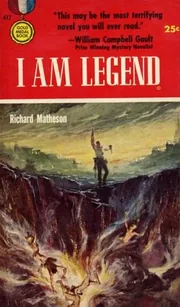
Works (Buried Talents / Dance of the Dead / Dress of White Silk / From Shadowed Places / I Am Legend / Mad House / Person to Person / Prey / The Funeral / The Near Departed / Witch War)
by Richard Matheson · 1954
Best suited to adult and older teen readers who are comfortable with horror.
317 pages, about 5 to 7.5 hours.
A lean, lonely vampire plague story that still bites. 65% taste match
The story
This collection gathers the work of Richard Matheson, an American writer of horror and science fiction. It pairs the 1954 novel I Am Legend with a run of short stories, among them Buried Talents, Dance of the Dead, Dress of White Silk, From Shadowed Places, Mad House, Person to Person, Prey, The Funeral, The Near Departed and Witch War. The material belongs to the tradition of American horror tales and touches on the occult, vampires and epidemics.
The title novel centers on Robert Neville, who may be the last living man on Earth. A plague has changed everyone else into nocturnal, bloodthirsty creatures that want him dead. He spends his days hunting them among the abandoned ruins of civilization and his nights barricaded inside his home, waiting for morning. The story unfolds over the years 1976 to 1979 and carries a strong thread of loneliness. It is a post-apocalyptic horror novel that treats vampirism through a scientific explanation, and it helped shape later zombie and vampire fiction. Films including The Last Man on Earth, The Omega Man and I Am Legend were adapted from it, and it also influenced George A. Romero's Night of the Living Dead.
On those cloudy days, Robert Neville was never sure when sunset came, and sometimes they were in the streets before he could get back.
Period
1976-1979
Themes
OccultAmerican Horror talesVampiresEpidemicsHorrorHorror talesShort storiesLoneliness
- Want to read 118
- Reading now 6
- Read 40
Most people shelving it are saving it for later.
Of 164 readers who put it on a shelf, 72% want to read it, 4% are reading it now, 24% have finished it and 0% stopped before the end.
By the numbers
- The median edition runs 317 pages. Counting about 275 words a page and an adult reading pace of 250 words a minute, that is about 5.8 hours of reading.
- Open Library tracks 9 editions from 8 publishers, the earliest dated 1970 and the latest 2019, across 2 languages.
- On reader demand it ranks in the top 7% of the classic books in our catalog (8,749 of them).
- Libraries shelve it under Dewey 813.54 and Library of Congress class PS-3563.00000000.A8355 Iam6.
 BookWard’s take
A lean, lonely vampire plague story that still bites
This collection pairs the 1954 novel I Am Legend with ten short stories, and the novel is the draw. Robert Neville, possibly the last living man, hunts by day and barricades himself in at night. The hook is immediate: the premise lands in a sentence and the dread starts at once. Its internal logic is a real strength, since the vampirism gets a scientific explanation rather than a magic one, which was fresh for its time and shaped later zombie and vampire fiction. Pace stays quick across 317 pages, and the loneliness gives it a restrained, character-led center. The shorter pieces mix occult and horror tales in the same tight, economical register. A strong pick if you like your horror concise and idea-driven.
At 317 pages with a short novel and brief stories, it stays compact, which suits BookWard's taste for tight reads.
The day-hunting, night-barricading routine keeps things moving, close to BookWard's preference for brisk reading.
It launched the scientific-vampire and disease-apocalypse ideas, so it was strikingly original, even if later imitators dulled that.
Matheson writes in lean, direct prose rather than ornament, favoring tension over style.
Survival events matter, yet the book's force comes from one man's isolation, so it sits slightly toward character.
This is bleak territory: a possibly last man, a world gone, and little comfort offered.
The book follows a fairly conventional shape, with the stories adding variety but not formal experiment.
Humor is largely absent; the tone is grim and tense throughout.
Plague, isolation and nightly siege make this a dark read.
Loneliness runs through it, giving real feeling without melodrama.
See all 50 dialsEvery position, side by side with this book
Where it lines up
- LengthBookWard 1 · book 2
- OpeningBookWard 10 · book 9
- PaceBookWard 8 · book 7
Where it pulls apart
- Familiar tropesBookWard 10 · book 7
- Internal logicBookWard 10 · book 8
- Story or ideasBookWard 3 · book 6
At 317 pages with a short novel and brief stories, it stays compact, which suits BookWard's taste for tight reads.
The last-man-on-Earth setup grabs you immediately, matching BookWard's love of openings that hook at once.
It helped create vampire and plague tropes, so they feel familiar now, though the scientific take stays distinctive.
Vampirism gets a scientific explanation, giving the horror a grounded, consistent internal logic BookWard values.
The day-hunting, night-barricading routine keeps things moving, close to BookWard's preference for brisk reading.
It launched the scientific-vampire and disease-apocalypse ideas, so it was strikingly original, even if later imitators dulled that.
Neville's isolation is drawn with real interior weight, though the shorter stories lean more on concept than people.
The novel closes its arc with purpose rather than leaving matters vague, in line with BookWard's taste.
Matheson keeps feeling spare and unsentimental, letting loneliness land without sweetening it.
The darkness serves the premise and the isolation, rather than existing just to startle.
This is fiction, so rigor as a nonfiction measure does not apply.
Matheson's plain, tense, economical style is recognizable and gives the stories a distinct edge.
Strong concepts drive the book, but Neville's daily struggle keeps it tied to story over pure argument.
Mostly the dread plays out through scenes, with some explaining when the plague's science comes up.
The compact length and constant threat keep the middle from drifting.
Matheson writes in lean, direct prose rather than ornament, favoring tension over style.
Survival events matter, yet the book's force comes from one man's isolation, so it sits slightly toward character.
This is bleak territory: a possibly last man, a world gone, and little comfort offered.
The book follows a fairly conventional shape, with the stories adding variety but not formal experiment.
Humor is largely absent; the tone is grim and tense throughout.
It reads easily and quickly, asking for attention to mood rather than effort.
The novel stays close to one man, keeping the view narrow and focused.
The story moves forward through its years, with little jumping around in time.
Vampires and plague mean the premise is fantastical, though the treatment is scientific and grounded.
Neville is nearly alone, so the novel's cast stays very small.
The world has ended, yet the focus is one man in one house, keeping it intimate.
Neville's thoughts and his hunting and defending balance each other fairly evenly.
With so little company, spoken exchange is limited and the book leans on narration.
Romance is minor; loneliness and survival take the space.
A ruined, emptied city is strange, but the suburban details keep it recognizable.
It is set in the late 1970s and published in 1954, so it reads as a past-era vision of the future.
Its influence on zombie and vampire fiction and repeated film adaptations show lasting appeal.
The narration stays close and straightforward rather than playing tricks on the reader.
Right and wrong are somewhat clear, though the book probes who counts as the monster.
Matheson sketches settings economically, giving enough for dread without lingering.
This collection stands alone as a set of independent works.
The plot holds some turns, though the story is driven more by dread than constant surprise.
It is unsettling and lonely but not hard to follow, so it sits near the middle.
Plague, isolation and nightly siege make this a dark read.
Loneliness runs through it, giving real feeling without melodrama.
Almost no humor appears, and what exists is dry at most.
The hunting of creatures brings real violence, though it is not the book's sole focus.
Sexual content is light in this collection.
The stories stay with personal horror rather than political argument.
The language is plain and accessible throughout.
The narration mostly reports events and Neville's state rather than lecturing.
Its apocalyptic vision looks to a bleak future more than back.
The mood is cynical and desolate rather than idealistic.
Review written by BookWard, dial version 1, November 2026.
Who is Works (Buried Talents / Dance of the Dead / Dress of White Silk / From Shadowed Places / I Am Legend / Mad House / Person to Person / Prey / The Funeral / The Near Departed / Witch War) right for?
Best suited to adult and older teen readers who are comfortable with horror. It contains violence, a grim tone and themes of isolation and plague.
It reads easily and quickly, asking for attention to mood rather than effort.
Plague, isolation and nightly siege make this a dark read.
Loneliness runs through it, giving real feeling without melodrama.
The hunting of creatures brings real violence, though it is not the book's sole focus.
Book CompanionWorks (Buried Talents / Dance of the Dead / Dress of White Silk / From Shadowed Places / I Am Legend / Mad House / Person to Person / Prey / The Funeral / The Near Departed / Witch War): ideas, characters, themes
A man who may be the last human alive survives a plague that turned everyone else into nocturnal, bloodthirsty creatures.
- The premise. Robert Neville may be the last living man, hunted by those the plague has changed.
- Day and night. By day he hunts the creatures through ruined cities; by night he barricades his home.
- Scientific vampirism. The novel gives vampirism a scientific explanation rather than a purely supernatural one.
- Lasting influence. It shaped later zombie and vampire fiction and inspired Night of the Living Dead.
- The short stories. The collection adds shorter horror and occult tales, including Prey and Dress of White Silk.
Characters
Robert Neville
Protagonist
A man who may be the last living human, hunting by day and sheltering by night.
Themes
The weight of surviving with no human company.
The daily routine of staying alive against constant threat.
Disease as the force that ends the old world.
What makes someone a threat, and to whom.
Discussion questions
- How does the scientific explanation change the way vampires feel as a threat?
- What does Neville's daily routine reveal about how he copes with isolation?
- Why might this story have influenced so much later horror?
- Which of the shorter stories stood out, and why?
- Does the book's bleakness make it more or less effective?
Personalize your Book Companion
This is the general edition. In BookWard, the Companion is written for you: your reading profile, your notes, and spoiler-safe to the page you are on.
Buy, listen or borrow Works (Buried Talents / Dance of the Dead / Dress of White Silk / From Shadowed Places / I Am Legend / Mad House / Person to Person / Prey / The Funeral / The Near Departed / Witch War)
Each link opens a search for this book on that store, in a new tab.
Read on a device
Borrow
Reviews and community
If you liked Works (Buried Talents / Dance of the Dead / Dress of White Silk / From Shadowed Places / I Am Legend / Mad House / Person to Person / Prey / The Funeral / The Near Departed / Witch War)
A lean curse story where a man's own body becomes the clock
PsychoRobert BlochA short, sharp shocker that lives inside one man's head
Semilla del DiabloIra LevinA slim, patient nightmare in a Manhattan apartment house
The Ocean at the End of the LaneNeil GaimanA short, strange fable of childhood, memory and quiet menace
Sources: Open Library.
Track Works (Buried Talents / Dance of the Dead / Dress of White Silk / From Shadowed Places / I Am Legend / Mad House / Person to Person / Prey / The Funeral / The Near Departed / Witch War) and find your next favorite
Add it to your shelf, rate what you have read, and BookWard will recommend what fits you.
Free to start. No credit card needed.