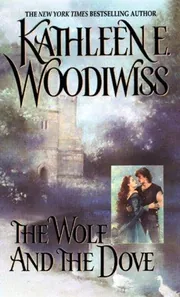
The Wolf and the Dove
by Kathleen E. Woodiwiss · 1974
Best suited to adult readers.
508 pages, about 8 to 12 hours.
A 1974 Norman Conquest romance that helped define the bodice-ripper. 40% taste match
The story
The Wolf and the Dove is a historical romance by Kathleen E. Woodiwiss, first published in 1974. It belongs to the bodice-ripper strand of the genre and combines love story with action and adventure. The book runs to roughly 508 pages and has appeared in 12 editions.
The story is set in 1066, as Norman forces advance across Saxon lands during the Norman period. Aislinn of Darkenwald, an eighteen-year-old Saxon noblewoman, is pulled between loyalty to her own people and her relationship with Wulfgar, a thirty-three-year-old Norman commander known as the Iron Wolf of Normandy. The conquest brings violence to her family, including the death of her father, and the novel follows how that history shadows her bond with the man who leads the invaders. Saxons and Normans are the two sides of the conflict, and the action takes place in Great Britain, with Scotland also part of the setting.
The clash of battle rang no more.
Characters
SaxonsNormans
Setting
Great BritainScotland
Period
Norman period, 1066-1154
- Want to read 131
- Reading now 5
- Read 31
Most people shelving it are saving it for later.
Of 167 readers who put it on a shelf, 78% want to read it, 3% are reading it now, 19% have finished it and 0% stopped before the end.
By the numbers
- The median edition runs 508 pages. Counting about 275 words a page and an adult reading pace of 250 words a minute, that is about 9.3 hours of reading.
- Open Library tracks 12 editions from 9 publishers, the earliest dated 1974 and the latest 2007.
- On reader demand it ranks in the top 7% of the classic books in our catalog (8,749 of them).
- Libraries shelve it under Dewey 813.54 and Library of Congress class PS-3573.00000000.O625.
 BookWard’s take
A 1974 Norman Conquest romance that helped define the bodice-ripper
Kathleen Woodiwiss's 1974 novel sets a Saxon noblewoman against a Norman commander in 1066, and it commits fully to the genre's appetites. The trade-offs are plain. The hook is immediate, with the conquest and the central pairing in play from the start, and the drive is romance-first. Familiar tropes are the point here rather than the flaw, so it doesn't pretend to be original and doesn't try to be. The description is rich, the prose leans ornate, and at 508 pages it takes its time. The material is violent and sexual, built on a morally fraught premise, which makes it a book to enter with open eyes.
At 508 pages it is a long, full-bodied saga, well past BookWard's preference for tight books.
Conquest, conflict and romance keep events moving, though a book this long carries some slower stretches.
The language is deliberately rich and romantic, closer to ornate than plain.
The drive comes from the two leads and their relationship, with the conquest as backdrop.
The tone is dark in its premise, but it moves toward emotional reconciliation, so the outlook leans hopeful.
The structure is conventional, with a linear love story and no formal experiments.
This is a serious, high-feeling book, not a comic one.
Murder and sexual violence sit at the heart of the premise, so this is a dark book.
Passion, grief and anger run at high intensity throughout.
See all 50 dialsEvery position, side by side with this book
Where it lines up
- EndingBookWard 8 · book 9
- Story or ideasBookWard 3 · book 2
- OpeningBookWard 10 · book 8
Where it pulls apart
- Familiar tropesBookWard 10 · book 2
- LengthBookWard 1 · book 8
- Internal logicBookWard 10 · book 5
At 508 pages it is a long, full-bodied saga, well past BookWard's preference for tight books.
The conquest and the clash between Aislinn and Wulfgar are established early, which matches BookWard's love of an immediate start.
It is a founding text of the bodice-ripper strand, so its tropes are the genre's own, which BookWard marks down.
Its emotional logic follows genre convention, and the central bond asks for generous suspension of disbelief, short of BookWard's airtight standard.
Conquest, conflict and romance keep events moving, though a book this long carries some slower stretches.
Aislinn and Wulfgar carry real weight, though the genre leans on archetypes more than BookWard's high bar likes.
Romance of this kind promises resolution, and the book delivers it, which BookWard welcomes.
Heightened feeling is the engine here, so restraint is not what this book is after.
Violence and violation are central to the premise, and the romance is built on top of them, which sits uneasily with BookWard's wish that darkness be earned.
A novel, so this dial does not apply.
Woodiwiss writes in an unmistakable lush historical-romance register, with a recognizable style that has been widely imitated.
Story carries everything: the invasion, the family, the romance. Ideas are secondary.
Historical setting and background are laid out for the reader as much as dramatized.
Over 500 pages, the energy of the central conflict is hard to hold evenly throughout.
The language is deliberately rich and romantic, closer to ornate than plain.
The drive comes from the two leads and their relationship, with the conquest as backdrop.
The tone is dark in its premise, but it moves toward emotional reconciliation, so the outlook leans hopeful.
The structure is conventional, with a linear love story and no formal experiments.
This is a serious, high-feeling book, not a comic one.
The prose is accessible and the story easy to follow, though the length takes commitment.
The story centers on its two leads, with a little room for others.
Events move forward in order through the Norman period.
It is historical fiction with no fantastical element.
The conquest of England frames events, though the story stays close to Aislinn's household.
Feeling and action share the stage, with conflict driving the scenes and desire driving the choices.
Charged confrontations between the leads give dialogue a prominent role.
The love story between Aislinn and Wulfgar is the book's center of gravity.
Eleventh-century Saxon England is unfamiliar territory for most readers, and the book builds it with some care.
It is set in 1066, far from the present day.
It is very much a product of 1970s romance publishing, though its place in the genre's history keeps it in view.
The narration is straightforward and the reader is not led astray.
The central relationship begins in violence and conquest, which leaves its moral footing contested.
Settings, clothing and feeling are described generously and in detail.
A novel, so this dial does not apply.
A novel, so this dial does not apply.
It reads as a self-contained story.
It is an indulgent read by design, but its themes of conquest and violation are uncomfortable.
Murder and sexual violence sit at the heart of the premise, so this is a dark book.
Passion, grief and anger run at high intensity throughout.
Humor is not a feature of this book, so the dial does not apply.
The conquest brings killing and physical violence into the foreground.
Sexual content is central to the genre and the book's reputation, including non-consensual encounters.
Conquest and loyalty shape the plot, but politics is the setting more than the subject.
The language is period-flavored but readable, with no heavy dialect.
The narration stays with its characters rather than editorializing.
It looks back to a distant historical turning point.
The romance leans on the belief that love can survive and heal even terrible harm.
Review written by BookWard, dial version 1, November 2026.
Who is The Wolf and the Dove right for?
Best suited to adult readers. It contains sexual violence, murder and non-consensual encounters, which some readers will want to know about before starting.
The prose is accessible and the story easy to follow, though the length takes commitment.
Murder and sexual violence sit at the heart of the premise, so this is a dark book.
Passion, grief and anger run at high intensity throughout.
The conquest brings killing and physical violence into the foreground.
Book CompanionThe Wolf and the Dove: ideas, characters, themes
Against the Norman invasion of Saxon England in 1066, a Saxon noblewoman and a Norman commander are drawn into a fraught bond that has to contend with the violence between their peoples.
- The setting. The story unfolds in 1066, as Norman forces advance across Saxon lands during the Norman period.
- The heroine. Aislinn of Darkenwald is an eighteen-year-old Saxon noblewoman caught between loyalty to her people and her relationship with a conqueror.
- The hero. Wulfgar, known as the Iron Wolf of Normandy, is a thirty-three-year-old Norman commander.
- The cost of conquest. The invasion brings violence to Aislinn's family, including the death of her father, and that history shadows her bond with Wulfgar.
- The genre. First published in 1974, it belongs to the bodice-ripper strand of historical romance, blending love story with action and adventure.
Characters
Aislinn
Saxon heroine
An eighteen-year-old noblewoman of Darkenwald who is torn between loyalty to her own people and her tempestuous relationship with Wulfgar.
Wulfgar
Norman commander
Known as the Iron Wolf of Normandy, he is a thirty-three-year-old leader of the conquering forces.
Themes
What people owe their own side when an invader takes everything.
Whether affection can form, or be trusted, between people on opposite sides of a war.
How grief and violation shape what a person can feel afterward.
The imbalance between conqueror and conquered, and how the story chooses to handle it.
Discussion questions
- Does the romance work when it begins in conquest and violence, and what does the book ask of the reader to accept it?
- How does Aislinn's loyalty to the Saxons shape her choices?
- What makes Wulfgar a hero in the genre's terms, and does he earn that?
- How has the bodice-ripper strand of romance changed since 1974, and what does this book show about what it used to take for granted?
- What does the 1066 setting add that another backdrop would not?
Personalize your Book Companion
This is the general edition. In BookWard, the Companion is written for you: your reading profile, your notes, and spoiler-safe to the page you are on.
Buy, listen or borrow The Wolf and the Dove
Each link opens a search for this book on that store, in a new tab.
Read on a device
Borrow
Reviews and community
If you liked The Wolf and the Dove
A sweeping 1977 bodice-ripper with a Newgate wedding and Caribbean exile
Almost HeavenJudith McNaughtA high-heat Regency romance of scandal, revenge and Highland secrets
A Kingdom of DreamsJudith McNaughtA kidnapped Highland heiress, an English duke, and a slow-burning war of wills
The WomenKristin HannahA Vietnam nurse's war, and the homecoming that nearly breaks her
Sources: Open Library.
Track The Wolf and the Dove and find your next favorite
Add it to your shelf, rate what you have read, and BookWard will recommend what fits you.
Free to start. No credit card needed.