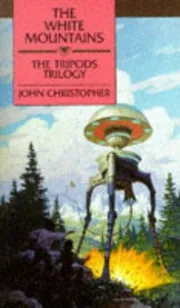
The White Mountains (The Tripods #1)
by Sam Youd · 1967
It suits young adult readers and anyone who enjoys classic dystopian adventure.
170 pages, about 2.5 to 4 hours.
A short, tense escape story from a tripod-ruled Earth. 54% taste match
The story
The White Mountains is a young adult science fiction novel and the first volume in the Tripods series. Sam Youd wrote it under the pen name John Christopher, and it was first published in 1967. The story is set in England on an Earth ruled by alien machines called Tripods, and it is told in the voice of a young narrator who grows up in a village where life follows a settled routine.
The Tripods capture mature human beings and turn them into docile, obedient servants. Will Parker and his companions, all of them teenagers, set out on a dangerous journey toward an outpost of freedom, hoping to escape that fate. The book belongs to the dystopian strand of science fiction, with themes of alien rule and the pursuit of liberty, and it carries some of the tension of a horror story as the travelers move through a world they cannot trust.
The novel opens a trilogy that continues with The City of Gold and Lead and The Pool of Fire. A prequel, When the Tripods Came, appeared in 1988 and recounts the conquest. Readers who enjoy young adult dystopias and invasion stories will find a short, self-contained first chapter in this series.
Apart from the one in the church tower, there were five clocks in the village that kept reasonable time, and my father owned one of them.
Characters
Tripods
Themes
young adultExtraterrestrial beingsFreedomaliensteenagersChildren's storiesDystopiasHorror stories
- Want to read 82
- Reading now 4
- Read 20
Most people shelving it are saving it for later.
Of 106 readers who put it on a shelf, 77% want to read it, 4% are reading it now, 19% have finished it and 0% stopped before the end.
By the numbers
- The median edition runs 170 pages. Counting about 275 words a page and an adult reading pace of 250 words a minute, that is about 3.1 hours of reading.
- Open Library tracks 39 editions from 34 publishers, the earliest dated 1967 and the latest 2017, across 7 languages.
- On reader demand it ranks in the top 12% of the classic books in our catalog (8,749 of them).
- Libraries shelve it under Dewey 428.6 and Library of Congress class PZ-0007.00000000.
 BookWard’s take
A short, tense escape story from a tripod-ruled Earth
At 170 pages, The White Mountains is lean, and it earns that brevity: Will Parker's journey toward a free outpost keeps moving without padding. The opening is steady rather than instant, since the book first builds a settled village routine before the danger lands. The logic holds together well, because the Tripods' capture of mature humans is a clear rule the whole plot leans on. A modern reader may feel the age of the 1967 invasion setup, though the quiet dread keeps it fresh. The characters are serviceable rather than deep. Expect a compact, well-built first chapter of a trilogy, with an ending that leaves the larger story open.
At 170 pages it is compact and unpadded, which fits BookWard's taste for tight books very well.
The journey keeps moving without detours, close to BookWard's fast-leaning preference.
The invasion setup was fresher in 1967 and now reads as a classic template, a notch below BookWard's bar.
The style is plain and clean, serving the story over ornament.
The escape plot drives things more than inner change does.
The quest toward an outpost of freedom gives it a guarded optimism over a bleak world.
It follows a conventional linear journey structure.
This is a serious book with little comic relief.
The threat of capture and servitude is dark but handled for a young audience.
Feeling runs steady and understated rather than intense.
See all 50 dialsEvery position, side by side with this book
Where it lines up
- LengthBookWard 1 · book 2
- PaceBookWard 8 · book 7
- SentimentBookWard 8 · book 7
Where it pulls apart
- OpeningBookWard 10 · book 5
- Familiar tropesBookWard 10 · book 5
- EndingBookWard 8 · book 4
At 170 pages it is compact and unpadded, which fits BookWard's taste for tight books very well.
It builds a settled village life first, so the pull is steadier than immediate, a little slower than BookWard likes.
Alien overlords and a flight to freedom are familiar territory, though the execution avoids easy shortcuts.
The Tripods' capture of mature humans is a clear, consistent rule that the plot respects, matching BookWard's love of airtight worlds.
The journey keeps moving without detours, close to BookWard's fast-leaning preference.
The invasion setup was fresher in 1967 and now reads as a classic template, a notch below BookWard's bar.
Will and his companions are drawn clearly but economically, adequate rather than deeply layered.
As the opening volume it resolves its own journey while pointing onward to the next book.
The tone stays plain and unsentimental, which suits BookWard's restraint.
The menace comes from the premise itself, with dread earned rather than used for effect.
This is a novel, so the dial does not apply.
The young narrator's plain account has a clear identity without being flashy.
The story and journey lead, with the ideas about freedom carried inside the adventure.
The rules of the Tripod world come through events and the narrator's experience rather than lectures.
A short length and a clear goal keep the middle from drifting.
The style is plain and clean, serving the story over ornament.
The escape plot drives things more than inner change does.
The quest toward an outpost of freedom gives it a guarded optimism over a bleak world.
It follows a conventional linear journey structure.
This is a serious book with little comic relief.
It reads easily as young adult fiction.
A single young narrator tells the whole story.
The events run in a straightforward order.
Alien machines ruling the Earth make this clearly speculative, though village life is grounded.
A small band of teenage travelers carries the story.
An alien-ruled Earth is big, but the focus stays on a small group's journey.
The travel and escape lean toward outward action.
Conversation among the companions moves the story along but does not dominate it.
Romance is not a feature of this adventure.
A future Earth ruled by Tripods is unfamiliar, even where the English setting is not.
A 1967 novel set in a future world, it reads as past-era science fiction.
The theme of freedom against control keeps it durable decades on.
The narrator tells his story plainly and can be trusted.
Right and wrong are fairly clear: freedom against enforced servitude.
Description is functional and spare, enough to place the reader.
The tension builds through danger and discovery, with some turns along the way.
It is an accessible adventure with some unsettling ideas about control.
The threat of capture and servitude is dark but handled for a young audience.
Feeling runs steady and understated rather than intense.
Humor is minimal and dry where it appears.
The menace is mostly implied, with little graphic violence.
There is no sexual content.
Control and freedom carry political weight without being the focus.
The language is plain and easy to follow.
The narrator reports events with limited editorializing.
Set in a future ruled by aliens, it looks ahead rather than back.
The hope of reaching freedom gives it a leaning toward idealism.
Review written by BookWard, dial version 1, November 2026.
Who is The White Mountains (The Tripods #1) right for?
It suits young adult readers and anyone who enjoys classic dystopian adventure. It carries an ongoing sense of menace and the threat of capture, but little graphic content.
It reads easily as young adult fiction.
The threat of capture and servitude is dark but handled for a young audience.
Feeling runs steady and understated rather than intense.
The menace is mostly implied, with little graphic violence.
Book CompanionThe White Mountains (The Tripods #1): ideas, characters, themes
A group of teenagers flee an Earth ruled by alien Tripods that make adults docile servants, seeking a free outpost in the mountains.
- The Tripods' rule. Alien machines capture mature humans and turn them into obedient servants, which drives the whole story.
- A journey toward freedom. Will Parker and his companions travel toward an outpost where they hope to escape that fate.
- Village life. The story is told by a young narrator raised in a village with a settled routine.
- Series opener. It begins the original Tripods trilogy, continuing with The City of Gold and Lead and The Pool of Fire.
- A later prequel. When the Tripods Came, published in 1988, tells the story of the conquest.
Characters
Will Parker
Young narrator and protagonist
A teenager who sets out with companions to find freedom beyond the Tripods' reach.
Themes
The pull of a place where people are not controlled.
What it costs to be made docile and obedient.
The tension of traveling through a world you cannot trust.
The threat that waits for people once they mature.
Discussion questions
- Why might the Tripods target mature humans specifically?
- How does the village routine shape the narrator's view of the world?
- What makes the outpost of freedom worth such a dangerous journey?
- How does the book build tension without relying on shock?
- Does the story feel like a complete book or only the start of a trilogy?
Personalize your Book Companion
This is the general edition. In BookWard, the Companion is written for you: your reading profile, your notes, and spoiler-safe to the page you are on.
Buy, listen or borrow The White Mountains (The Tripods #1)
Each link opens a search for this book on that store, in a new tab.
Read on a device
Borrow
Reviews and community
If you liked The White Mountains (The Tripods #1)
A fast YA dystopia about beauty, choice, and a friend's escape
The Spook's ApprenticeJoseph DelaneyA brisk, chilling Lancashire monster hunt with a young apprentice
The Dangerous GiftTui T. SutherlandA young ice queen learns walls are not the same as safety
Wild MagicTamora PierceA girl who talks to animals finds her place and her power
Sources: Open Library.
Track The White Mountains (The Tripods #1) and find your next favorite
Add it to your shelf, rate what you have read, and BookWard will recommend what fits you.
Free to start. No credit card needed.