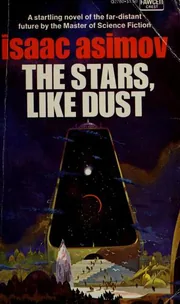
The Stars, Like Dust
by Isaac Asimov · 1951
Its clear prose and fast plot suit teens and adults new to classic science fiction.
229 pages, about 3.5 to 5.5 hours.
Asimov's brisk 1951 space chase, with a bomb on page one. 54% taste match
The story
The Stars, Like Dust is a science fiction mystery by the American writer Isaac Asimov, first published in 1951. It belongs to his fiction set among colonized worlds and imperial powers, and it combines space adventure with political intrigue.
Biron Farrell is a student at the University of Earth when a radiation bomb is left in his dorm room. The attempt on his life sends him running from an assassin he cannot identify. Word then reaches him that his father, the Rancher of Widemos, has been killed far away across the galaxy. Biron sets out to learn why, and his search draws him into a web of rebellion, espionage, and scheming among rival powers. His path leads him into deep space and into conflict with the rulers of Tyrann, where his own survival becomes tied to a larger fight over freedom across the galaxy.
The story unfolds against the backdrop of the Trantorian empire, an invented setting of far-flung colonies and contested control. The book runs a little over two hundred pages in its typical edition and has appeared in dozens of editions since its first release.
Setting
Trantorian empire (Ficticious place)
Themes
Space coloniesImperialismManned space flightLong Now Manual for Civilization
- Want to read 127
- Reading now 4
- Read 55
Most people shelving it are saving it for later.
Of 186 readers who put it on a shelf, 68% want to read it, 2% are reading it now, 30% have finished it and 0% stopped before the end.
By the numbers
- The median edition runs 229 pages. Counting about 275 words a page and an adult reading pace of 250 words a minute, that is about 4.2 hours of reading.
- Open Library tracks 47 editions from 32 publishers, the earliest dated 1951 and the latest 2023, across 7 languages.
- On reader demand it ranks in the top 6% of the classic books in our catalog (8,749 of them).
- Libraries shelve it under Dewey 813.54 and Library of Congress class PS-3551.00000000.S5.
 BookWard’s take
Asimov's brisk 1951 space chase, with a bomb on page one
A student, a radiation bomb in his dorm room, an assassin he cannot name: The Stars, Like Dust opens with a hook, and it keeps up the pressure from there. At a little over two hundred pages it stays tight, and the pace is brisk. The politics are the real draw: rebellion, espionage and rival powers in the Trantorian empire. Where it stumbles is in how much it leans on familiar tropes, since the young hero, the murdered father and the scheming despots are well-worn pulp furniture, and the characters are drawn more lightly than the plot deserves. Think of it as a sturdy mystery adventure from a master of the form, more entertaining than profound.
At 229 pages it is compact and moves without padding, which sits very comfortably with BookWard.
A fugitive chase through space keeps the story moving at roughly BookWard's own brisk speed.
The mystery frame is neat, but the plot and setting follow familiar pulp-era patterns, below BookWard's high bar.
The prose is plain and functional, a little plainer than BookWard's middle-leaning taste.
Events and intrigue drive the book far more than inner change, more plot-led than BookWard.
A fight for galactic freedom keeps a hopeful current, near BookWard's mild optimism.
A straightforward adventure structure with no formal games, more conventional than BookWard's mild tolerance.
It plays its mystery and politics mostly straight, leaving it more serious than BookWard's leaning.
Murder and assassination give it an edge, but the tone stays adventurous, lighter than BookWard's middle.
Grief and anger are present, but the book keeps emotion at a low simmer, below BookWard's level.
See all 50 dialsEvery position, side by side with this book
Where it lines up
- PaceBookWard 8 · book 8
- EndingBookWard 8 · book 8
- LengthBookWard 1 · book 2
Where it pulls apart
- Familiar tropesBookWard 10 · book 4
- OriginalityBookWard 9 · book 4
- Internal logicBookWard 10 · book 7
At 229 pages it is compact and moves without padding, which sits very comfortably with BookWard.
A radiation bomb in a dorm room starts the trouble at once, matching BookWard's love of immediate openings.
A young hero avenging his father among scheming despots is well-worn territory, short of what BookWard prizes.
The intrigue is built as a mystery with cause and effect, close to BookWard's taste for tight reasoning.
A fugitive chase through space keeps the story moving at roughly BookWard's own brisk speed.
The mystery frame is neat, but the plot and setting follow familiar pulp-era patterns, below BookWard's high bar.
Biron is drawn mainly through what he does and what happens to him, lighter than BookWard prefers.
It is a mystery with a clear destination, so it resolves, in line with BookWard's preference.
Grief over a murdered father is present but handled with little sentiment, close to BookWard's restraint.
The violence serves the plot's stakes rather than existing for effect, which BookWard respects.
This is a novel, so rigor does not apply.
Asimov's plain, clear style is recognizable but less singular than BookWard's top picks.
Ideas about empire and freedom sit inside a plot-first adventure, leaning toward story as BookWard does.
Asimov explains his political setup readily and often through talk, more than BookWard likes.
Short and driven by pursuit and intrigue, it holds momentum through the middle, which BookWard likes.
The prose is plain and functional, a little plainer than BookWard's middle-leaning taste.
Events and intrigue drive the book far more than inner change, more plot-led than BookWard.
A fight for galactic freedom keeps a hopeful current, near BookWard's mild optimism.
A straightforward adventure structure with no formal games, more conventional than BookWard's mild tolerance.
It plays its mystery and politics mostly straight, leaving it more serious than BookWard's leaning.
Clean prose and a plot-forward style make it an easy read, easier than BookWard's usual.
The story stays with Biron's journey, narrower than BookWard's taste for many viewpoints.
The story moves forward in a straight line, a touch more linear than BookWard's mix.
Interstellar travel and an invented empire make this firmly science fiction, above BookWard's middle.
A modest circle of allies and enemies keeps the cast manageable, about where BookWard sits.
A galaxy-wide fight over freedom gives the plot an epic reach, beyond BookWard's mid-range taste.
Flight, intrigue and pursuit dominate, making it action-focused beyond BookWard's balance.
Plot and politics are worked out largely through conversation, in the heavy-dialogue zone BookWard enjoys.
Romance is not the engine of the story, which is driven by mystery and politics.
Far-flung colonies and an empire put readers in unfamiliar territory, matching BookWard's appetite.
A 1951 novel set in an invented far future, it reads as a work of its own period.
Its political intrigue still works, though its pulp mechanics date it somewhat, below BookWard's top.
The narration is straightforward and trustworthy, more reliable than BookWard's usual taste.
Rebels and despots are drawn in fairly clear terms, clearer than BookWard prefers.
Asimov keeps scenery brief and functional, sparser than BookWard's middle position.
This is fiction, so nonfiction style does not apply.
This is fiction, so nonfiction perspective does not apply.
It belongs to Asimov's linked colonized-worlds fiction, leaning toward series membership, as BookWard tolerates.
A mystery of hidden enemies and shifting loyalties delivers plenty of surprises, above BookWard's level.
It is an adventure to enjoy rather than a book that unsettles, softer than BookWard's preference.
Murder and assassination give it an edge, but the tone stays adventurous, lighter than BookWard's middle.
Grief and anger are present, but the book keeps emotion at a low simmer, below BookWard's level.
Humor is minor and dry, if present at all, dryer than BookWard's middle.
A bomb, a murdered father and pursuit bring danger, though little is lingered over.
Little sexual content, in keeping with its era and adventure focus.
Rebellion, imperialism and espionage are the heart of the plot, far above BookWard's middle.
Plain, clear language keeps it accessible, simpler than BookWard's mid-range.
Asimov narrates the action fairly neutrally, a little less opinionated than BookWard.
A fight over the galaxy's future gives it a forward-looking drive, near BookWard.
The struggle for freedom carries an idealistic charge, close to BookWard's worldview.
Review written by BookWard, dial version 1, November 2026.
Who is The Stars, Like Dust right for?
Its clear prose and fast plot suit teens and adults new to classic science fiction. It includes a murder, an assassination attempt and political violence, but little that is graphic.
Clean prose and a plot-forward style make it an easy read, easier than BookWard's usual.
Murder and assassination give it an edge, but the tone stays adventurous, lighter than BookWard's middle.
Grief and anger are present, but the book keeps emotion at a low simmer, below BookWard's level.
A bomb, a murdered father and pursuit bring danger, though little is lingered over.
Book CompanionThe Stars, Like Dust: ideas, characters, themes
A young man whose father is murdered chases the truth across a galaxy where empires, rebels and spies fight over who gets to be free.
- The attempt on his life. A radiation bomb in his dorm room turns Biron Farrell from a student into a marked man.
- A father's murder. News that the Rancher of Widemos has been killed gives Biron a reason to stop running and start asking questions.
- Mystery as engine. The book is built as a science fiction mystery, so clues, hidden enemies and espionage drive the plot.
- Space as stage. The hunt leads Biron into deep space and into conflict with the rulers of Tyrann.
- Freedom at stake. His own survival becomes tied to a wider fight over liberty across the galaxy.
Characters
Biron Farrell
Protagonist
A young, naive student who grows up fast after an attempt on his life.
The Rancher of Widemos
Biron's father
A highly respected figure whose murder sets Biron's search in motion.
Themes
How a powerful empire controls distant worlds and the people who resist it.
What it costs to organize and survive resistance against a stronger power.
The question of liberty, for one man and for a whole galaxy.
How sudden danger and loss force a naive young man to grow up quickly.
A world where trust is scarce and every ally may hide a motive.
Discussion questions
- How does opening with an assassination attempt shape what you expect from the rest of the book?
- What does Biron gain and lose by being so naive at the start?
- How does the book portray the rulers of Tyrann compared with the rebels?
- Which elements of the plot feel familiar from other adventure stories, and which feel fresh?
- How well does a small personal quest carry a story about the freedom of a whole galaxy?
Personalize your Book Companion
This is the general edition. In BookWard, the Companion is written for you: your reading profile, your notes, and spoiler-safe to the page you are on.
Buy, listen or borrow The Stars, Like Dust
Each link opens a search for this book on that store, in a new tab.
Read on a device
Borrow
Reviews and community
If you liked The Stars, Like Dust
Pern's second Threadfall: dragons, politics, and a planet to save
Tunnel in the skyRobert A. HeinleinHeinlein strands a class of students and watches society form
UgliesScott WesterfeldA fast YA dystopia about beauty, choice, and a friend's escape
Short FictionH. Beam PiperPiper's magazine-era science fiction, from galactic empire to parallel timelines
Sources: Open Library.
Track The Stars, Like Dust and find your next favorite
Add it to your shelf, rate what you have read, and BookWard will recommend what fits you.
Free to start. No credit card needed.