Best suited to adult readers and mature teens comfortable with long horror.
1153 pages, about 18.5 to 27 hours.
A thousand-page plague epic where good and evil pick sides. 57% taste match
The story
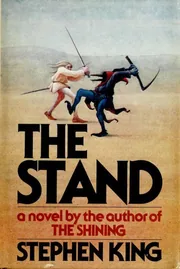
The Stand is a horror and post-apocalyptic novel by Stephen King, first published in 1978. It sits at the meeting point of horror, suspense, and science fiction, and it draws on themes of biological warfare, nuclear weapons, and quarantine. The story begins at a Texaco station on US 93, north of the small Texas town of Arnette, roughly 110 miles from Houston.
An accident at a biological weapons facility lets loose a rapidly mutating influenza known as Captain Tripps, which kills most of the world's population within weeks. The few who live through it are drawn into two camps. One gathers around an elderly woman in Boulder, while the other forms around Randall Flagg, who has made his base in Las Vegas. The two groups move toward a clash between good and evil. The novel is also where Flagg first appears, a figure King brought back in later work.
King began writing it in 1975, aiming for an epic in the tradition of The Lord of the Rings. The cast is large and the storylines many, and the printed editions run to well over a thousand pages.
Hapscomb's Texaco sat on Number 93 just north of Arnette, a pissant four-street burg about 110 miles from Houston.
Characters
RandallRandall Flagg
Setting
BoulderLas VegasHapscomb's TexacoUS 93Arnette
Period
198019811985
Themes
suspense & thrillergothic & horrorbiological warfareresearchhorror talesThrillersSuspenseHorror
- Want to read 1,288
- Reading now 69
- Read 198
Most people shelving it are saving it for later.
Of 1555 readers who put it on a shelf, 83% want to read it, 4% are reading it now, 13% have finished it and 0% stopped before the end.
By the numbers
- The median edition runs 1153 pages. Counting about 275 words a page and an adult reading pace of 250 words a minute, that is about 21 hours of reading.
- Open Library tracks 87 editions from 46 publishers, the earliest dated 1978 and the latest 2023, across 8 languages.
- On reader demand it ranks in the top 1% of the modern books in our catalog (15,152 of them).
- Libraries shelve it under Dewey 813.54 and Library of Congress class PS-3561.00000000.I483 S7 1990.
 BookWard’s take
A thousand-page plague epic where good and evil pick sides
The Stand is enormous, and that is the first thing to weigh against it. At 1153 pages it asks for a serious chunk of your reading life, and the good-versus-evil frame leans on familiar tropes. What it offers in return is character depth: a huge cast drawn with real specificity, and a voice that is plainly King's. The opening drops you at a Texas gas station, and the pandemic that follows keeps the story moving for long stretches. The internal logic holds up well, since the plague's spread is traced with a grim, orderly precision. It is a big, rewarding, uneven book, best taken as a commitment.
At 1153 pages it is about as long and sprawling as a novel gets, far from BookWard's love of tight and short.
Momentum is strong in the collapse, then slows through the rebuilding, a little under BookWard's brisk preference.
The pandemic setup was influential, but the quest and faction structure is borrowed from the epic tradition.
The prose is plain and conversational, closer to BookWard's mildly plain leaning than to ornate.
Events drive it, but the survivors' inner lives carry much of the weight, tilting toward character.
Heavy loss gives way to a rebuilding community, leaving it more hopeful than bleak.
It moves through a fairly conventional arc of collapse, gathering, and confrontation.
It is mostly serious, with scattered gallows humor in the characters' voices.
See all 50 dialsEvery position, side by side with this book
Where it lines up
- Character depthBookWard 8 · book 8
- EndingBookWard 8 · book 8
- Authorial voiceBookWard 9 · book 9
Where it pulls apart
- LengthBookWard 1 · book 10
- Familiar tropesBookWard 10 · book 3
- Internal logicBookWard 10 · book 7
At 1153 pages it is about as long and sprawling as a novel gets, far from BookWard's love of tight and short.
It opens at a Texaco station on US 93 and the plague catches fast, close to BookWard's taste for an immediate pull.
The embodied good-versus-evil showdown leans on familiar epic tropes, short of the fresh ground BookWard prefers.
The plague's spread and its aftermath follow a clear internal order, though the supernatural turn loosens it slightly.
Momentum is strong in the collapse, then slows through the rebuilding, a little under BookWard's brisk preference.
The pandemic setup was influential, but the quest and faction structure is borrowed from the epic tradition.
A very large cast gets individual detail and history, which fits BookWard's appetite for deeply drawn people.
It leans warm toward its survivors without turning syrupy, a middle path against BookWard's restraint.
The deaths are heavy, yet they serve the story's stakes more often than they exist to jolt.
King's colloquial, confident narration is unmistakable, exactly the distinctive voice BookWard rewards.
This is story-led first, with big ideas carried by events rather than argued directly.
King explains a fair amount outright, more than the show-in-scene style BookWard favors.
The prose is plain and conversational, closer to BookWard's mildly plain leaning than to ornate.
Events drive it, but the survivors' inner lives carry much of the weight, tilting toward character.
Heavy loss gives way to a rebuilding community, leaving it more hopeful than bleak.
It moves through a fairly conventional arc of collapse, gathering, and confrontation.
It is mostly serious, with scattered gallows humor in the characters' voices.
The length asks stamina, though the readable style keeps the effort moderate.
The story follows many survivors across the country, spread across a very wide set of viewpoints.
Events move forward through the plague and its aftermath, largely linear.
It begins grounded in a lab accident and then turns openly supernatural around its figure of evil.
The cast is vast, one of the largest in popular fiction.
The end of nearly all human life makes this an epic in scope.
Survival and journeys give it plenty of action, balanced by the characters' inner struggles.
Conversation carries a lot of the storytelling, as in much of King's work.
Relationships appear but stay secondary to survival and the larger conflict.
The emptied, post-plague America is strange even though the places are familiar.
First published in 1978, it reads as late twentieth century rather than present day.
Its fears of disease and its good-versus-evil frame have kept it widely read for decades.
The narration is straightforward and reliable, guiding the reader plainly.
The camps are drawn as clearly good and clearly evil, which is sharper than BookWard's liking for ambiguity.
King renders places and objects with plenty of concrete detail, leaning rich.
Review written by BookWard, dial version 1, November 2026.
Who is The Stand right for?
Best suited to adult readers and mature teens comfortable with long horror. It includes widespread death, violence, and dark supernatural themes.
The length asks stamina, though the readable style keeps the effort moderate.
Book CompanionThe Stand: ideas, characters, themes
After a weaponized flu kills most of humanity, the survivors gather around two opposing leaders and move toward a clash between good and evil.
- The accident. A mishap at a biological weapons facility releases a mutating influenza called Captain Tripps.
- The collapse. The virus wipes out most of the world's population within weeks.
- Two camps. Survivors are drawn either to an elderly woman in Boulder or to Randall Flagg in Las Vegas.
- Growing toward confrontation. Both groups prepare for a showdown between the forces of good and evil.
- An epic ambition. King began writing it in 1975 hoping to build an epic in the spirit of The Lord of the Rings.
Characters
Randall Flagg
The dark figure of Las Vegas
He sets up his command post in Las Vegas and draws survivors to his side.
Themes
The survivors divide into two camps that embody opposing moral forces.
A single accident and a fast-moving virus remove most of the world.
Rebuilding depends on whom the survivors choose to follow.
The catastrophe begins with human-made biological warfare research.
Discussion questions
- Why do the survivors gravitate to one leader or the other?
- Does the story need its supernatural element, or would the plague alone have been enough?
- How does the huge cast change what the book can show about a collapse?
- What does the opening at a small Texas gas station set up for the rest of the novel?
- Is a clear contest between good and evil satisfying here, or too neat?
Personalize your Book Companion
This is the general edition. In BookWard, the Companion is written for you: your reading profile, your notes, and spoiler-safe to the page you are on.
Buy, listen or borrow The Stand
Each link opens a search for this book on that store, in a new tab.
Read on a device
Borrow
Reviews and community
If you liked The Stand
King's desert horror: a possessed deputy, a praying boy, a long fight
ItStephen KingA sprawling, gripping horror epic about childhood fear and memory
Under the DomeStephen KingAn invisible dome traps a Maine town, and the people inside are the danger
The Priory of the Orange TreeSamantha ShannonA vast, dragon-filled epic that BookWard admires more than it is hooked
Sources: Open Library.
Track The Stand and find your next favorite
Add it to your shelf, rate what you have read, and BookWard will recommend what fits you.
Free to start. No credit card needed.