It suits young adult and older children's readers who enjoy action and dystopian adventure, especially those already in the series.
384 pages, about 6 to 9 hours.
A prequel that explains the maze, for series devotees. 45% taste match
About the book
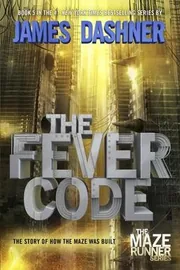
The Fever Code is a young adult science fiction novel by James Dashner, first published in 2016 by Delacorte Press. It is the fifth book in The Maze Runner series and the second prequel, set chronologically between The Kill Order and The Maze Runner. The edition runs to roughly 384 pages and is shelved among children's fiction, in the action and adventure category.
The story is set in a dystopian future where the world has been wrecked by catastrophe. Fires have swept the forests, rivers and lakes have dried up, and the seas have risen. A plague of fever then spread across the globe, leaving families dead and society sliding into violence. Into this ruined world comes WICKED, an organization searching for an answer. The book follows a boy named Thomas, who is involved in the building of a maze, and traces the secrets, lies, and shifting loyalties surrounding it. Survival, disease, and natural disaster run through the novel, which gives readers of the series the background to the maze at the center of the later books.
Themes
SurvivalNatural disastersVirus diseasesLabyrinthsSurvival skills
- Want to read 113
- Reading now 2
- Read 17
Most people shelving it are saving it for later.
Of 132 readers who put it on a shelf, 86% want to read it, 2% are reading it now, 13% have finished it and 0% stopped before the end.
By the numbers
- The median edition runs 384 pages. Counting about 275 words a page and an adult reading pace of 250 words a minute, that is about 7.0 hours of reading.
- Open Library tracks 8 editions from 8 publishers, the earliest dated 2016 and the latest 2020.
- On reader demand it ranks in the top 8% of the recent books in our catalog (6,647 of them).
- Libraries shelve it under Library of Congress class PZ-0007.00000000.D2587Fe 2016.
 BookWard’s take
A prequel that explains the maze, for series devotees
The Fever Code is the second prequel in the Maze Runner series, set between The Kill Order and The Maze Runner, and it exists to show how the maze came to be. It is written for people already invested in the series, and it makes no apology for that. The disaster-and-plague setting covers well-worn dystopian ground, so it leans on familiar tropes more than I'd like, and the originality is middling. Where it should please is in its momentum: this is a young adult adventure for readers who want to be pulled along, and the maze premise gives it a hook from the first pages. The prose is plain and direct rather than ornate. Readers who already care about Thomas get the payoff of the origin story. Newcomers will find it a thin place to begin.
At 384 pages it is mid-length for the genre, longer than BookWard's taste for tight books but not sprawling.
Written as action and adventure for younger readers, it moves briskly, which suits BookWard's preference for speed.
The maze itself is a distinctive hook, but the dystopian frame around it is well trodden, which sits below BookWard's high bar.
Young adult adventure prose is plain and functional, which puts it toward the simple end.
The book is propelled by what happens next and what is revealed, with character serving the plot.
A scorched world, a deadly plague and lies at every turn make for a bleak tone with little consolation.
It follows a conventional chronological narrative, with its only structural twist being its place in the series.
The setting and stakes are grim, leaving little room for humor.
Plague, death, violence and betrayal give it a notably dark backdrop for the age group.
Loss, loyalty and betrayal give it real emotional charge, though it stays within young adult bounds.
See all 50 dialsEvery position, side by side with this book
Where it lines up
- PaceBookWard 8 · book 8
- Story or ideasBookWard 3 · book 4
- OpeningBookWard 10 · book 8
Where it pulls apart
- Familiar tropesBookWard 10 · book 4
- Internal logicBookWard 10 · book 6
- OriginalityBookWard 9 · book 4
At 384 pages it is mid-length for the genre, longer than BookWard's taste for tight books but not sprawling.
A world-ending plague and a boy who builds a maze give it an immediate pull, close to BookWard's taste for hooks.
Plague, ruined earth and a shadowy organization are staples of young adult dystopia, so it leans on the familiar more than BookWard prefers.
As an origin story it has to explain how the maze fits together, which helps its internal consistency, though prequels can strain it.
Written as action and adventure for younger readers, it moves briskly, which suits BookWard's preference for speed.
The maze itself is a distinctive hook, but the dystopian frame around it is well trodden, which sits below BookWard's high bar.
The book is built around Thomas and his shifting loyalties, though young adult adventure usually favors momentum over deep interiority.
As a bridge to the first Maze Runner book, it is designed to lead into what follows rather than stand fully closed.
Survival stakes and betrayal keep it from being syrupy, though young adult fiction tends toward some emotional emphasis.
Plague, violence and betrayal carry the darkness, and some of it is likely there for impact rather than earned weight.
This is a novel, so rigor does not apply.
It is serviceable genre prose in a shared series house style rather than a strongly personal voice.
The story is what drives it, with the plot revealing the maze's origins rather than arguing an idea.
A prequel that exists to explain the series' backstory leans toward telling readers how things came to be.
Short chapters and a steady stream of secrets generally keep this type of adventure moving through the middle.
Young adult adventure prose is plain and functional, which puts it toward the simple end.
The book is propelled by what happens next and what is revealed, with character serving the plot.
A scorched world, a deadly plague and lies at every turn make for a bleak tone with little consolation.
It follows a conventional chronological narrative, with its only structural twist being its place in the series.
The setting and stakes are grim, leaving little room for humor.
Aimed at young readers, it reads easily and asks little of the reader beyond following the series.
The story centers on Thomas, so it stays with essentially one viewpoint.
It moves forward through the events that lead up to the first book, without elaborate time-jumping.
Engineered mazes, a global fever and a secret organization put it in speculative science fiction territory.
A secretive organization and a group of young characters imply a fairly sizable cast.
A world-ending catastrophe frames the story, though the focus stays on one boy and one project.
Action and adventure drive the book, so events outweigh interior reflection.
Adventure for young readers usually leans on conversation to carry plot and secrets, so dialogue plays a solid role.
The pitch centers on survival and conspiracy, so romance stays in the background.
A burned, flooded, plague-ridden future is far from everyday life and unfamiliar to the reader.
It is set in a future dystopia, though written and published in the contemporary era.
As a series prequel tied to a specific franchise, its appeal is mostly to existing fans.
A straightforward third-person adventure narrative suggests a reliable, direct narrator.
WICKED's pursuit of an answer at human cost points to murky ethics, though young adult fiction tends to guide the reader.
Action and plot take priority over lavish scene-setting, though the ruined world gets some color.
It is the fifth book in the Maze Runner series and a prequel, so it depends heavily on the wider saga.
The blurb promises secrets, lies and reversals of loyalty, signaling a plot built on revelations.
It is meant as an accessible page-turner and does not push readers hard.
Plague, death, violence and betrayal give it a notably dark backdrop for the age group.
Loss, loyalty and betrayal give it real emotional charge, though it stays within young adult bounds.
There is little humor here, and what appears is incidental.
A world where man kills man and a deadly fever spreads means violence is a real presence, if pitched for teens.
As a children's and young adult adventure, sexual content is minimal.
Institutional power and a controlling organization give it political undertones without making it a political book.
The language is plain and accessible for young readers.
The narration tells the story in a fairly neutral adventure register.
It looks back to explain the origins of a story readers already know, though the setting is a future world.
A world of lies, plague and betrayal leans cynical about institutions and people.
Review written by BookWard, dial version 1, November 2026.
Who is The Fever Code right for?
It suits young adult and older children's readers who enjoy action and dystopian adventure, especially those already in the series. It deals with plague, death and violence, so sensitive younger readers may want to check first.
Aimed at young readers, it reads easily and asks little of the reader beyond following the series.
Plague, death, violence and betrayal give it a notably dark backdrop for the age group.
Loss, loyalty and betrayal give it real emotional charge, though it stays within young adult bounds.
A world where man kills man and a deadly fever spreads means violence is a real presence, if pitched for teens.
Book CompanionThe Fever Code: ideas, characters, themes
The book tells how a boy named Thomas came to build the maze at the center of the series, against the backdrop of a ruined, plague-stricken world.
- The ruined world. Fires, drying rivers, rising seas and a spreading fever set the stage for everything that follows.
- WICKED's search. An organization looking for an answer to the catastrophe enters the story and shapes events.
- The perfect boy. Thomas is singled out, and his role in the maze's creation is the heart of the book.
- Secrets and lies. The story is driven by what characters hide and what they claim, building toward revelations.
- A bridge in the series. It sits between The Kill Order and The Maze Runner, connecting the earlier and later stories.
Characters
Thomas
Central figure
The boy at the center of the story, tied to the creation of the maze.
WICKED
Organization
The group searching for an answer to the plague and the devastation it caused.
Themes
Staying alive in a world stripped of safety and resources.
Who characters stand with when the truth is hidden and the stakes are high.
Secrets and lies used by those in power and those caught in their plans.
What gets sacrificed in the search for a cure or a solution.
Discussion questions
- How does knowing the maze's origin change the way you see the original story?
- Is WICKED's search for an answer justified by what is at stake?
- What makes loyalty difficult when so many people are lying?
- How does the ruined world shape the choices characters make?
- Does a prequel work better as a standalone story or as a companion to the series?
Personalize your Book Companion
This is the general edition. In BookWard, the Companion is written for you: your reading profile, your notes, and spoiler-safe to the page you are on.
Buy, listen or borrow The Fever Code
Each link opens a search for this book on that store, in a new tab.
Read on a device
Borrow
Reviews and community
If you liked The Fever Code
A fast, factional war story that trades hooks for sequel stakes
The Darkest MindsAlexandra BrackenA fast YA dystopia with a hooked-in-chapter-one premise
ScorpiaAnthony HorowitzA teenage spy goes looking for his father's killers
Glass SwordVictoria AveyardFast, bloody YA sequel where Mare builds a rebel army
Sources: Open Library.
Track The Fever Code and find your next favorite
Add it to your shelf, rate what you have read, and BookWard will recommend what fits you.
Free to start. No credit card needed.