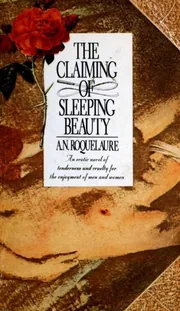
The Claiming of Sleeping Beauty
by Anne Rice · 1983
This book suits adult readers who already know and want erotica and fairy-tale retellings.
270 pages, about 4.5 to 6.5 hours.
Anne Rice's erotic fairy-tale retelling, built on dominance and submission. 45% taste match
The story
The Claiming of Sleeping Beauty is an erotic romance by Anne Rice, first published in 1983. It is the opening volume of a trilogy that Rice wrote under the name A.N. Roquelaure, and it takes the old fairy tale of Sleeping Beauty as its starting point. The story is told in a fairy-tale kingdom of kings, queens and courts, and the book belongs to the tradition of erotic fiction built on sexual dominance and submission, with bondage and sadomasochism central to its content.
The Prince grew up knowing the tale of the princess who pricked her finger on a spindle and slept for a hundred years, along with her parents and the whole Court. Here he breaks the enchantment through sexual initiation rather than a kiss, and in return Beauty becomes completely subject to him. Characters include Prince Alexi, Felix, Lady Juliana and Queen Eleanor, and the action moves between settings such as the Queen's Chambers and the Hall of Punishments. The book runs to roughly 270 pages and has appeared in about 25 editions, including audiobook versions. It is intended for adult readers of erotica and of fairy-tale retellings.
THE PRINCE had all his young life known the story of Sleeping Beauty, cursed to sleep for a hundred years, with her parents, the King and Queen, and all of the Court, after pricking her finger on a spindle.
Characters
Prince AlexiFelixLady JulianaSleeping BeautyBeautyQueen Eleanor
Setting
Hall of PunishmentsQueen's Chambers
Themes
tributesromanceeroticaAdaptationsaudiobooksSleeping Beauty adaptationsSexual dominance and submissionSadomasochism
- Want to read 457
- Reading now 27
- Read 35
- Stopped 1
Most people shelving it are saving it for later.
Of 520 readers who put it on a shelf, 88% want to read it, 5% are reading it now, 7% have finished it and 0% stopped before the end.
By the numbers
- The median edition runs 270 pages. Counting about 275 words a page and an adult reading pace of 250 words a minute, that is about 5.0 hours of reading.
- Open Library tracks 25 editions from 21 publishers, the earliest dated 1983 and the latest 2015, across 3 languages.
- On reader demand it ranks in the top 2% of the modern books in our catalog (15,152 of them).
- Libraries shelve it under Dewey 811.54 and Library of Congress class PS-3568.00000000.O696 C5 1983.
 BookWard’s take
Anne Rice's erotic fairy-tale retelling, built on dominance and submission
This is the first of the Roquelaure trilogy, and it takes Sleeping Beauty's hundred-year sleep and turns the awakening into sexual initiation, with Beauty's complete submission as the Prince's reward. The hook is immediate, since the premise is the book, and the whole thing runs at a brisk 270 pages. On familiar tropes it plays differently from most retellings: it starts from a very old tale and takes it somewhere few versions go, though the dominance-and-submission frame has its own conventions. Sexual content is the point rather than a side element, and bondage and sadomasochism are central. Character depth is modest; the figures serve the fantasy more than they unfold as people. Readers of erotica and of fairy-tale retellings are the audience, and the explicit material is not incidental.
At roughly 270 pages it is compact for a trilogy opener, closer to BookWard's short end than a sprawling retelling would be.
Erotic fiction of this kind tends to escalate steadily from one encounter to the next, close to BookWard's quick preference.
The core idea of Beauty awakened by initiation rather than a kiss is a bold reframing, though the genre around it is established.
The prose is rich and sensuous, more ornate than BookWard's middling taste.
Events and encounters drive the book far more than any inner development of its characters.
Beauty's surrender to the Prince is neither plainly bleak nor warm, leaving the outlook in the middle.
A straightforward forward telling of a single arc, more conventional than BookWard's mild appetite for experiment.
The tone is sensual and serious, with little humor.
Bondage and sadomasochism are central, making it dark in content.
Heightened desire and surrender give it real intensity, though less about feeling than sensation.
See all 50 dialsEvery position, side by side with this book
Where it lines up
- OpeningBookWard 10 · book 9
- PaceBookWard 8 · book 7
- Story or ideasBookWard 3 · book 4
Where it pulls apart
- Familiar tropesBookWard 10 · book 4
- Internal logicBookWard 10 · book 6
- Character depthBookWard 8 · book 3
At roughly 270 pages it is compact for a trilogy opener, closer to BookWard's short end than a sprawling retelling would be.
The fairy-tale premise and its erotic turn announce themselves at once, which suits BookWard's love of a fast opening.
It reworks a famous folktale and leans on the conventions of dominance-and-submission fiction, so it is only partly free of tropes.
The kingdom runs by its own rules of rank and obedience, consistent enough inside the fantasy though not tightly argued.
Erotic fiction of this kind tends to escalate steadily from one encounter to the next, close to BookWard's quick preference.
The core idea of Beauty awakened by initiation rather than a kiss is a bold reframing, though the genre around it is established.
The characters serve the fantasy more than they grow, short of the depth BookWard favors.
As the first book of a trilogy, it leaves the larger arc open rather than fully resolving it.
The material is lush and heightened rather than restrained, which sits on the sentimental side of BookWard's taste.
The erotic content is the premise rather than a surprise, so darkness is declared up front instead of used for effect.
Not applicable to a work of fiction.
Rice's lush, suggestive manner is recognizable and carries the book, in line with BookWard's taste for distinctive voices.
Story leads, though the fairy tale's buried erotic undertones are the idea the book exists to explore.
The kingdom's customs are conveyed through what happens to Beauty rather than lectured, close to BookWard's liking for showing.
The short length and steady escalation keep it from drifting, roughly as sustained as BookWard prefers.
The prose is rich and sensuous, more ornate than BookWard's middling taste.
Events and encounters drive the book far more than any inner development of its characters.
Beauty's surrender to the Prince is neither plainly bleak nor warm, leaving the outlook in the middle.
A straightforward forward telling of a single arc, more conventional than BookWard's mild appetite for experiment.
The tone is sensual and serious, with little humor.
It reads easily and quickly, lighter in effort than BookWard's middle setting.
The story stays close to Beauty and the Prince, a narrower lens than BookWard's liking for many viewpoints.
The tale moves forward after the awakening, with the hundred-year sleep as backstory rather than a shifting timeline.
A fairy-tale kingdom with a hundred-year enchantment places it well toward the fantastical.
A court of royals and attendants gives a moderate cast, somewhat larger than BookWard's small-cast preference.
Most of the action is private and confined to chambers and halls, favoring the intimate end.
Events and physical encounters outweigh interior reflection.
Scenes mix exchange and description, with dialogue present but not dominant.
Desire between the Prince and Beauty is the engine, though framed as domination more than courtship.
A fantasy court with its own rules and punishments is unfamiliar territory for most readers.
Published in 1983 but set in a timeless fairy-tale kingdom, far from the present day.
The folktale roots endure, but this erotic treatment is tied to its genre and moment.
The narration is straightforward and reliable in telling what happens.
The book sets out its world of command and submission plainly, with little ambiguity about its terms.
Lush, suggestive description of bodies, rooms and rituals is central to the book's effect.
Not applicable to a work of fiction.
Not applicable to a work of fiction.
It is explicitly the first volume of a trilogy.
The path from awakening to enslavement is the premise from the start, leaving few surprises.
Its explicit content and themes of sexual dominance push many readers out of a comfort zone.
Bondage and sadomasochism are central, making it dark in content.
Heightened desire and surrender give it real intensity, though less about feeling than sensation.
Humor is not a feature of the book.
Punishment and discipline are on the page as part of the erotic content, though not framed as combat.
Erotica is the point: sexual content runs throughout, with bondage and sadomasochism central.
Power appears as sexual and royal hierarchy rather than any political argument.
The language is plain and flowing rather than dense or dialectal.
The narration presents events without pressing a commentary on them.
It reaches back to an ancient tale rather than looking ahead.
The hierarchy of rule and submission is neither cynical nor idealistic, resting in the middle.
Review written by BookWard, dial version 1, November 2026.
Who is The Claiming of Sleeping Beauty right for?
This book suits adult readers who already know and want erotica and fairy-tale retellings. It contains explicit sexual content, bondage and sadomasochism throughout, and is not suitable for younger readers.
It reads easily and quickly, lighter in effort than BookWard's middle setting.
Bondage and sadomasochism are central, making it dark in content.
Heightened desire and surrender give it real intensity, though less about feeling than sensation.
Punishment and discipline are on the page as part of the erotic content, though not framed as combat.
Book CompanionThe Claiming of Sleeping Beauty: ideas, characters, themes
The Sleeping Beauty tale is reread as a story of sexual awakening, where the Prince's reward for breaking the spell is Beauty's complete submission to him.
- The old tale, reversed. The spell breaks through sexual initiation rather than a kiss, taking the folktale somewhere its traditional telling never goes.
- Beginning of a trilogy. This is the first of three books Rice wrote as A.N. Roquelaure, so the story is set up here rather than concluded.
- A world of rank and obedience. The kingdom is organized around command and submission, with settings such as the Queen's Chambers and the Hall of Punishments.
- The Prince's reward. Beauty's enslavement is framed as the price of ending the hundred years of enchantment.
- Erotica as tradition. The book belongs to erotic fiction centered on dominance and submission, with bondage and sadomasochism at its core.
Characters
Beauty
The awakened princess
She is roused from a hundred years of sleep and becomes completely subject to the Prince.
The Prince
The awakener
He ends the enchantment through sexual initiation and claims Beauty as his reward.
Queen Eleanor
Royal figure
A ruler whose chambers are one of the book's key settings.
Themes
Sexual longing is the force that drives the whole story.
The book explores command and submission as the basis of its world.
A familiar folktale is reread for its unspoken erotic implications.
Beauty's rousing is physical and sexual rather than a chaste kiss.
Beauty becomes the Prince's reward, completely subject to him.
Discussion questions
- How does reading Sleeping Beauty as a story of sexual awakening change the original tale for you?
- Does the Prince's reward of Beauty's total submission feel like a reversal of the folktale or an extension of it?
- What does the setting of a fairy-tale kingdom add to a story about dominance and submission?
- How much do the characters matter here compared with the situations they are placed in?
- Where does fantasy end and discomfort begin for you in material like this?
Personalize your Book Companion
This is the general edition. In BookWard, the Companion is written for you: your reading profile, your notes, and spoiler-safe to the page you are on.
Buy, listen or borrow The Claiming of Sleeping Beauty
Each link opens a search for this book on that store, in a new tab.
Read on a device
Borrow
Reviews and community
If you liked The Claiming of Sleeping Beauty
A cursed palace, a deadly game, and a fake marriage
PhantasmaKaylie SmithA haunted-mansion death game where the heart is the real danger
The Songbird and the Heart of StoneCarissa BroadbentA vampire's descent to the underworld, with a slow-burn bond at its center
The Rose BargainSasha Peyton SmithVictorian fae court intrigue where a crown costs more than blood
Sources: Open Library.
Track The Claiming of Sleeping Beauty and find your next favorite
Add it to your shelf, rate what you have read, and BookWard will recommend what fits you.
Free to start. No credit card needed.