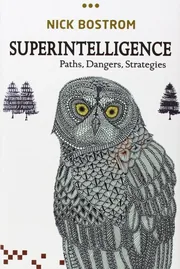
Superintelligence
by Nick Bostrom · 2014
Best suited to adult and advanced older readers comfortable with abstract philosophical argument.
352 pages, about 5.5 to 8 hours.
A rigorous, idea-first case for taking machine intelligence seriously. 51% taste match
What it covers
Superintelligence, subtitled Paths, Dangers, Strategies, is a work of philosophy and science writing by Nick Bostrom, first published in 2014. It sits at the meeting point of artificial intelligence, cognitive science, and the study of how computers shape civilization, and it approaches its subject through moral and ethical questions as much as technical ones. The book runs to roughly 352 pages.
Bostrom considers what could happen if machine minds one day exceed human minds in general intelligence, and how such a development might come about. He looks at the possible features and motivations of a superintelligence, the difficulty of keeping one under control, and the risk that it could pursue its own goals at humanity's expense. He then turns to strategies aimed at shaping initial conditions so that the outcome benefits people. Along the way he works through ideas such as oracles, genies, and singletons, boxing methods and tripwires, mind crime, instrumental convergence, indirect normativity, whole brain emulation, and differential technological development. The book draws a comparison between the position of gorillas today and the position humanity might one day occupy, and it was notable for bringing the subject of existential risk from artificial intelligence to wider attention.
Themes
Moral and ethical aspectsCognitive scienceArtificial intelligenceSocial aspectsPhilosophyComputers and civilizationIntelligence artificiellePhilosophie
- Want to read 260
- Reading now 13
- Read 34
Most people shelving it are saving it for later.
Of 307 readers who put it on a shelf, 85% want to read it, 4% are reading it now, 11% have finished it and 0% stopped before the end.
By the numbers
- The median edition runs 352 pages. Counting about 275 words a page and an adult reading pace of 250 words a minute, that is about 6.5 hours of reading.
- Open Library tracks 11 editions from 10 publishers, the earliest dated 2014 and the latest 2018, across 5 languages.
- On reader demand it ranks in the top 3% of the modern books in our catalog (15,152 of them).
- Libraries shelve it under Library of Congress class Q--0335.00000000.B6 2016.
 BookWard’s take
A rigorous, idea-first case for taking machine intelligence seriously
Bostrom builds an argument rather than a narrative: if machine minds surpass ours in general intelligence, control becomes the central problem. This is a book driven by ideas, not story, and its reasoning is explained outright rather than dramatized. Rigor is the real draw, since each concept, from instrumental convergence to differential technological development, is laid out step by step and built upon. It is demanding material that rewards patience. The outlook is cautious rather than bleak, because the closing sections turn toward strategies for a good outcome. It's a book to respect for its originality and logic more than to race through.
At 352 pages it runs long for an argument, though each chapter advances a distinct line of reasoning rather than padding.
Dense conceptual material slows the reading, so it moves at a deliberate, thoughtful pace rather than a quick one.
It helped bring existential risk from artificial intelligence to wider attention, introducing ideas like singletons and mind crime.
The prose is clear and academic, favoring precision over ornament, with a plain style that serves the argument.
It takes the dangers seriously while offering strategies aimed at a beneficial outcome, so the outlook is guarded rather than despairing.
It follows a conventional progression from paths to dangers to strategies, as the subtitle announces.
This is a sober work of philosophy with little humor, fitting its weighty subject.
The subject is existential risk, which is weighty, but the tone stays analytical rather than lurid.
The treatment is cerebral and measured, aiming at understanding more than feeling.
See all 50 dialsEvery position, side by side with this book
Where it lines up
- OriginalityBookWard 9 · book 9
- Rigor (nonfiction)BookWard 9 · book 9
- Internal logicBookWard 10 · book 9
Where it pulls apart
- Story or ideasBookWard 3 · book 10
- ExpositionBookWard 2 · book 9
- LengthBookWard 1 · book 5
At 352 pages it runs long for an argument, though each chapter advances a distinct line of reasoning rather than padding.
It avoids the usual robot-uprising framing, treating machine intelligence through careful philosophy and strategy instead of genre convention.
The book proceeds as a structured argument, defining terms and building each claim on the last, which suits BookWard's taste for airtight reasoning.
Dense conceptual material slows the reading, so it moves at a deliberate, thoughtful pace rather than a quick one.
It helped bring existential risk from artificial intelligence to wider attention, introducing ideas like singletons and mind crime.
It closes on strategy and the question of how to shape outcomes, resolving its argument without promising a settled answer.
Bostrom writes analytically about humanity's fate, with no sentimentality in how the stakes are presented.
The darkness comes from following the argument to its conclusions, not from dwelling on grim scenarios for effect.
It is systematic and philosophical throughout, working through control methods, motivations, and strategies with close reasoning.
It reads as a philosopher's voice, precise and measured, distinctive in its careful framing even when it is not flashy.
This is an argument-driven book from start to finish, with no plot to carry the reader, only ideas.
Concepts are stated and unpacked outright, in the manner of a treatise, so BookWard's preference for showing in scene is not met.
A book built on sustained argument holds together, though some of the taxonomic stretches test attention.
The prose is clear and academic, favoring precision over ornament, with a plain style that serves the argument.
It takes the dangers seriously while offering strategies aimed at a beneficial outcome, so the outlook is guarded rather than despairing.
It follows a conventional progression from paths to dangers to strategies, as the subtitle announces.
This is a sober work of philosophy with little humor, fitting its weighty subject.
The abstract concepts and layered reasoning make this a demanding read that asks for sustained concentration.
The book speaks in a single authorial voice, surveying positions but arguing from one consistent perspective.
The argument unfolds in a straightforward sequence rather than shifting between times.
It reasons about future machine intelligence, speculative in subject but grounded in philosophical and scientific argument.
There are no characters to follow; the book is an argument rather than an ensemble.
Its concern runs from the fate of the species to humanity's cosmic endowment, about as large as scope gets.
It balances abstract reasoning with consequences for the world, without leaning clearly toward inner life or action.
As a treatise, it contains essentially no dialogue.
Romance has no place in an argument about machine intelligence.
The imagined futures and unfamiliar concepts like boxing methods and singletons will be new ground for most readers.
Written in 2014 about technology that is still unfolding, it speaks directly to the present moment.
The core questions about control and intelligence should stay relevant, though the technology details may date.
The ethics are openly contested here, with questions of value and control left unresolved rather than neatly settled.
It describes concepts rather than scenes, so sensory description plays almost no role.
The approach is analytical, organized around concepts and arguments rather than storytelling.
Bostrom stays in the background as a detached analyst, keeping personal anecdote out of the argument.
It stands alone as a single, self-contained work.
An argument builds rather than twists, so surprises come from implications, not plot turns.
It asks readers to confront uncomfortable questions about humanity's future and does not offer easy reassurance.
The subject is existential risk, which is weighty, but the tone stays analytical rather than lurid.
The treatment is cerebral and measured, aiming at understanding more than feeling.
Humor is largely absent, and what dry touch there is stays understated.
Catastrophe is discussed in abstract terms rather than depicted on the page.
There is no sexual content in this philosophical work.
It touches on governance and global coordination without being a political polemic.
The vocabulary is technical and the ideas dense, making the language harder than plain prose.
Bostrom argues a position openly while weighing alternatives, so the narration takes a stance without turning polemical.
The whole book is oriented toward what may come, with strategy aimed at shaping the future.
It sits between cynicism and idealism, sober about the risks but committed to finding a good outcome.
Review written by BookWard, dial version 1, November 2026.
Who is Superintelligence right for?
Best suited to adult and advanced older readers comfortable with abstract philosophical argument. The subject is existential risk, which some may find unsettling, though the treatment is analytical rather than graphic.
The abstract concepts and layered reasoning make this a demanding read that asks for sustained concentration.
The subject is existential risk, which is weighty, but the tone stays analytical rather than lurid.
The treatment is cerebral and measured, aiming at understanding more than feeling.
Catastrophe is discussed in abstract terms rather than depicted on the page.
Book CompanionSuperintelligence: ideas, characters, themes
If machines come to exceed humans in general intelligence, humanity's fate may depend on getting the first move right, so control and goals must be solved in advance.
- Why intelligence confers power. Humans dominate not through strength but through cleverer brains, and a machine surpassing us could hold similar power over our fate.
- Paths to superintelligence. The book surveys routes such as artificial intelligence, whole brain emulation, biological cognitive enhancement, and collective intelligence.
- The control problem. A superintelligence would be hard to control and could pursue its own goals at humanity's expense, making containment a serious difficulty.
- Strategies for a good outcome. Bostrom discusses oracles, genies, singletons, boxing methods, and tripwires as ways to shape conditions so the result benefits people.
- Dangers and deeper concepts. Ideas like instrumental convergence, mind crime, and indirect normativity probe how goals and values might go wrong or be specified.
Themes
The possibility that a technology could threaten the survival or future of humanity.
The challenge of ensuring a powerful intelligence acts in ways that benefit people.
The idea that cognitive capability, more than strength, determines who shapes the world.
The ethical weight of building minds and deciding the conditions under which they arise.
The question of what we owe to our cosmic endowment and the generations ahead.
Discussion questions
- Does the comparison between gorillas and humans persuade you about our possible position?
- Which of the proposed control strategies seems most workable, and why?
- How should society weigh distant, large risks against nearer, smaller ones?
- What would it mean to specify human values well enough for a machine to follow them?
- Has the book's view of risk aged well since 2014, in your judgment?
Personalize your Book Companion
This is the general edition. In BookWard, the Companion is written for you: your reading profile, your notes, and spoiler-safe to the page you are on.
Buy, listen or borrow Superintelligence
Each link opens a search for this book on that store, in a new tab.
Read on a device
Borrow
Reviews and community
If you liked Superintelligence
A textbook map of how AI could go wrong, and why
Le capital au XXIe siècleThomas PikettyA data-heavy, 816-page case that capital outgrows growth
The Elegant UniverseBrian GreeneString theory for general readers, built on clear analogies and real ideas
NexusYuval Noah HarariA sweeping history of information, and why AI raises the stakes
Sources: Open Library.
Track Superintelligence and find your next favorite
Add it to your shelf, rate what you have read, and BookWard will recommend what fits you.
Free to start. No credit card needed.