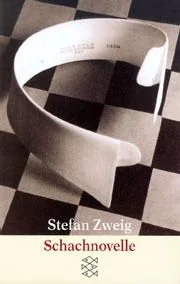
Suited to mature teens and adults, and a common choice in German language readers.
88 pages, about 1.5 to 2 hours.
Eighty-eight pages of chess, captivity and a mind turned on itself. 68% taste match
The story
Schachnovelle is a novella by the Austrian writer Stefan Zweig, first published in 1943 and set in the twentieth century. It belongs to historical fiction and runs to roughly 88 pages, with a long publication history that includes many editions, among them German-language readers and Spanish translations.
The story takes place on a passenger steamer travelling from New York to Buenos Aires. A wealthy passenger pays the chess world champion Mirko Czentovic to play a game against him, and a fellow traveller, the Austrian emigrant Dr. B., steps in with advice during the match. Dr. B. was once arrested by the Gestapo and held in isolation in a hotel room, where he played 150 games of chess in his head. The book follows chess players and the effects of social isolation, and it turns on the question of whether Dr. B.'s mental game was play or something closer to madness, which he tests when he sits down to face a real opponent for the first time since his confinement.
Gecəyarısı Nyu-Yorkdan Buenos-Ayresə yola düşən böyük sərnişin gəmisində son saatın adi çaxnaşması, get-gəli hökm sürürdü.
Period
20th century
Themes
ChessChrestomathies and readersGerman languageReadersGerman language, readersCriticism and interpretationChess playersSocial isolation
- Want to read 207
- Reading now 15
- Read 62
- Stopped 1
Most people shelving it are saving it for later.
Of 285 readers who put it on a shelf, 73% want to read it, 5% are reading it now, 22% have finished it and 0% stopped before the end.
By the numbers
- The median edition runs 88 pages. Counting about 275 words a page and an adult reading pace of 250 words a minute, that is about 1.6 hours of reading.
- Open Library tracks 245 editions from 148 publishers, the earliest dated 1943 and the latest 2024, across 12 languages.
- On reader demand it ranks in the top 4% of the classic books in our catalog (8,749 of them).
- Libraries shelve it under Dewey 838.99 and Library of Congress class LA-2383.00000000.T92 A46 2012.
 BookWard’s take
Eighty-eight pages of chess, captivity and a mind turned on itself
Schachnovelle is Zweig at his most compressed: a steamer crossing, a chess champion who plays like a machine, and an Austrian emigrant whose past surfaces move by move. At eighty-eight pages it is very short, and that suits it. The hook is immediate, and the internal logic is tight, since every piece of the frame story earns its place. The characters have real depth despite the page count, especially Dr. B. Zweig's voice is distinctive and polished, though the prose is more formal than I tend to like, a little stiff where something plainer would breathe. The ending is fully resolved. My main reservation is the exposition: much of the backstory is told outright by a narrator in dialogue rather than shown in scene.
At 88 pages it is a true novella, as short and tight as BookWard likes.
Short and propulsive, though the long recounted backstory slows it slightly below BookWard's fast setting.
A chess duel used to examine isolation and obsession was a fresh idea, close to BookWard's appetite for originality.
The prose is formal and refined, somewhat more ornate than BookWard's middling preference.
The plot is a single match, but its force comes from Dr. B.'s mind, matching BookWard's character-driven lean.
The tone is grim, centered on confinement and collapse, and sits well below BookWard's mild optimism.
A frame story wrapping a long confession is slightly more structured than conventional, close to BookWard's setting.
It is grave throughout, with almost no comedy, well below BookWard's lighter side.
Imprisonment, interrogation and breakdown make it dark, roughly matching BookWard's setting.
The tension and Dr. B.'s breakdown carry real intensity, near BookWard's middle-high setting.
See all 50 dialsEvery position, side by side with this book
Where it lines up
- LengthBookWard 1 · book 1
- Character depthBookWard 8 · book 8
- SentimentBookWard 8 · book 8
Where it pulls apart
- ExpositionBookWard 2 · book 7
- OpeningBookWard 10 · book 8
- Familiar tropesBookWard 10 · book 8
At 88 pages it is a true novella, as short and tight as BookWard likes.
The steamer, the champion and the challenge set the game in motion quickly, close to BookWard's preference.
The chess-as-psychological-ordeal premise avoids stock plotting, in line with BookWard's taste.
The frame story and the isolation backstory fit together cleanly, matching BookWard's love of airtight construction.
Short and propulsive, though the long recounted backstory slows it slightly below BookWard's fast setting.
A chess duel used to examine isolation and obsession was a fresh idea, close to BookWard's appetite for originality.
Dr. B. is drawn with real psychological depth, in line with BookWard's taste for deeply drawn characters.
The story closes decisively on its central question, matching BookWard's liking for resolution.
Zweig treats suffering with restraint rather than melodrama, consistent with BookWard's dislike of sentimentality.
The darkness comes from the isolation and its mental toll, earned by the story rather than used for effect.
Zweig's measured, elegant narration is unmistakable, and BookWard values that distinctiveness.
Story carries it, though the ideas about obsession and isolation are central, leaning a little more toward ideas than BookWard does.
Dr. B. explains his past at length in dialogue, so much is told outright, which is more than BookWard prefers.
There is no filler across its short span, which suits BookWard's wish for sustained tension.
The prose is formal and refined, somewhat more ornate than BookWard's middling preference.
The plot is a single match, but its force comes from Dr. B.'s mind, matching BookWard's character-driven lean.
The tone is grim, centered on confinement and collapse, and sits well below BookWard's mild optimism.
A frame story wrapping a long confession is slightly more structured than conventional, close to BookWard's setting.
It is grave throughout, with almost no comedy, well below BookWard's lighter side.
Short and clear, it reads easily despite its serious subject, near BookWard's moderate effort level.
A single narrator frames the tale, so it sits well under BookWard's appetite for multiple viewpoints.
The shipboard present contains a long flashback to the confinement, a modest shift in time.
It is entirely grounded, a realist story of persecution and the mind, below BookWard's slightly fantastical lean.
A handful of passengers and two chess players keep it small, matching BookWard's moderate-to-small taste.
Set on a ship with one match at its center, it is intimate, a little below BookWard's mid-range.
Most of the drama happens inside Dr. B.'s head, even more inward than BookWard usually prefers.
Conversations on deck and Dr. B.'s spoken account carry much of it, close to BookWard's dialogue-heavy side.
Romance plays no part in the story, below BookWard's middle setting.
An ocean liner, emigration and Nazi-era detention are somewhat unfamiliar ground, near BookWard's taste.
It is rooted in the 1930s and 1940s, well back from BookWard's present-day lean.
Its study of isolation and the fragile mind has lasted, in line with BookWard's taste for staying power.
The framing narrator is mostly reliable, though Dr. B.'s own account is colored by his state, so it sits below BookWard's setting.
The cruelty of the persecutors is clear, but Dr. B.'s mental ordeal is morally uncertain, mid-range overall.
Zweig sketches the ship and the players economically, a little sparer than BookWard's middle setting.
It is a close, intimate account of one man's ordeal rather than a detached study.
It stands entirely on its own as a single novella.
The unfolding of Dr. B.'s history and the chess games bring some surprises, a little under BookWard's liking.
The portrait of mental collapse under isolation is unsettling, matching BookWard's taste for challenge.
Imprisonment, interrogation and breakdown make it dark, roughly matching BookWard's setting.
The tension and Dr. B.'s breakdown carry real intensity, near BookWard's middle-high setting.
There is almost no humor, so it falls well below BookWard's setting on style.
The cruelty is psychological more than physical, keeping violence on the page low.
There is no sexual content in the story.
The Nazi persecution behind Dr. B.'s ordeal gives it a political backdrop, though not as a polemic.
The German is formal but clear, with no dialect, so it sits just below BookWard's middle.
The narration observes more than it editorializes, slightly more neutral than BookWard's setting.
It looks back on persecution and its toll, not forward, well under BookWard's setting.
The mood is bleak about human cruelty, so it sits well below BookWard's mildly idealistic side.
Review written by BookWard, dial version 1, November 2026.
Who is Schachnovelle right for?
Suited to mature teens and adults, and a common choice in German language readers. It deals with imprisonment, psychological torment and mental collapse.
Short and clear, it reads easily despite its serious subject, near BookWard's moderate effort level.
Imprisonment, interrogation and breakdown make it dark, roughly matching BookWard's setting.
The tension and Dr. B.'s breakdown carry real intensity, near BookWard's middle-high setting.
The cruelty is psychological more than physical, keeping violence on the page low.
Book CompanionSchachnovelle: ideas, characters, themes
A chess match on an ocean liner reveals how total isolation can push a brilliant mind toward the edge of madness.
- The shipboard frame. The story opens on a passenger steamer from New York to Buenos Aires, where a wealthy passenger pays the world chess champion to play.
- A machine-like champion. Mirko Czentovic plays with a kind of mechanical precision, setting up a contrast with the human who challenges him.
- An emigrant steps in. The Austrian emigrant Dr. B. advises the challenger during the match, helping secure a draw.
- Chess in confinement. Dr. B. explains he was once held in isolation by the Gestapo and played 150 games in his head to keep his mind intact.
- Play or madness. Facing a real opponent for the first time since his confinement, Dr. B. tests whether his mental game was play or something closer to madness.
Characters
Mirko Czentovic
The world chess champion
He plays with mechanical precision and is the opponent against whom the other characters measure themselves.
Dr. B.
Austrian emigrant and chess player
A former prisoner of the Gestapo who played 150 games in his head during isolation, and who wonders whether that was play or madness.
Themes
What happens to a person cut off entirely from the outside world.
How a game can become something a mind cannot stop doing.
The Gestapo's treatment of Dr. B. lies behind his ordeal.
The line between a sustaining mental exercise and a destructive one.
Discussion questions
- Is Dr. B.'s chess in confinement a form of resistance or a path to madness?
- Why contrast a machine-like champion with a human challenger?
- How does the ship setting shape the story?
- What does Dr. B. gain, and lose, by playing a real opponent again?
- Why might Zweig have chosen chess for this story?
Personalize your Book Companion
This is the general edition. In BookWard, the Companion is written for you: your reading profile, your notes, and spoiler-safe to the page you are on.
Buy, listen or borrow Schachnovelle
Each link opens a search for this book on that store, in a new tab.
Read on a device
Borrow
Reviews and community
If you liked Schachnovelle
A short, sharp novel about friendship, identity, and a secret in Harlem
John BarleycornJack LondonJack London's candid, argumentative memoir of drink and his long struggle
Petit paysGaël FayeA Burundian childhood breaks apart as history reaches the street
The Lathe of HeavenUrsula K. Le GuinA short, strange novel where one man's dreams rewrite the world
Sources: Open Library.
Track Schachnovelle and find your next favorite
Add it to your shelf, rate what you have read, and BookWard will recommend what fits you.
Free to start. No credit card needed.