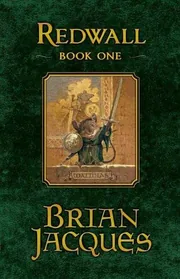
It suits young readers and anyone who enjoys classic adventure, especially readers around middle-grade age.
352 pages, about 5.5 to 8 hours.
A mouse, a sword, and a siege that still grips. 42% taste match
The story
Redwall is a fantasy novel for young readers by Brian Jacques, first published in 1986 and the opening book of the Redwall series. It is an animal fantasy in which mice and other creatures live in and around Redwall Abbey, an imaginary place that gives the book its name. The story centers on the long struggle between good and evil.
Matthias is a young mouse who lives at the abbey as a novice. When the rat Cluny arrives with his hordes and ends the quiet life of the abbey's inhabitants, Matthias sets out to find the sword of Martin the Warrior, which he believes can help them defeat the invaders.
The edition was illustrated by Gary Chalk, with cover art by Pete Lyon for the British release and Troy Howell for the US release. Redwall was later adapted as an animated television series, as were Mattimeo and Martin the Warrior, two other novels in the series. The book runs to roughly 352 pages in its typical edition and has appeared in 59 editions.
Matthias cut a comical little figure as he wobbled his way along the cloisters, with his large sandals flip-flopping and his tail peeping from beneath the baggy folds of an oversized novice's habit.
Setting
Redwall Abbey
Themes
MiceAnimalsFantasyGood and evilFantasy comic books, stripsComic books, stripsCartoons and comicsRats
- Want to read 388
- Reading now 24
- Read 86
Most people shelving it are saving it for later.
Of 498 readers who put it on a shelf, 78% want to read it, 5% are reading it now, 17% have finished it and 0% stopped before the end.
By the numbers
- The median edition runs 352 pages. Counting about 275 words a page and an adult reading pace of 250 words a minute, that is about 6.5 hours of reading.
- Open Library tracks 59 editions from 38 publishers, the earliest dated 1986 and the latest 2023, across 7 languages.
- On reader demand it ranks in the top 1% of the modern books in our catalog (15,152 of them).
- Libraries shelve it under Dewey 813.54 and Library of Congress class PZ-0007.70000000.J35Re 2007.
 BookWard’s take
A mouse, a sword, and a siege that still grips
Redwall opens a long animal-fantasy series with a clear, old-fashioned engine: a peaceful abbey, a rat named Cluny and his horde at the gate, and a young mouse named Matthias who goes looking for Martin the Warrior's sword. It leans heavily on familiar tropes, the quest and the chosen underdog, and I'd rather it hadn't. It is plainly driven by story, with hardly any abstract argument to slow it down. The middle holds its momentum, the ending resolves everything, and the good-versus-evil frame draws its moral lines sharply instead of leaving anything ambiguous. At 352 pages it runs longer than I'd like, but it suits readers who want adventure, loyalty and a satisfying finish.
At 352 pages it is a substantial children's novel, longer than BookWard's taste for tight, short books.
Adventure and conflict keep it moving at a steady clip, a little slower than BookWard's brisk preference.
Mice in a medieval abbey give it a distinct flavor, but the structure is familiar fantasy.
Rich, flavorful language and a storyteller's cadence, a touch more ornate than BookWard's middle ground.
Events and the quest drive things forward more than inner change, leaning plot over character.
Good and evil are set against each other and the tone stays encouraging, aligning with BookWard's hopeful side.
A conventional narrative arc from threat through quest to confrontation, more traditional than BookWard's mild appetite for experiment.
Warm, lively touches lighten the tale, but the dominant tone is adventure and earnestness.
Cluny's horde brings real menace, though handled within a children's fantasy frame.
Courage, loss and loyalty give it emotional weight, in a warm, adventurous register.
See all 50 dialsEvery position, side by side with this book
Where it lines up
- EndingBookWard 8 · book 9
- Authorial voiceBookWard 9 · book 8
- Story or ideasBookWard 3 · book 2
Where it pulls apart
- Familiar tropesBookWard 10 · book 3
- LengthBookWard 1 · book 5
- OpeningBookWard 10 · book 6
At 352 pages it is a substantial children's novel, longer than BookWard's taste for tight, short books.
The abbey's peace is broken by Cluny's arrival early on, so the threat is felt quickly, though not instantly.
Humble hero, legendary sword and an evil horde are well-worn fantasy staples, short of what BookWard prizes.
The quest and siege follow a clear, consistent cause and effect, in a gentle fantasy that doesn't demand airtight rules.
Adventure and conflict keep it moving at a steady clip, a little slower than BookWard's brisk preference.
Mice in a medieval abbey give it a distinct flavor, but the structure is familiar fantasy.
Characters are drawn in clear, bold strokes suited to a young audience, closer to types than deep portraits.
A conflict of this kind resolves decisively, which fits BookWard's taste for closure.
Warmth, loyalty and community are central, making it more sentimental than BookWard's restrained preference.
Threat and battle come from the story's conflict rather than gratuitous darkness, though the evil is plainly drawn.
Fiction, so this dial does not apply.
Jacques' storytelling has a strong, recognizable identity that stands out within animal fantasy.
This is firmly story-led, built on quest and siege rather than abstract argument, matching BookWard.
The setting and its history are readily explained to readers, more than BookWard's show-don't-tell leaning.
The quest and the siege give the story steady momentum, with no obvious drop in energy.
Rich, flavorful language and a storyteller's cadence, a touch more ornate than BookWard's middle ground.
Events and the quest drive things forward more than inner change, leaning plot over character.
Good and evil are set against each other and the tone stays encouraging, aligning with BookWard's hopeful side.
A conventional narrative arc from threat through quest to confrontation, more traditional than BookWard's mild appetite for experiment.
Warm, lively touches lighten the tale, but the dominant tone is adventure and earnestness.
Written for young readers, it reads easily and is accessible to most.
The story follows the abbey's creatures and their enemies, spreading attention across several parties.
A straightforward forward-moving story with no notable time shifts.
Talking animals in an imaginary abbey place it deep in fantasy, beyond BookWard's middling comfort.
An abbey community plus Cluny's horde means a sizeable cast, larger than BookWard's usual.
Centered on one abbey and its defense, with stakes that stay local rather than world-spanning.
Action, journeying and conflict dominate, with less weight on inner reflection.
Animal characters talk plenty, giving conversation a solid place in scenes, close to BookWard's taste.
The story is about courage and the defense of home, with romance playing no real part.
An imagined abbey of mice and other creatures is an unfamiliar world, which BookWard enjoys.
Its setting is an invented, timeless past, far from the present day.
Adventure, loyalty and good versus evil are lasting themes, with the series and adaptations backing its staying power.
A classic storyteller's voice, straightforward and trustworthy.
Good and evil are sharply drawn, leaving little ambiguity, the opposite of BookWard's lean.
Abbey life, meals and landscapes are rendered vividly, richer than BookWard's middle position.
Fiction, so this dial does not apply.
Fiction, so this dial does not apply.
It is the first of the long Redwall series, with sequels that extend its world.
A classic quest tale with a few turns, but largely a predictable path.
A comforting adventure with clear stakes and little to unsettle.
Cluny's horde brings real menace, though handled within a children's fantasy frame.
Courage, loss and loyalty give it emotional weight, in a warm, adventurous register.
Humor skews to hearty, playful storytelling rather than dry wit.
A siege and a villainous horde mean battle, softened by the children's-book framing.
A children's fantasy with no sexual content.
Good versus evil dominates, with no engagement in real-world politics.
Creature speech brings some flavorful, stylized phrasing, a mild extra hurdle.
The narrator tells the tale straight, without much editorializing.
It is rooted in legend and a heroic past, drawing on an ancient sword and warrior.
Courage, community and the triumph of good give it a distinctly idealistic bent.
Review written by BookWard, dial version 1, November 2026.
Who is Redwall right for?
It suits young readers and anyone who enjoys classic adventure, especially readers around middle-grade age. It includes a siege and a villainous horde, so expect battle and danger handled within a children's-fantasy tone.
Written for young readers, it reads easily and is accessible to most.
Cluny's horde brings real menace, though handled within a children's fantasy frame.
Courage, loss and loyalty give it emotional weight, in a warm, adventurous register.
A siege and a villainous horde mean battle, softened by the children's-book framing.
Book CompanionRedwall: ideas, characters, themes
A young mouse in a peaceful abbey must find a legendary sword to help defend his home against an invading rat horde.
- The Setting. Redwall Abbey is an imaginary place where mice and other creatures live, and it is the heart of the story.
- The Threat. The rat Cluny arrives with his hordes and ends the abbey's quiet life.
- The Quest. Matthias, a young novice mouse, sets out to find the sword of Martin the Warrior.
- Good and Evil. The book frames its conflict as a long struggle between good and evil.
- A Series Begins. Published in 1986, it opens the Redwall series, later adapted into an animated series.
Characters
Matthias
Young mouse and novice
Lives at the abbey and sets out to find Martin the Warrior's sword to help defeat the invaders.
Cluny
Villainous rat
Arrives with his hordes and shatters the abbey's peaceful life.
Martin the Warrior
Legendary figure
His sword is the object Matthias believes can help defeat the enemy.
Themes
The central struggle between the abbey's defenders and the invaders.
A young, unlikely hero chooses to act when his home is threatened.
The abbey's inhabitants share a way of life worth protecting.
A warrior's sword from the past carries hope for the present.
Discussion questions
- Why does Matthias believe the sword can change the outcome?
- How does the author make Redwall Abbey feel like a real, lived-in home?
- What makes Cluny an effective villain for a young audience?
- Which familiar fantasy elements does the story use, and do they still work?
- How does choosing animals as characters shape the way we read the conflict?
Personalize your Book Companion
This is the general edition. In BookWard, the Companion is written for you: your reading profile, your notes, and spoiler-safe to the page you are on.
Buy, listen or borrow Redwall
Each link opens a search for this book on that store, in a new tab.
Read on a device
Borrow
Reviews and community
If you liked Redwall
A big, borrowed-bones quest fantasy that BookWard would read warily
The Wishing SpellChris ColferA fairy-tale mash-up that trades menace for wit and warmth
DragonquestAnne McCaffreyPern's second Threadfall: dragons, politics, and a planet to save
The White DragonAnne McCaffreyA dragon-and-Thread finale built around the smallest, whitest runt
Sources: Open Library.
Track Redwall and find your next favorite
Add it to your shelf, rate what you have read, and BookWard will recommend what fits you.
Free to start. No credit card needed.