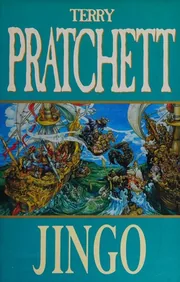
Suits adult readers and confident teens who enjoy satire and fantasy.
415 pages, about 6.5 to 9.5 hours.
Pratchett turns a war over a new island into a cop story. 62% taste match
The story
Jingo is a humorous fantasy novel by Terry Pratchett, first published in 1996 and the 21st book in his Discworld series. It follows Commander Samuel Vimes of the Ankh-Morpork City Watch, a recurring figure in the series, and takes its title from the concept of jingoism.
The story begins when a small island called Leshp surfaces from the Circle Sea, and the sudden appearance of new land sets Ankh-Morpork against the people of Klatch. As tensions rise toward armed conflict, Vimes finds himself serving his city in a role he did not choose. His watch includes Carrot Ironfoundersson, Angua von Überwald, Detritus, Cheery Littlebottom, Fred Colon and Nobby Nobbs, and the cast also draws in Leonard of Quirm, Lord Rust, Prince Cadram and Reg Shoe. Vimes treats war as a crime like any other, and he sets out to find those responsible, whichever side they are on. The book runs to roughly 415 pages and has appeared in 36 editions.
It was a moonless night, which was good for the purposes of Solid Jackson.
Period
1990-
Themes
Samuel Vimes (Fictitious character)Discworld (Imaginary place)FantasyDiscworld (Lugar imaginario)FicciónVimes, Samuel (Personaje literario)Powieść fantastyczna angielskaTłumaczenia polskie
- Want to read 76
- Reading now 4
- Read 76
Readers are split between finishing it and saving it for later.
Of 156 readers who put it on a shelf, 49% want to read it, 3% are reading it now, 49% have finished it and 0% stopped before the end.
By the numbers
- The median edition runs 415 pages. Counting about 275 words a page and an adult reading pace of 250 words a minute, that is about 7.6 hours of reading.
- Open Library tracks 36 editions from 34 publishers, the earliest dated 1996 and the latest 2024, across 7 languages.
- On reader demand it ranks in the top 6% of the modern books in our catalog (15,152 of them).
- Libraries shelve it under Dewey 823.914 and Library of Congress class PR-6066.00000000.R34 J56 2007x.
 BookWard’s take
Pratchett turns a war over a new island into a cop story
Jingo drops Commander Vimes into a war he never wanted, set off when the island of Leshp surfaces between Ankh-Morpork and Klatch. The setup is a joke with teeth: Vimes treats war as just another crime and goes looking for the culprits, whichever side they are on. The book feels fresh, and Pratchett's footnote-happy, aphorism-dense style is unmistakable. It asks little of the reader, and the humor is easy to step into. The pace is brisk for 415 pages, and politics sits right at the center, yet the book is more interested in character than slogans. It is the 21st Discworld novel, so there is a long series behind it, but the Watch cast carries the story and earlier books are not required.
At 415 pages it runs longer than BookWard's taste for tight books, though the comic momentum keeps it moving.
Short scenes and constant incident keep it quick, a little below BookWard's preferred speed.
Treating an international crisis as a police procedural is a fresh angle, matching what BookWard values.
Pratchett's sentences are playful and quotable, richer than BookWard's plainer middle ground.
A plot about a looming war runs alongside Vimes's conscience, balancing both, a touch more plot-led than BookWard.
It ends on a decent, humane note despite the war, matching BookWard's mildly hopeful outlook.
It follows a standard linear narrative with a few cutaways, more conventional than BookWard's mild tilt.
Humor runs through nearly every page, funnier than BookWard's already generous setting.
War is central yet treated with comic lightness, a little gentler than BookWard's middle.
Feeling is present but kept under a wry surface, slightly more restrained than BookWard.
See all 50 dialsEvery position, side by side with this book
Where it lines up
- Character depthBookWard 8 · book 8
- EndingBookWard 8 · book 8
- PaceBookWard 8 · book 7
Where it pulls apart
- LengthBookWard 1 · book 5
- OpeningBookWard 10 · book 7
- Familiar tropesBookWard 10 · book 7
At 415 pages it runs longer than BookWard's taste for tight books, though the comic momentum keeps it moving.
A moonless-night island rising from the sea and an instant diplomatic spark give it a strong start, close to BookWard's liking.
It wears fantasy and war-story tropes, then bends them for jokes; BookWard likes the bending more than the borrowing.
Vimes's war-as-crime premise holds together on its own terms, which suits BookWard's appetite for tight internal logic.
Short scenes and constant incident keep it quick, a little below BookWard's preferred speed.
Treating an international crisis as a police procedural is a fresh angle, matching what BookWard values.
Vimes and the Watch are drawn with real inner lives beneath the comedy, in line with BookWard.
The central conflict is resolved and the culprits dealt with, which fits BookWard's preference for closure.
Warmth is present but regularly undercut by wit, a little more sentimental than BookWard's restrained ideal.
Its darker moments serve the argument about war rather than existing to jolt, which BookWard approves.
This is a novel, so the nonfiction rigor dial does not apply.
Pratchett's footnotes, asides and comic rhythms are unmistakable, the kind of distinctive voice BookWard rates highest.
The story drives it, though it carries clear ideas about nationalism, leaning slightly more toward ideas than BookWard does.
Most of the world is shown through the Watch in action, though the narrator does step in to explain jokes.
Subplots and the ensemble keep the middle busy, close to BookWard's wish for sustained energy.
Pratchett's sentences are playful and quotable, richer than BookWard's plainer middle ground.
A plot about a looming war runs alongside Vimes's conscience, balancing both, a touch more plot-led than BookWard.
It ends on a decent, humane note despite the war, matching BookWard's mildly hopeful outlook.
It follows a standard linear narrative with a few cutaways, more conventional than BookWard's mild tilt.
Humor runs through nearly every page, funnier than BookWard's already generous setting.
The prose is accessible and the jokes land quickly, making it easier going than BookWard's middle setting.
It moves between Vimes, his officers and figures on both sides of the conflict, a broad spread BookWard enjoys.
Events unfold in order without time jumps, more linear than BookWard's middle position.
Trolls, dwarfs, werewolves and a floating island make it thoroughly fantastical, above BookWard's middle.
A full Watch roster plus rulers and inventors make a large cast, bigger than BookWard usually seeks.
Two nations edging toward war gives it more sweep than the intimate middle BookWard favors.
It balances Vimes's reflections with plenty of outward action, slightly more outer than BookWard's lean.
Banter and verbal sparring drive scene after scene, matching BookWard's liking for dialogue.
Romance sits at the edges of the story, well below BookWard's middle setting.
Discworld is a made-up world with its own quirks, which BookWard enjoys.
Written in the 1990s and set in an invented past-ish world, it leans slightly away from the present day.
Its satire of jingoism stays relevant, in step with BookWard's liking for lasting books.
The narrator is open and trustworthy, in clear contrast to BookWard's taste for unreliability.
Vimes's code gives clear moral footing, though both sides get grey areas; a bit clearer than BookWard prefers.
Pratchett paints places with quick, vivid strokes, richer than BookWard's average.
This is fiction, so the nonfiction style dial does not apply.
This is fiction, so the nonfiction perspective dial does not apply.
It is the 21st Discworld novel, well into a series, far from BookWard's standalone-leaning middle.
Reversals about who is really behind the crisis keep it surprising, matching BookWard's liking for surprises.
It entertains first while still asking pointed questions, more comforting than BookWard's challenge-seeking taste.
War is central yet treated with comic lightness, a little gentler than BookWard's middle.
Feeling is present but kept under a wry surface, slightly more restrained than BookWard.
Dry wit and clever understatement dominate over slapstick, drier than BookWard's middle.
There is conflict and some fighting, handled with a light touch, below BookWard's middle.
Sexual content is minimal, well below BookWard's middle setting.
Jingoism and war are the point of the book, so politics sits front and center, higher than BookWard.
The language is plain and quick, easier than BookWard's middle setting.
The narrator has strong views on war and patriotism, a little more opinionated than BookWard.
It looks at present-style politics through an invented lens, roughly balanced and close to BookWard.
Vimes's stubborn decency gives it an idealistic streak, in line with BookWard's slightly idealistic leaning.
Review written by BookWard, dial version 1, November 2026.
Who is Jingo right for?
Suits adult readers and confident teens who enjoy satire and fantasy. Contains war themes, some fighting and political commentary, handled mostly with a comic touch.
The prose is accessible and the jokes land quickly, making it easier going than BookWard's middle setting.
War is central yet treated with comic lightness, a little gentler than BookWard's middle.
Feeling is present but kept under a wry surface, slightly more restrained than BookWard.
There is conflict and some fighting, handled with a light touch, below BookWard's middle.
Book CompanionJingo: ideas, characters, themes
Jingo argues that war is simply the biggest crime of all, and sets a stubborn policeman to investigate it.
- A new island sparks old tension. The appearance of Leshp between Ankh-Morpork and Klatch revives a historic territorial dispute and pushes both sides toward armed conflict.
- Vimes treats war as crime. Sam Vimes approaches the crisis as a policeman, looking for who is responsible rather than who is winning.
- The Watch as ensemble. Carrot, Angua, Detritus, Cheery, Fred Colon and Nobby Nobbs each bring a distinct angle to the situation.
- Satire of jingoism. The title names the theme, and the story pokes at flag-waving patriotism and the way it is used to justify conflict.
- Part of a long series. As the 21st Discworld novel it draws on the Watch's earlier history, but it is written to be enjoyed without having read the rest.
Characters
Samuel Vimes
Commander of the Ankh-Morpork City Watch
A cynical, honest policeman who is drafted into a war and insists on treating it as a crime to be solved.
Carrot Ironfoundersson
Watch officer
A principled and earnest member of the Watch who brings his own steady approach to the crisis.
Angua von Überwald
Watch officer
A werewolf in the Watch whose senses and instincts matter to the investigation.
Leonard of Quirm
Inventor
A brilliant and gentle inventor whose ideas become entangled with the unfolding conflict.
Prince Cadram
Figure on the Klatchian side
A leader connected to Al-Khali and the Klatchian side of the dispute.
Themes
Aggressive, flag-waving patriotism that pushes nations toward war.
The idea that organized conflict deserves the same scrutiny as any other wrongdoing.
What a person owes to their city versus what they owe to what is right.
How suspicion of foreigners is stirred up and used.
How the Watch holds together under strain.
Discussion questions
- Is Vimes right to treat war as a crime, and what would that change in practice?
- How does Pratchett use humor to make his argument about patriotism land?
- Which member of the Watch shows the most about what duty means?
- What does the dispute over a tiny island say about how conflicts begin?
- Does the book work as a standalone, or does it reward knowing the earlier Discworld novels?
Personalize your Book Companion
This is the general edition. In BookWard, the Companion is written for you: your reading profile, your notes, and spoiler-safe to the page you are on.
Buy, listen or borrow Jingo
Each link opens a search for this book on that store, in a new tab.
Read on a device
Borrow
Reviews and community
If you liked Jingo
Pratchett's Watch novel pairs a golem murder with a poisoned Patrician
Men at ArmsTerry PratchettPratchett's cop story: a city, a gonne, a rightful king
Guards! Guards!Terry PratchettA dragon, a doomed Watch, and Pratchett's sharpest early satire
Wyrd SistersTerry PratchettPratchett's Macbeth-flavored Discworld comedy, sharp and quick, with three unforgettable witches
Sources: Open Library.
Track Jingo and find your next favorite
Add it to your shelf, rate what you have read, and BookWard will recommend what fits you.
Free to start. No credit card needed.