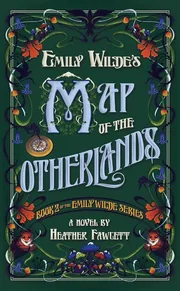
Emily Wilde's Map of the Otherlands
by Heather Fawcett · 2024
It suits adult readers and older teens who enjoy cozy, witty fantasy.
352 pages, about 5.5 to 8 hours.
A cozy, bookish faerie sequel with a prickly scholar at its heart. 54% taste match
The story
Emily Wilde's Map of the Otherlands is a fantasy novel by Heather Fawcett, first published in 2024. It is the second book in the Emily Wilde series, following the title character, a scholar who studies faeries. The story is set at a university, where faeries from other realms arrive unexpectedly, and Emily, a professor with a reputation for being difficult, sets out to learn what they want before time runs short.
The book runs to about 352 pages and has appeared in eight editions. It opens with Emily on one of her research expeditions, carrying an unusual object wrapped in cloth in an old knapsack. Readers who like stories about academic fieldwork, folklore and the world of faerie will find those interests at the center of this installment, which continues the series for those who have already met Emily and offers a way into her work for those who have not.
The foot would not fit in my briefcase, so I wrapped it in cloth and wrestled it into an old knapsack I sometimes carry with me on expeditions.
- Want to read 13
- Read 8
Readers are split between finishing it and saving it for later.
Of 21 readers who put it on a shelf, 62% want to read it, 0% are reading it now, 38% have finished it and 0% stopped before the end.
By the numbers
- The median edition runs 352 pages. Counting about 275 words a page and an adult reading pace of 250 words a minute, that is about 6.5 hours of reading.
- Open Library tracks 8 editions from 4 publishers, the earliest dated 2024 and the latest 2025, across 2 languages.
- On reader demand it ranks in the top 14% of the recent releases books in our catalog (1,627 of them).
- Libraries shelve it under Dewey 813.6 and Library of Congress class PR-9199.40000000.F39.
 BookWard’s take
A cozy, bookish faerie sequel with a prickly scholar at its heart
Heather Fawcett's second Emily Wilde novel puts a difficult academic at the center of a faerie mystery, and it leans hard on voice. Emily is a scholar first, so the fieldwork, folklore and university setting give the book its texture. The tone is funny, close to the kind of humor I tend to enjoy. It is a comfort read, gentler than the books I usually reach for, and it uses familiar tropes rather than avoiding them. The hook is quick and the pace moves. It also belongs to a series, which counts for something with me, and the ending is mostly resolved while leaving room for more. Characters carry the story, which suits what I look for, though the book is more modest in originality than I usually want.
At 352 pages it sits mid-range, longer than BookWard's love of tight books but not sprawling.
The expeditions and a ticking clock keep things moving, close to BookWard's fast-leaning taste.
A scholar treating faeries as a field of study is a fresh angle, though the genre ground is well worn.
Clean, witty and mildly period in flavor, a touch more polished than plain.
Emily's temperament shapes how every event unfolds, so character leads, as BookWard prefers.
It ends on warmth and possibility, a notch more hopeful than BookWard's outlook.
Journal-style framing gives some shape, but the structure stays conventional overall.
Emily's grumpiness and social awkwardness give steady humor, in line with BookWard's lean.
Faerie peril adds menace, but the tone stays gentle overall.
Feeling builds through friendship and stakes, moderately intense but not overwhelming.
See all 50 dialsEvery position, side by side with this book
Where it lines up
- Authorial voiceBookWard 9 · book 9
- Story or ideasBookWard 3 · book 3
- PaceBookWard 8 · book 7
Where it pulls apart
- Familiar tropesBookWard 10 · book 4
- Rigor (nonfiction)BookWard 9 · book 2
- LengthBookWard 1 · book 5
At 352 pages it sits mid-range, longer than BookWard's love of tight books but not sprawling.
It opens mid-expedition with an odd object in a knapsack, which fits BookWard's taste for an immediate pull.
Faerie fieldwork and a grumpy scholar lean on familiar comforts, which sits a little below BookWard's preference.
Folklore rules and scholarly method give the magic a workable internal order, though BookWard wants it tighter.
The expeditions and a ticking clock keep things moving, close to BookWard's fast-leaning taste.
A scholar treating faeries as a field of study is a fresh angle, though the genre ground is well worn.
Emily's prickliness and private world are drawn with care, which BookWard values.
The central problem resolves while the series keeps some threads open, a little looser than BookWard prefers.
Warmth and affection run through it, so it is less restrained than BookWard's lean.
The danger is real but the book is not built on shocks, so it earns its tension reasonably well.
This is a novel, so scholarly detail is flavor rather than rigor, and the dial barely applies.
Emily's dry, self-regarding narration is the book's signature, matching BookWard's love of a distinctive voice.
The book is story-led, driven by Emily's quest rather than argument, and BookWard sits the same way.
Folklore is delivered through Emily's scholarly asides, a bit more explained than BookWard likes.
The middle stays engaged through new locations and revelations, though a sequel can lose some drive.
Clean, witty and mildly period in flavor, a touch more polished than plain.
Emily's temperament shapes how every event unfolds, so character leads, as BookWard prefers.
It ends on warmth and possibility, a notch more hopeful than BookWard's outlook.
Journal-style framing gives some shape, but the structure stays conventional overall.
Emily's grumpiness and social awkwardness give steady humor, in line with BookWard's lean.
It reads smoothly and invites quick reading, easier than BookWard's middle ground.
The story stays with Emily's perspective throughout, narrower than BookWard's taste.
Events unfold chronologically, so the timeline stays simple.
Faerie realms and their rules sit at the center, making this firmly fantastical.
A university, colleagues and faerie figures give a moderate ensemble beyond Emily herself.
The stakes reach beyond a single room but stay personal, between intimate and epic.
Emily's thoughts and her expeditions share the page fairly evenly.
Banter and exchanges between characters carry much of the charm, in line with BookWard's lean.
A romantic thread runs through the series and matters here, more central than BookWard usually likes.
Faerie realms and academic fieldwork feel fresh, matching BookWard's taste for the unfamiliar.
It uses a historical-leaning academic setting rather than the present day.
Cozy, character-led fantasy tends to age gracefully, though this is tied to its genre moment.
Emily is candid but a touch blind to herself, only mildly unreliable.
Right and wrong stay mostly clear, with faerie ambiguity adding some gray.
Landscapes, libraries and faerie courts are described richly, richer than BookWard's middle ground.
The book is intimate and first-person, far from detached.
This is the second Emily Wilde book, so it sits firmly in a series.
There are discoveries and reversals, in step with BookWard's liking for surprises.
It is a comforting read more than a challenging one, gentler than BookWard's lean.
Faerie peril adds menace, but the tone stays gentle overall.
Feeling builds through friendship and stakes, moderately intense but not overwhelming.
The wit is dry and character-driven rather than slapstick.
Danger is present but kept mostly off the page.
Romance stays chaste and low in sexual content.
Court intrigue exists but politics is not the book's concern.
The language reads plainly, with only some archaic scholarly flavor.
Emily's strong views color every observation, making the narration decidedly opinionated.
It looks ahead through an ongoing quest, while drawing on old folklore.
Curiosity and kindness win out, giving it an idealistic streak.
Review written by BookWard, dial version 1, November 2026.
Who is Emily Wilde's Map of the Otherlands right for?
It suits adult readers and older teens who enjoy cozy, witty fantasy. Faerie peril and some romance appear, but content stays gentle.
It reads smoothly and invites quick reading, easier than BookWard's middle ground.
Faerie peril adds menace, but the tone stays gentle overall.
Feeling builds through friendship and stakes, moderately intense but not overwhelming.
Danger is present but kept mostly off the page.
Book CompanionEmily Wilde's Map of the Otherlands: ideas, characters, themes
A difficult faerie scholar must uncover why mysterious beings from other realms have appeared at her university before time runs out.
- A scholar's lens on faerie. Emily treats faeries as a field of study, which sets the tone for the series.
- The university setting. The faeries arrive at Emily's academic home, bringing the strange into the ordinary.
- Fieldwork opening. The book opens on a research expedition, with Emily carrying a cloth-wrapped object in her knapsack.
- A reputation to carry. Emily's difficult nature shapes how others deal with her and how she copes with them.
- A race against time. She must learn what the visitors want before it is too late.
Characters
Emily Wilde
Protagonist
A curmudgeonly professor and faerie scholar with a reputation for being difficult.
Themes
How the drive to study and understand shapes a life.
The old stories that give faerie its rules and meaning.
How a prickly person still earns loyalty and care.
What it means when strange realms intrude on the familiar.
Discussion questions
- Why does Emily approach faeries as a scholar rather than a believer or a fan?
- How does a university setting change what faerie stories can do?
- What makes a difficult protagonist enjoyable to follow?
- How much does knowing the first book add to this one?
- What would you want to learn from visitors from another realm?
Personalize your Book Companion
This is the general edition. In BookWard, the Companion is written for you: your reading profile, your notes, and spoiler-safe to the page you are on.
Buy, listen or borrow Emily Wilde's Map of the Otherlands
Each link opens a search for this book on that store, in a new tab.
Read on a device
Borrow
Reviews and community
If you liked Emily Wilde's Map of the Otherlands
A cozy fantasy road trip with a foul-mouthed bookseller and a goblin
Siege and StormLeigh BardugoAlina's hidden power meets a bigger, hungrier world in book two
MaskeradeTerry PratchettDiscworld's witches crash the opera in a witty Phantom spoof
BehoovedM. StevensonA cozy romantasy where the groom is a horse by day
Sources: Open Library.
Track Emily Wilde's Map of the Otherlands and find your next favorite
Add it to your shelf, rate what you have read, and BookWard will recommend what fits you.
Free to start. No credit card needed.