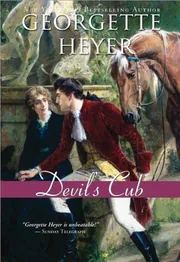
Devil's Cub (Alastair-Audley #2)
by Georgette Heyer · 1932
Suited to adult and older teen readers who enjoy historical romance.
288 pages, about 4.5 to 6.5 hours.
A rake, the wrong sister, and a very quick-witted Regency romp. 58% taste match
The story
Devil's Cub is a historical romance by Georgette Heyer, first published in 1932 and the second book in the Alastair-Audley series. It is set among the aristocracy of Georgian England, with scenes in London and in France, and it draws on the social life and customs of the nobility during the reign of George III.
The story centers on Dominic Alastair, Marquis of Vidal, the heir to a dukedom and the son of the Duke of Avon. His reckless conduct has earned him the nickname of the title. After a duel sends him abroad, he plans to carry off Sophia Challoner, a young woman whose mother is eager to see her marry well. Sophia's older sister, Mary Challoner, steps in to shield her, and the plan goes awry when Vidal takes the wrong sister to France. Marriage proposals and the expectations of rank run through the book, which runs to roughly 288 pages and has appeared in 45 editions.
Characters
Lord Dominic Alastair, Marquis of VidalMary ChallonerMarquis de Vidal
Setting
EnglandGreat BritainFranceLondon
Period
18th centuryGeorge III, 1760-182019th century
Themes
Social life and customsAristocracy (Social class)Marriage proposalsNobilityHistory
- Want to read 137
- Reading now 16
- Read 50
Most people shelving it are saving it for later.
Of 203 readers who put it on a shelf, 67% want to read it, 8% are reading it now, 25% have finished it and 0% stopped before the end.
By the numbers
- The median edition runs 288 pages. Counting about 275 words a page and an adult reading pace of 250 words a minute, that is about 5.3 hours of reading.
- Open Library tracks 45 editions from 34 publishers, the earliest dated 1932 and the latest 2019, across 4 languages.
- On reader demand it ranks in the top 6% of the classic books in our catalog (8,749 of them).
- Libraries shelve it under Dewey 823.912 and Library of Congress class PR-6015.00000000.E795.
 BookWard’s take
A rake, the wrong sister, and a very quick-witted Regency romp
Devil's Cub is a brisk, dialogue-driven historical romance that earns its romance without much fuss. At 288 pages it moves along and never lingers, and the opening hooks quickly, with a duel, an exile and an abduction attempt arriving almost at once. Where it divides is in its familiar figures: the rake and the sensible heroine are well-worn types, though Heyer's comic timing keeps them lively. The feeling is restrained, with wit doing the work that gush might do elsewhere. This is a book that leans firmly toward story rather than ideas. It is a sequel in the Alastair-Audley series, yet it reads happily without its predecessor.
At 288 pages it is compact, with no padding between its abduction and its resolution, which sits well with BookWard's liking for tight books.
Events move quickly through London and Paris, so it keeps close to BookWard's preference for pace.
The wrong-sister mix-up and the reformed rake are established romance moves, so it feels more familiar than fresh, short of what BookWard prizes.
Mannered and rich in period diction, but never so ornate that it slows the read.
Events and personalities drive it about equally, since the plot works mainly by throwing two strong characters together.
For all its rake and its scandal, it is a warm, optimistic book that believes people can change.
A conventional straight run from setup to resolution, with no formal experiments.
Wit is central: the dialogue and the sparring between leads supply constant comedy.
There is a violent temper and a kidnapping, but the tone stays light and the edges are soft.
Feelings run warm and sometimes strong, expressed through wit more than anguish.
See all 50 dialsEvery position, side by side with this book
Where it lines up
- PaceBookWard 8 · book 8
- LengthBookWard 1 · book 2
- OpeningBookWard 10 · book 9
Where it pulls apart
- Familiar tropesBookWard 10 · book 4
- OriginalityBookWard 9 · book 4
- Internal logicBookWard 10 · book 7
At 288 pages it is compact, with no padding between its abduction and its resolution, which sits well with BookWard's liking for tight books.
A duel, an exile and a planned abduction crowd the opening, so the story is moving before you have settled in.
The rake and the clever heroine are familiar romance figures, but Heyer's comic handling keeps them from feeling stock, a partial miss for BookWard.
The plot runs on mistaken identity and aristocratic rules, and the chain of cause and effect holds together well enough to enjoy.
Events move quickly through London and Paris, so it keeps close to BookWard's preference for pace.
The wrong-sister mix-up and the reformed rake are established romance moves, so it feels more familiar than fresh, short of what BookWard prizes.
Vidal and Mary are drawn with enough wit and friction to feel real, though some supporting figures are broader sketches.
Romance promises a satisfying close and this one delivers it, matching BookWard's taste for resolved endings.
Feeling is carried by banter and sharp edges rather than sighing, which is welcome, though it stays warmer than the strict end.
Vidal's temper and the abduction carry real menace, but the darkness serves the story and is not there for effect.
Heyer's arch, period-flavored narration is unmistakably hers, which is a strong point for BookWard.
This is entirely story-led: it exists to entertain through plot and character, not to argue an idea.
Information arrives through scenes and conversation more than through lecturing, which BookWard prefers.
With so short a span and a steady run of complications, the middle holds its energy.
Mannered and rich in period diction, but never so ornate that it slows the read.
Events and personalities drive it about equally, since the plot works mainly by throwing two strong characters together.
For all its rake and its scandal, it is a warm, optimistic book that believes people can change.
A conventional straight run from setup to resolution, with no formal experiments.
Wit is central: the dialogue and the sparring between leads supply constant comedy.
Period slang takes a moment to adjust to, but the book reads easily once you are in its rhythm.
Attention stays mostly with the central pair, with limited shifts to other perspectives.
Events unfold in order without flashbacks or jumps.
Nothing here departs from a realistic Georgian world.
A modest circle of family, rivals and Parisian society fills the book without crowding it.
Stakes are personal and social, a marriage and a reputation, not national or epic.
Action and incident lead, though Mary's calculating mind is a steady presence.
Conversation carries a large share of the story and the humor.
The central relationship is the engine of the whole book.
Georgian aristocratic society in London and France will feel foreign to most readers, and the book gives it texture.
Written in 1932 and set in the 18th century, so it looks entirely to the past.
Its comic romance has outlasted its era, though its period manners date it.
The narrator is a straightforward guide, with no sense of deception.
Right and wrong are fairly clear, though Vidal's redemption blurs them in places.
Clothes, rooms and Parisian society are evoked with period detail, without long catalogues.
It is the second Alastair-Audley novel, yet its story is complete and readable on its own.
Mistaken identity and reversals keep surprises coming, though readers of romance will foresee the destination.
It is easy company, built to delight, not to unsettle.
There is a violent temper and a kidnapping, but the tone stays light and the edges are soft.
Feelings run warm and sometimes strong, expressed through wit more than anguish.
The comedy sits between dry and broad, with sharp banter and some theatrical set pieces.
A duel and a volatile temper appear, but little is shown at length.
The plot turns on seduction, but the treatment is discreet and period-appropriate.
Rank and marriage matter socially, but politics proper stays offstage.
Period vocabulary and slang can slow you briefly, though it is manageable.
The narrator keeps mostly neutral, with a light, amused tone toward its characters.
It is rooted in a vanished world and does not look ahead.
It believes in love, in redemption, and in sensible women taming hot-headed men.
Review written by BookWard, dial version 1, November 2026.
Who is Devil's Cub (Alastair-Audley #2) right for?
Suited to adult and older teen readers who enjoy historical romance. It involves an abduction, a violent temper and the threat of seduction, handled with period discretion.
Period slang takes a moment to adjust to, but the book reads easily once you are in its rhythm.
There is a violent temper and a kidnapping, but the tone stays light and the edges are soft.
Feelings run warm and sometimes strong, expressed through wit more than anguish.
A duel and a volatile temper appear, but little is shown at length.
Book CompanionDevil's Cub (Alastair-Audley #2): ideas, characters, themes
A notorious rake abducts the wrong sister, and the clever woman he takes proves more than a match for him.
- The nickname. Dominic Alastair, Marquis of Vidal, is known as the Devil's Cub for a rakish reputation that rivals his father's.
- The duel. After wounding an opponent in a duel, Vidal is sent abroad to the Continent.
- The plan. Vidal sets out to carry off Sophia Challoner and make her his mistress.
- The substitution. Sophia's practical sister, Mary, steps in to protect her and ends up taken to France in her place.
- The setting. The story moves between Georgian London and the glittering society of Paris.
Characters
Dominic Alastair, Marquis of Vidal
The rake
Heir to a dukedom and son of the Duke of Avon, with a reckless streak and a fierce temper.
Mary Challoner
The heroine
An intelligent, practical young woman who takes her sister's place to shield her.
Sophia Challoner
The intended target
Mary's younger sister, whom their mother wants married well.
Themes
How a name for wickedness shapes how others see and treat a person.
How rank and money press on who may marry whom.
How a swapped person upends everyone's plans.
Whether a reckless man can be changed by an honest relationship.
Discussion questions
- Is Vidal a believable romantic lead, or does his behavior ask too much of the reader's forgiveness?
- Why does Mary choose to take her sister's place, and what does it say about her?
- How much does the book depend on its Georgian setting and manners?
- Does the comedy soften the seriousness of an abduction?
- How well does it stand alone as a sequel?
Personalize your Book Companion
This is the general edition. In BookWard, the Companion is written for you: your reading profile, your notes, and spoiler-safe to the page you are on.
Buy, listen or borrow Devil's Cub (Alastair-Audley #2)
Each link opens a search for this book on that store, in a new tab.
Read on a device
Borrow
Reviews and community
If you liked Devil's Cub (Alastair-Audley #2)
A brisk Regency romance with a girl in boy's clothes
The Quiet GentlemanGeorgette HeyerA Regency homecoming where the charming surface hides a murder plot
The WeddingJulie GarwoodA Highland marriage of convenience, with revenge pulling at both of them
The BrideJulie GarwoodA warm, fast Highland marriage-of-convenience romance built on familiar bones
Sources: Open Library.
Track Devil's Cub (Alastair-Audley #2) and find your next favorite
Add it to your shelf, rate what you have read, and BookWard will recommend what fits you.
Free to start. No credit card needed.