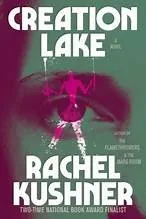
Creation Lake
by Rachel Kushner · 2024
Best suited to adult readers comfortable with morally murky narrators and political themes.
416 pages, about 6.5 to 9.5 hours.
An undercover agent, a radical farm commune, and Neanderthals. 57% taste match
The story
Creation Lake is a novel by Rachel Kushner, first published in 2024. It belongs to literary and general fiction and runs to roughly 416 pages in its typical edition. The book has appeared in six editions, and it was shortlisted for the 2024 Booker Prize.
The story follows an agent provocateur who works undercover, a figure described as both self-involved and only semi-competent. Her assignment takes her to a radical farming commune in rural France, where she carries out her trade among the people living there. The setting places the book in the French countryside, within a community built around communal agricultural life and radical politics.
The novel opens with a line about Neanderthals and their supposed tendency toward depression, spoken by a male voice. That early turn toward prehistoric humans hints at an interest in deep human history alongside the contemporary rural setting. Readers who enjoy fiction about covert work, intentional communities, and the French provinces, or who follow Kushner's writing and the Booker shortlists, may find this one fits their reading list.
Neanderthals were prone to depression, he said.
By the numbers
- The median edition runs 416 pages. Counting about 275 words a page and an adult reading pace of 250 words a minute, that is about 7.6 hours of reading.
- Open Library tracks 6 editions from 3 publishers.
- On reader demand it ranks in the top 36% of the recent releases books in our catalog (1,627 of them).
- Libraries shelve it under Library of Congress class PS-3611.00000000.U7386C74 2024.
 BookWard’s take
An undercover agent, a radical farm commune, and Neanderthals
Creation Lake sends a self-involved, semi-competent agent provocateur into a radical farming commune in rural France, and it opens with a line about Neanderthals and depression. That is a strong hook: odd and voicey, a way of beginning that has nothing to do with scene-setting. Kushner's setup also feels original and her voice is unmistakable, since she avoids the usual spy-novel furniture. The narrator is both the real pleasure and the real risk, because a protagonist whose competence and motives are in question makes for a slippery guide. Expect ideas about deep human history and politics to share space with the plot, and the book leans further toward ideas than I usually like. A Booker Prize 2024 shortlisted novel and a New York Times bestseller, it rewards readers who prefer a puzzle of character to a straight ride.
At about 416 pages it runs longer than BookWard's taste for tight books, though not sprawling.
Built around infiltration and observation, it moves at a measured pace, slower than BookWard likes.
The mix of covert work, communal farming and deep prehistory is distinctive, matching BookWard's appetite for the new.
Kushner's prose is literary and polished, more ornate than BookWard's plainer lean.
Plot exists through the assignment, but the narrator's character and perspective carry the book, matching BookWard.
A cynical agent among radicals points toward a bleak outlook, below BookWard's mildly hopeful lean.
The Neanderthal opening hints at a looser shape than a straight thriller, a bit beyond BookWard's conventional lean.
Self-involved narrator and semi-competent spycraft allow dry comedy, but it reads as mostly serious.
Political deception and a cynical outlook give it a dark edge, matching BookWard's middle stance.
A detached, self-involved narrator keeps feeling cool, below BookWard's middling intensity.
See all 50 dialsEvery position, side by side with this book
Where it lines up
- SentimentBookWard 8 · book 8
- Authorial voiceBookWard 9 · book 9
- OriginalityBookWard 9 · book 8
Where it pulls apart
- LengthBookWard 1 · book 6
- Internal logicBookWard 10 · book 6
- EndingBookWard 8 · book 4
At about 416 pages it runs longer than BookWard's taste for tight books, though not sprawling.
Opening on a line about Neanderthals and depression grabs attention at once, which suits BookWard well.
An undercover agent in a radical French commune sidesteps standard spy and rural-novel tropes, which BookWard values.
A semi-competent narrator keeps events deliberately a little unsteady, so it is less airtight than BookWard prefers.
Built around infiltration and observation, it moves at a measured pace, slower than BookWard likes.
The mix of covert work, communal farming and deep prehistory is distinctive, matching BookWard's appetite for the new.
A self-involved agent of doubtful skill invites close study of motive, in line with BookWard's taste for drawn characters.
Novels built on an unreliable agent tend toward open resolutions, short of the full closure BookWard prefers.
The cynical, self-involved lead keeps the tone dry and unsentimental, which BookWard likes.
Darkness comes from the political and moral setup rather than gratuitous shocks, in keeping with BookWard.
Kushner's narration is strongly individual from the opening line, squarely what BookWard seeks.
Prehistory and radical politics sit alongside the plot, so it leans toward ideas more than BookWard usually does.
Ideas are voiced through characters and narration, leaving it more explanatory than BookWard's show-it-in-scene preference.
A long novel built on slow infiltration risks lulls in the middle, a small concern for BookWard.
Kushner's prose is literary and polished, more ornate than BookWard's plainer lean.
Plot exists through the assignment, but the narrator's character and perspective carry the book, matching BookWard.
A cynical agent among radicals points toward a bleak outlook, below BookWard's mildly hopeful lean.
The Neanderthal opening hints at a looser shape than a straight thriller, a bit beyond BookWard's conventional lean.
Self-involved narrator and semi-competent spycraft allow dry comedy, but it reads as mostly serious.
Ideas, politics and an unreliable guide ask for attention, more effort than BookWard's easy-leaning taste.
The synopsis centers on one agent, though the opening voice suggests other perspectives, so it sits mid-range.
The setting is a real rural France commune, grounded rather than fantastical, below BookWard's mid-range.
A commune implies a modest ensemble around one central agent, matching BookWard's small-to-mid lean.
One agent in one commune keeps it intimate, even with prehistoric asides.
An undercover observer mixes watching action with her own commentary, balanced like BookWard's lean.
Commune conversations and an opening spoken line suggest a fair amount of talk, a bit lighter than BookWard's preference.
Nothing in the setup puts romance at the center, which suits a minor-romance reader.
Radical farming communes in rural France are an unfamiliar milieu for most readers, which BookWard enjoys.
A contemporary rural setting makes it a present-day novel, matching BookWard's lean.
Questions of belief, deception and human nature give it lasting appeal, a bit below BookWard's timeless lean.
A self-involved, semi-competent undercover agent is a prime unreliable guide, matching BookWard's taste.
A farming landscape and commune life invite a good deal of physical detail, edging past BookWard's balance.
It is a standalone novel with no sign of a series, as BookWard prefers.
Covert work and shifting loyalties promise some surprises, though not wall-to-wall, a little under BookWard's lean.
Moral murk and idea-heavy passages make it challenging rather than comforting, in line with BookWard.
Political deception and a cynical outlook give it a dark edge, matching BookWard's middle stance.
A detached, self-involved narrator keeps feeling cool, below BookWard's middling intensity.
Any humor is likely dry and sardonic, leaning toward the drier end where BookWard sits.
Nothing in the setup foregrounds violence, so it likely stays in the background.
The premise centers on infiltration and ideas, not sex, so it likely stays light.
A radical commune and an agent provocateur put politics at the heart, well beyond BookWard's middle lean.
Literary but not dialect-driven, the language is fairly standard, a touch easier than BookWard's range.
A strongly voiced narrator is opinionated about the people around her, near BookWard's lean.
With its deep-history opening, the book looks backward more than BookWard's forward lean.
Radical idealism is seen through a cynical agent, so the book sits on the cynical side, below BookWard's lean.
Review written by BookWard, dial version 1, November 2026.
Who is Creation Lake right for?
Best suited to adult readers comfortable with morally murky narrators and political themes. Expect mature subject matter around surveillance and radical activism.
Ideas, politics and an unreliable guide ask for attention, more effort than BookWard's easy-leaning taste.
Political deception and a cynical outlook give it a dark edge, matching BookWard's middle stance.
A detached, self-involved narrator keeps feeling cool, below BookWard's middling intensity.
Nothing in the setup foregrounds violence, so it likely stays in the background.
Book CompanionCreation Lake: ideas, characters, themes
An unreliable undercover agent infiltrates a radical farming commune in rural France, and the book sets that contemporary deception against questions of deep human history.
- The assignment. An agent provocateur, described as self-involved and only semi-competent, is placed inside a radical farming commune to carry out her trade.
- The setting. The story is set in rural France, within a community built around communal agricultural life and radical politics.
- The opening. The novel begins with a male voice on Neanderthals and their supposed tendency toward depression, an early signal of its interest in prehistory.
- The narrator. The agent's mix of self-regard and uneven skill makes her a guide the reader must weigh rather than simply trust.
- Reception. Published in 2024, it was shortlisted for the 2024 Booker Prize and reached the New York Times hardcover fiction bestseller list.
Characters
The agent provocateur
Protagonist and narrator
A self-involved, semi-competent operative working undercover at the commune.
Themes
What it costs to live under a false identity inside a community built on shared belief.
How ideals are lived, tested and exploited in an intentional community.
The pull of prehistoric humanity, signaled by the Neanderthal opening, set against modern life.
The gap between how an unreliable narrator sees herself and what her actions show.
Discussion questions
- How does the narrator's mix of vanity and uneven skill shape how much you trust her account?
- Why might the book open on Neanderthals before turning to a modern French commune?
- What does a farming commune offer a novel about deception that a city setting would not?
- Does the book ask you to sympathize with the radicals, the agent, or neither?
- How does the rural French setting affect the mood of the story?
Personalize your Book Companion
This is the general edition. In BookWard, the Companion is written for you: your reading profile, your notes, and spoiler-safe to the page you are on.
Buy, listen or borrow Creation Lake
Each link opens a search for this book on that store, in a new tab.
Read on a device
Borrow
Reviews and community
If you liked Creation Lake
A strange Kent tideline, and an object that won't hold still
Life of MRachel CuskCusk turns her cool, spare eye on an actress called M
PlaygroundRichard PowersFour lives, one ocean, and a game that ate the world
FlashlightSusan ChoiA family wrecked by one night on a breakwater
Sources: Open Library.
Track Creation Lake and find your next favorite
Add it to your shelf, rate what you have read, and BookWard will recommend what fits you.
Free to start. No credit card needed.