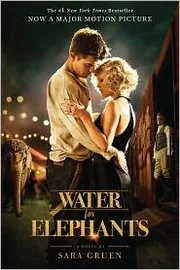
Water for Elephants
by Sara Gruen, David LeDoux · 2006
Best suited to adult and older teen readers who enjoy historical romance.
355 pages, about 5.5 to 8.5 hours.
A circus train, a ninety-year-old memory, and a love worth the risk. 49% taste match
The story
Water for Elephants is a historical romance novel by Sara Gruen, first published in 2006. Gruen, a Canadian-American author, wrote it as part of National Novel Writing Month. The story is set in the United States during the Depression era and follows life inside a traveling circus, a world of performers, animals and long rides by rail.
The narrator is Jacob Jankowski, who recalls his younger days from the vantage of age ninety. As a veterinary student close to finishing his degree, he ends up on a train belonging to the Benzini Brothers Most Spectacular Show on Earth and is given charge of its menagerie. There he meets Marlena, an equestrian performer who is married to August, the show's animal trainer. He also meets Rosie, an elephant the troupe hopes will turn its fortunes around. The three of them form a close bond that matters for their survival.
Readers who enjoy circus settings, Depression-era America and love stories told as memory will find those threads here. The book runs to about 355 pages and has appeared in 36 editions.
Only three people were left under the red and white awning of the grease joint: Grady, me and the fry cook.
Characters
MarlenaJacob JankowskiAugustRosie
Setting
United States
Period
192919321933-1945
Themes
circus performersdepression erahistoricalelephantsromanceNew York Times bestsellerCircusDepressions
- Want to read 153
- Reading now 7
- Read 70
Most people shelving it are saving it for later.
Of 230 readers who put it on a shelf, 67% want to read it, 3% are reading it now, 30% have finished it and 0% stopped before the end.
By the numbers
- The median edition runs 355 pages. Counting about 275 words a page and an adult reading pace of 250 words a minute, that is about 6.5 hours of reading.
- Open Library tracks 36 editions from 25 publishers, the earliest dated 2006 and the latest 2015, across 4 languages.
- On reader demand it ranks in the top 3% of the modern books in our catalog (15,152 of them).
- Libraries shelve it under Dewey 813.6 and Library of Congress class PS-3607.00000000.R696 W3818 2007.
 BookWard’s take
A circus train, a ninety-year-old memory, and a love worth the risk
Water for Elephants works best as a story-led, character-centered romance set in a vividly unfamiliar world. Gruen puts Jacob Jankowski on a Depression-era circus train and lets an old man's memory carry the telling, which gives the book its voice and its warmth. The setting is the draw: it is rich, specific and far from everyday life, and the bond between Jacob, Marlena and Rosie holds the plot together. It does lean on a classic love triangle, so readers hoping for the unexpected may come away wanting more. The sentiment runs high, and the ending is tidily resolved rather than left open. A confident, readable crowd-pleaser rather than a boundary-pusher.
At 355 pages it is mid-sized, longer than BookWard's tight preference but never sprawling.
The story keeps moving from scene to scene, a little steadier than fast, near BookWard's preferred drive.
The circus setting is distinctive, but the romance beats are well worn, so it falls short of BookWard's originality.
The writing is clear and readable rather than ornate, close to BookWard's plain-leaning taste.
Events and relationships share the load, with the bond between the three leads giving a slight edge to character.
Hardship runs through the story, but love and survival give it a hopeful current, near BookWard's outlook.
A frame of old age around remembered youth adds shape without being experimental, close to BookWard's middle.
The tone is mostly earnest and dramatic, more serious than BookWard's lightly funny taste.
Depression-era hardship and a twisted trainer bring real darkness, a touch above BookWard's middle.
Love, loss and loyalty are felt strongly, a bit more intense than BookWard's balance.
See all 50 dialsEvery position, side by side with this book
Where it lines up
- EndingBookWard 8 · book 8
- Story or ideasBookWard 3 · book 2
- PaceBookWard 8 · book 6
Where it pulls apart
- Familiar tropesBookWard 10 · book 4
- LengthBookWard 1 · book 5
- Internal logicBookWard 10 · book 6
At 355 pages it is mid-sized, longer than BookWard's tight preference but never sprawling.
The ninety-year-old narrator and the circus train set the story moving early, close to BookWard's taste for an immediate pull.
A young man, a married beauty and a menacing husband is a familiar triangle, which cuts against BookWard's wish for fresh ground.
The circus world hangs together sensibly, though it does not reach the airtight consistency BookWard prizes.
The story keeps moving from scene to scene, a little steadier than fast, near BookWard's preferred drive.
The circus setting is distinctive, but the romance beats are well worn, so it falls short of BookWard's originality.
Jacob, Marlena and August are clearly drawn, though some lean toward type, a little short of BookWard's depth.
The story comes to a resolved close, in line with BookWard's liking for fully settled endings.
The love story and the elephant bond reach for the heart, warmer than BookWard's restrained taste.
Darkness is part of the circus life here, though some of it feels pitched for impact over BookWard's earned standard.
This is a novel, so rigor does not apply.
An elderly narrator looking back gives the book a recognizable, personable voice, close to BookWard's preference.
This is firmly story-led, matching BookWard's lean toward narrative over argument.
Circus life is mostly shown through events and encounters rather than lectured, fitting BookWard's taste.
The momentum generally holds across the journey, though some stretches coast, a touch under BookWard's sustained ideal.
The writing is clear and readable rather than ornate, close to BookWard's plain-leaning taste.
Events and relationships share the load, with the bond between the three leads giving a slight edge to character.
Hardship runs through the story, but love and survival give it a hopeful current, near BookWard's outlook.
A frame of old age around remembered youth adds shape without being experimental, close to BookWard's middle.
The tone is mostly earnest and dramatic, more serious than BookWard's lightly funny taste.
It reads easily and asks little of the reader, slightly easier than BookWard's middle ground.
Jacob alone narrates, so the book sits at the single-viewpoint end, apart from BookWard's wider appetite.
Jacob at ninety recalls his younger days, so time shifts, as BookWard's mild preference allows.
It is firmly grounded in historical reality, below BookWard's slight lean toward the fantastical.
A traveling show brings a sizable troupe of performers and workers, a bit larger than BookWard's usual.
The story stays close to a few lives within one show, so it feels intimate, as BookWard likes.
Animals, performances and the rail journey give it an outward bent, a little more action than BookWard's middle.
Conversation carries many scenes between the leads, close to BookWard's dialogue-friendly taste.
Romance is central through Jacob and Marlena, well above BookWard's moderate interest.
A Depression-era traveling circus is a vivid, unfamiliar world, which suits BookWard's setting taste well.
Set largely in the Depression era, it looks to the past, against BookWard's lean toward the present day.
Love, loyalty and survival give it lasting appeal, close to BookWard's liking for staying power.
Jacob recalls events plainly and the story gives no strong sign of deceit, so he reads as reliable, not BookWard's unreliable lean.
Good and bad are fairly clearly drawn, with August as the darker figure, less ambiguous than BookWard prefers.
The circus, the train and the animals are described with real texture, richer than BookWard's middle position.
This is fiction, so nonfiction style does not apply.
This is fiction, so nonfiction perspective does not apply.
It stands alone as a single novel, near BookWard's standalone leaning.
There are turns along the way, though the romance frame keeps them from being relentless, a bit under BookWard's taste.
It leans comforting despite its hardships, less challenging than BookWard likes.
Depression-era hardship and a twisted trainer bring real darkness, a touch above BookWard's middle.
Love, loss and loyalty are felt strongly, a bit more intense than BookWard's balance.
Humor is light and incidental rather than broad, slightly drier than BookWard's middle.
Animal handling and a menacing trainer bring harshness onto the page, a little more than BookWard's midpoint.
Romance is central but the content stays moderate, close to BookWard's middle.
The Depression forms the backdrop, but the book is not about politics, well below BookWard's middle.
The language is plain and accessible, easier than BookWard's midpoint.
Jacob colors his recollections with feeling, but the narration stays fairly neutral, somewhat under BookWard's taste.
The story is an old man looking back, so it faces the past, against BookWard's forward lean.
Love and decency are given real weight against a rough world, near BookWard's slightly idealistic side.
Review written by BookWard, dial version 1, November 2026.
Who is Water for Elephants right for?
Best suited to adult and older teen readers who enjoy historical romance. It deals with hardship, a menacing figure and the harsh treatment of animals, so some scenes may be upsetting.
It reads easily and asks little of the reader, slightly easier than BookWard's middle ground.
Depression-era hardship and a twisted trainer bring real darkness, a touch above BookWard's middle.
Love, loss and loyalty are felt strongly, a bit more intense than BookWard's balance.
Animal handling and a menacing trainer bring harshness onto the page, a little more than BookWard's midpoint.
Book CompanionWater for Elephants: ideas, characters, themes
An old man looks back on a Depression-era circus where a young veterinary student found both salvation and a living hell.
- The frame. Jacob, now ninety, remembers his younger days, which colors the whole story with age and reflection.
- The circus. The Benzini Brothers Most Spectacular Show on Earth is a third-rate traveling show held together by rail travel and hard work.
- The menagerie. Jacob is put in charge of the animals, which gives a student of veterinary medicine a role he can step into.
- The trio. Jacob, Marlena and the elephant Rosie form a bond of love and trust that matters for survival.
- The danger. August, the charismatic but twisted animal trainer, stands between the three and any easy happiness.
Characters
Jacob Jankowski
Narrator and young veterinary student
He recalls his time with the circus from the vantage of age ninety.
Marlena
Equestrian star
A beautiful performer married to August, and central to the bond among the three.
August
Animal trainer
Charismatic but twisted, he is married to Marlena.
Rosie
Elephant
An untrainable elephant seen as the great gray hope for the show.
Themes
How an old man's recollection shapes the story of his youth.
Getting through hardship in the Depression and in a harsh circus world.
The bonds between people and an animal that carry them through.
The contrast between a menacing trainer and those who protect the animals.
The Depression era as a backdrop that raises the stakes for everyone.
Discussion questions
- How does telling the story from age ninety change the way you read Jacob's younger self?
- Why might a circus be a good setting for a Depression-era story?
- What makes the bond among Jacob, Marlena and Rosie matter to the story?
- How does the book use August to shape the sense of danger?
- Does the love story feel fresh to you, or familiar?
Personalize your Book Companion
This is the general edition. In BookWard, the Companion is written for you: your reading profile, your notes, and spoiler-safe to the page you are on.
Buy, listen or borrow Water for Elephants
Each link opens a search for this book on that store, in a new tab.
Read on a device
Borrow
Reviews and community
If you liked Water for Elephants
A shuttle disaster frames a long, tender story about love and ambition
Where the Crawdads SingDelia OwensA marsh girl, a death, and a slow-burning mystery
Stolen Life of Colette MarceauKristin HarmelA jewel thief's old crime and a bracelet that resurfaces
Before We Were YoursLisa WingateA shantyboat childhood torn apart, and a descendant who digs
Sources: Open Library.
Track Water for Elephants and find your next favorite
Add it to your shelf, rate what you have read, and BookWard will recommend what fits you.
Free to start. No credit card needed.