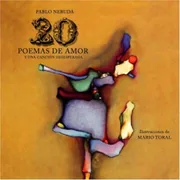
Veinte poemas de amor y una canción desesperada
by Pablo Neruda · 1924
Best for mature teens and adults, since the poems are frankly sensual and dwell on loss.
96 pages, about 1.5 to 2 hours.
Neruda's teenage love poems: sensual, plain-spoken, and aching. 53% taste match
What is inside
Veinte poemas de amor y una canción desesperada is a book of poetry by the Chilean poet Pablo Neruda, first issued in 1924. Neruda was 19 at the time of publication, and the collection marked the start of his reputation as a writer in the Spanish language. It belongs to the tradition of Chilean and Spanish love poetry and runs to roughly 96 pages in a typical edition.
The poems join desire and youthful passion with the pain of loss, drawing on the natural world for much of their imagery. They open with the line "Cuerpo de mujer, blancas colinas, muslos blancos," and keep to a fairly plain vocabulary within the established literary language. Neruda himself described the book as a deliberate move away from grand poetic ambition toward a new manner of writing. The work has appeared in 135 editions and has been translated widely. W. S. Merwin made the English version, which appeared in 1969 as Twenty Love Poems and a Song of Despair.
Cuerpo de mujer, blancas colinas, muslos blancos, te pareces al mundo en tu actitud de entrega.
Period
20th century
Themes
Chilean Love poetryPoesía amorosa chilenaPoesía chilenaChilean poetrySpanish Love poetryPoetry (poetic works by one author)Spanish poetryCriticism and interpretation
- Want to read 364
- Reading now 24
- Read 51
Most people shelving it are saving it for later.
Of 439 readers who put it on a shelf, 83% want to read it, 5% are reading it now, 12% have finished it and 0% stopped before the end.
By the numbers
- The median edition runs 96 pages. Counting about 275 words a page and an adult reading pace of 250 words a minute, that is about 1.8 hours of reading.
- Open Library tracks 135 editions from 84 publishers, the earliest dated 1924 and the latest 2023, across 5 languages.
- On reader demand it ranks in the top 3% of the classic books in our catalog (8,749 of them).
- Libraries shelve it under Dewey 861.62 and Library of Congress class PQ-8097.00000000.N4 V4 1988.
 BookWard’s take
Neruda's teenage love poems: sensual, plain-spoken, and aching
At 96 pages, this is a short book that opens by hitting you with a body: 'Cuerpo de mujer, blancas colinas, muslos blancos.' It grabs you at once, and a reader who wants a hook from the first line will feel at home. Neruda was 19 and chose, by his own account, to trade grand poetic ambition for a new manner, so the language is plainer than the Spanish literary tradition around it, even as the imagery of earth, sea and sky stays rich. The emotion is far from restrained, which may surprise you: desire and loss both run hot. What makes it interesting is that love poetry is old ground, yet the voice is unmistakably his. It is a book of moods, not plot, and it is over fast.
Around 96 pages, it is about as short as a book gets, which suits BookWard's taste for the tight.
Short poems move quickly and rarely linger, though they invite slow rereading, which sits well with BookWard's brisk preference.
The bold metaphors set it apart, but the love-poem tradition it works in keeps it short of wholly new.
The vocabulary is generally simple, yet the metaphors give it a lyrical richness, a touch more ornate than BookWard likes.
There is no plot to drive it; the speaker's longing and loss carry everything, as BookWard prefers.
Youthful passion shares the book with desolation and ends on despair, so it leans sad.
A set of numbered poems plus a closing song is a familiar collection format, not an experimental one.
The book is earnest and aching from start to finish, with little room for comedy.
Grief and desolation shadow the passion, giving it a real but not brutal darkness.
Passion and sorrow are intense and openly expressed, well above BookWard's measured level.
See all 50 dialsEvery position, side by side with this book
Where it lines up
- LengthBookWard 1 · book 1
- Authorial voiceBookWard 9 · book 9
- ExpositionBookWard 2 · book 2
Where it pulls apart
- Internal logicBookWard 10 · book 5
- Familiar tropesBookWard 10 · book 6
- EndingBookWard 8 · book 4
Around 96 pages, it is about as short as a book gets, which suits BookWard's taste for the tight.
It opens on a bodily image in its very first line, which is exactly the instant grab BookWard rewards.
Love and longing are the oldest subjects in poetry, though Neruda's natural-world imagery keeps it from feeling stock.
Poems run on association and mood rather than a built system, so airtight logic is not the point here.
Short poems move quickly and rarely linger, though they invite slow rereading, which sits well with BookWard's brisk preference.
The bold metaphors set it apart, but the love-poem tradition it works in keeps it short of wholly new.
The speaker and the beloved emerge through feeling and image, not through fully drawn portraits.
The closing song of despair lands with a clear emotional finality rather than leaving things dangling.
Passion and grief are laid out openly, so this is warmer and more exposed than BookWard's restrained taste.
The sensuality is frank and the grief is genuine, earned in feeling instead of used for effect.
This is poetry, so the rigor dial does not apply.
Neruda's voice is unmistakable, sensual, metaphor-rich and direct, which is just what BookWard values.
It is led by feeling and image more than by argument or narrative, landing near the middle of the dial.
Nothing is explained outright; feeling arrives through image and metaphor, matching BookWard's love of showing.
At this length there is no room for a middle to sag, and the intensity holds throughout.
The vocabulary is generally simple, yet the metaphors give it a lyrical richness, a touch more ornate than BookWard likes.
There is no plot to drive it; the speaker's longing and loss carry everything, as BookWard prefers.
Youthful passion shares the book with desolation and ends on despair, so it leans sad.
A set of numbered poems plus a closing song is a familiar collection format, not an experimental one.
The book is earnest and aching from start to finish, with little room for comedy.
Simple vocabulary keeps it approachable, though dense metaphor rewards a careful second pass.
One speaker addresses a beloved throughout, giving a single, intimate viewpoint.
The poems move between memory, longing and loss without a strict chronology, so time is loose.
The world is grounded in body, nature and feeling, with metaphor stretching reality only figuratively.
Essentially two figures, the speaker and the beloved, make this about as small as a cast can be.
The scope is one person's inner life and a single love, resolutely intimate.
Almost everything happens inside the speaker's feelings and perceptions, not in outward action.
Poetry here is monologue and address, with essentially no exchanged dialogue.
Love and desire are the whole subject, so romance sits at the very center.
Landscape and sea are familiar elemental images rather than an unfamiliar setting.
Written in 1924, it belongs to the early twentieth century, not the present day.
A century on, it remains one of the most renowned Spanish-language works of its era.
The speaker is candid and direct about feeling, with no sense of deceiving the reader.
It makes no moral case; it simply presents desire and loss, leaving judgment aside.
Bodies and natural imagery are described vividly, giving the poems a rich sensory texture.
The poems are drawn from the poet's most intimate connections, so the perspective is deeply personal.
It stands alone as a single, self-contained collection.
Poems build on mood and image, so surprise comes from metaphor, not plot turns.
It is emotionally frank but accessible, neither a comfort read nor a hard one.
Grief and desolation shadow the passion, giving it a real but not brutal darkness.
Passion and sorrow are intense and openly expressed, well above BookWard's measured level.
The book contains essentially no violence; its pain is emotional.
Eroticism and bodily imagery are central to the poems, though expressed through metaphor.
The collection is concerned with love and grief, not political matters.
The vocabulary is generally simple and keeps to established literary language, so it reads plainly.
The speaker's feelings and judgments color every line, so the narration is anything but neutral.
Longing and loss pull the speaker toward memory more than toward the future.
Romantic ideals of love run through it, tempered by the sorrow of loss.
Review written by BookWard, dial version 1, November 2026.
Who is Veinte poemas de amor y una canción desesperada right for?
Best for mature teens and adults, since the poems are frankly sensual and dwell on loss. Readers new to poetry will find the vocabulary approachable, though the metaphors reward slow reading.
Simple vocabulary keeps it approachable, though dense metaphor rewards a careful second pass.
Grief and desolation shadow the passion, giving it a real but not brutal darkness.
Passion and sorrow are intense and openly expressed, well above BookWard's measured level.
The book contains essentially no violence; its pain is emotional.
Book CompanionVeinte poemas de amor y una canción desesperada: ideas, characters, themes
A teenage poet turns desire and the pain of loss into plain-spoken, nature-soaked love poems that made his name.
- Published in 1924. The collection appeared in June 1924 and launched Neruda to fame when he was only 19.
- A deliberate shift. Neruda described the book as a conscious move away from grand poetic ambition toward a new way of writing.
- Simple words, literary tradition. The vocabulary is generally simple but belongs to the conventional literary language shaped by Romanticism and Modernism.
- Nature and the body. Eroticism and the natural world are woven together, and the first poem opens with an image of a woman's body.
- Passion against grief. The collection sets youthful passion beside the desolation of loss, ending with a song of despair.
Themes
Physical and emotional longing drives the poems and shapes their imagery.
The pain of separation and grief shadows the passion and gives the book its ache.
Landscape and elements serve as the vocabulary for feeling and the body.
The intensity and rawness come from a poet writing at 19.
Neruda's chosen simplicity stands against the grand poetic ambition of earlier work.
Discussion questions
- How does the opening image set the tone for everything that follows?
- Where does simple vocabulary create more force than ornate language would?
- How do natural images stand in for the body and for emotion?
- What changes between the love poems and the closing song of despair?
- Does knowing the poet was 19 change how you read the passion and the grief?
Personalize your Book Companion
This is the general edition. In BookWard, the Companion is written for you: your reading profile, your notes, and spoiler-safe to the page you are on.
Buy, listen or borrow Veinte poemas de amor y una canción desesperada
Each link opens a search for this book on that store, in a new tab.
Read on a device
Borrow
Reviews and community
If you liked Veinte poemas de amor y una canción desesperada
A memoir of love and addiction told from inside the wreckage
Giovanni's RoomJames BaldwinA short, devastating confession of love and denial in Paris
RebeccaDaphne du MaurierA Gothic classic where a dead woman outshines the living
Bonjour tristesseFrançoise SaganA short, cool summer of a teenage girl's schemes
Sources: Open Library.
Track Veinte poemas de amor y una canción desesperada and find your next favorite
Add it to your shelf, rate what you have read, and BookWard will recommend what fits you.
Free to start. No credit card needed.