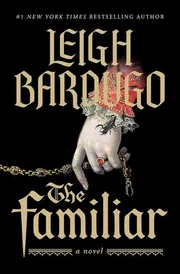
The Familiar
by Leigh Bardugo · 2024
Suits adult and older teen readers who enjoy historical fantasy and romance.
400 pages, about 6.5 to 9.5 hours.
A scullion's small miracles meet Inquisition-era court intrigue in Madrid. 58% taste match
The story
The Familiar is a historical fantasy novel by Leigh Bardugo, first published in 2024 by Flatiron Books and running about 400 pages. It stands on its own and is not part of a series.
The story is set in Madrid, the new capital, during the years when the pyres of the Inquisition were burning. Luzia Cotado works as a scullion in a shabby house, where she relies on small scraps of magic to get through long days of toil. When her scheming mistress learns that Luzia has a talent for little miracles, she insists that the girl use it to win favor at the royal court. Luzia sees a chance to improve her fortunes and enters a world of nobles hungry for power, desperate kings, holy men and seers, where magic, science and fraud are hard to tell apart. To succeed she must draw on her wit and resilience while keeping the truth of her ancestry hidden.
The book falls within literary and general fiction and belongs to American literature, blending court intrigue with magic in an earlier century.
- Want to read 14
- Read 13
Readers are split between finishing it and saving it for later.
Of 27 readers who put it on a shelf, 52% want to read it, 0% are reading it now, 48% have finished it and 0% stopped before the end.
By the numbers
- The median edition runs 400 pages. Counting about 275 words a page and an adult reading pace of 250 words a minute, that is about 7.3 hours of reading.
- Open Library tracks 9 editions from 5 publishers, the earliest dated 2024 and the latest 2025.
- On reader demand it ranks in the top 20% of the recent releases books in our catalog (1,627 of them).
- Libraries shelve it under Library of Congress class PS-3602.00000000.A775325F36.
 BookWard’s take
A scullion's small miracles meet Inquisition-era court intrigue in Madrid
The Familiar is a historical fantasy set in Madrid while the Inquisition's pyres burn, and it stands alone at about 400 pages. Luzia Cotado, a scullion with a gift for little miracles, is pushed by her scheming mistress into the royal court. A servant girl with hidden magic is well-worn ground, though the setting and its real history give it a distinct edge. The magic needs to be consistent, because magic, science and fraud blur at court and the rules have to hold. Character is a draw, with Luzia's wit and resilience carrying the story. The ending is the part to watch, as is the pacing through the middle. Expect rich description of a vivid era.
At about 400 pages it is moderate, shorter than most historical fantasy, which suits BookWard's taste for tight books.
Court intrigue and danger keep things moving, a little under BookWard's brisk preference.
The real history of the Inquisition gives it a distinct flavor, though the core setup is recognizable.
Lush, sensory writing leans ornate, a little richer than BookWard's middling preference.
Luzia's rise and secrets drive events, so plot and character are balanced, close to BookWard's lean.
Fate can be changed, but persecution looms, so it holds hope and dread in balance.
A conventional, forward-moving telling of Luzia's story, close to BookWard's mildly traditional taste.
The tone is serious and perilous, a world where ambition proves deadly, so humor is secondary.
The Inquisition's pyres and deadly ambition make it dark, a touch beyond BookWard's middle ground.
Stakes, romance and fear make it emotionally charged, a bit stronger than BookWard's measured taste.
See all 50 dialsEvery position, side by side with this book
Where it lines up
- Story or ideasBookWard 3 · book 3
- Character depthBookWard 8 · book 7
- EndingBookWard 8 · book 7
Where it pulls apart
- Familiar tropesBookWard 10 · book 5
- Internal logicBookWard 10 · book 7
- LengthBookWard 1 · book 3
At about 400 pages it is moderate, shorter than most historical fantasy, which suits BookWard's taste for tight books.
A scullion hiding magic in a shabby Madrid house sets up the premise fast, close to BookWard's love of immediate openings.
The hidden-gift servant is a familiar shape, but the Inquisition setting sharpens it; BookWard wants fewer tropes.
Magic sits beside science and fraud at court, so the rules need to hold, which BookWard prizes.
Court intrigue and danger keep things moving, a little under BookWard's brisk preference.
The real history of the Inquisition gives it a distinct flavor, though the core setup is recognizable.
Luzia's wit, resilience and hidden ancestry point to a drawn protagonist, which BookWard values.
Romance and ambition run through it, so it can feel warmer than BookWard's restrained preference.
Danger and persecution are built into the setting, which gives its darkness a reason to be there.
Bardugo's prose has a recognizable richness, in line with BookWard's appetite for a distinctive voice.
This is story-led, driven by Luzia's fortunes at court, which fits BookWard's story-first lean.
Court and magic systems need some explaining, though mostly through scene, near BookWard's show-don't-tell leaning.
Court intrigue gives it plenty to keep moving, though a book this long can loosen in the middle.
Lush, sensory writing leans ornate, a little richer than BookWard's middling preference.
Luzia's rise and secrets drive events, so plot and character are balanced, close to BookWard's lean.
Fate can be changed, but persecution looms, so it holds hope and dread in balance.
A conventional, forward-moving telling of Luzia's story, close to BookWard's mildly traditional taste.
The tone is serious and perilous, a world where ambition proves deadly, so humor is secondary.
Historical detail and court politics ask some attention but stay approachable.
The story centers on Luzia, with the familiar's own perspective adding a second voice, so it stays fairly focused.
The story moves forward through events at court, in line with BookWard's mostly linear preference.
Magic, an immortal familiar and little miracles mean it leans fantastical against a real historical backdrop.
Nobles, kings, holy men, seers and a mistress make for a sizable court cast, a bit larger than BookWard prefers.
Court and kingdom stakes widen the scope, yet the heart stays on one woman's survival.
Luzia's schemes and survival mix action with her inner struggle, near BookWard's inner-leaning taste.
Court scheming and bargains between Luzia and others run on conversation, near BookWard's dialogue-friendly side.
Described as deeply romantic, and the bond with the familiar is central, more so than BookWard prefers.
Inquisition-era Madrid is an unfamiliar setting to most readers, which BookWard enjoys.
It is set centuries ago, so it sits at the past end of the dial.
Ambition, persecution and hidden identity are enduring themes, so it should age well, as BookWard favors.
A straightforward third-person telling with no hint of unreliability, unlike BookWard's taste for unreliable narrators.
Nobles, fraud and survival blur right and wrong, so morality is not clear-cut, as BookWard enjoys.
Lush, sensory depiction of Madrid and its court puts it on the rich side, above BookWard's moderate taste.
It is a standalone, which suits BookWard's preference for self-contained books.
Hidden ancestry and the familiar's secrets promise reveals, in line with BookWard's taste for surprises.
Persecution and danger bring tension, yet it remains an engaging adventure rather than a punishing one.
The Inquisition's pyres and deadly ambition make it dark, a touch beyond BookWard's middle ground.
Stakes, romance and fear make it emotionally charged, a bit stronger than BookWard's measured taste.
Humor is minor and dry when it appears, in keeping with BookWard's modest taste.
The Inquisition's pyres imply real brutality, though the story is not built around gore.
A romantic thread brings some sensuality, but it is not the focus.
Royal court power plays and religious persecution give it a strong political backbone, above BookWard's middle.
Historical flavor is present, but the language stays accessible rather than dense.
The narration is mostly neutral and immersive, a touch less opinionated than BookWard's slight lean.
It looks back at a historical era, unlike BookWard's mild forward lean.
Luzia's resilience and the chance to change fate point to a hopeful current, near BookWard's idealistic lean.
Review written by BookWard, dial version 1, November 2026.
Who is The Familiar right for?
Suits adult and older teen readers who enjoy historical fantasy and romance. Expect religious persecution, threat of burning and some sensuality.
Historical detail and court politics ask some attention but stay approachable.
The Inquisition's pyres and deadly ambition make it dark, a touch beyond BookWard's middle ground.
Stakes, romance and fear make it emotionally charged, a bit stronger than BookWard's measured taste.
The Inquisition's pyres imply real brutality, though the story is not built around gore.
Book CompanionThe Familiar: ideas, characters, themes
A servant with hidden magic uses her gift to rise at the Spanish court while the Inquisition threatens anyone who is different.
- A scullion with a secret. Luzia Cotado works in a shabby Madrid house, using scraps of magic to get through her endless labor.
- A mistress with plans. When her scheming mistress discovers Luzia's talent for little miracles, she demands Luzia use it to win over the royal court.
- A court of power and peril. Nobles, desperate kings, holy men and seers surround her, and magic, science and fraud are hard to tell apart.
- The shadow of the Inquisition. With the pyres burning, Luzia must hide the truth of her ancestry while winning fame.
- An immortal familiar. She enlists an embittered immortal familiar whose own secrets could cost her everything.
Characters
Luzia Cotado
Protagonist
A scullion with a gift for little miracles who must survive and win favor at court while hiding her ancestry.
The familiar
Immortal ally
An embittered immortal whose help is useful and whose secrets are dangerous.
Luzia's mistress
Schemer
The woman who discovers Luzia's talent and pushes her toward the royal court for her own ends.
Themes
How far a woman will go to better her fortunes, and what it costs.
The danger of being different when the Inquisition is burning people.
The weight of concealing one's ancestry to survive.
How faith, fraud and genuine power blur at court.
Whether curses can be broken and destiny rewritten.
Discussion questions
- How does Luzia's lowly position shape the choices she makes at court?
- Where do magic, science and fraud overlap, and who benefits from the confusion?
- What does hiding her ancestry cost Luzia, and what does it protect?
- How does the bond with the familiar change as secrets surface?
- Does the book treat ambition as admirable, dangerous, or both?
Personalize your Book Companion
This is the general edition. In BookWard, the Companion is written for you: your reading profile, your notes, and spoiler-safe to the page you are on.
Buy, listen or borrow The Familiar
Each link opens a search for this book on that store, in a new tab.
Read on a device
Borrow
Reviews and community
If you liked The Familiar
A grieving enslaved girl, a sister's spirit, and a plantation's secrets
Lady MacbethAva ReidShakespeare's villainess gets a voice, a past, and real magic
The Woods All BlackLee MandeloA short, haunted Appalachian novella with a queer nurse at its center
Blood on Her TongueJohanna van VeenA twin, a corpse, and a hunger that may not be madness
Sources: Open Library.
Track The Familiar and find your next favorite
Add it to your shelf, rate what you have read, and BookWard will recommend what fits you.
Free to start. No credit card needed.