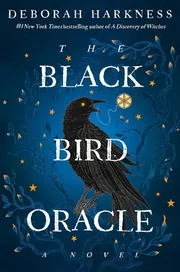
The Black Bird Oracle
by Deborah Harkness · 2024
Suited to adult and older teen readers who enjoy fantasy with family drama.
464 pages, about 7.5 to 11 hours.
A witch goes home to Ravenswood and her family's dark past. 44% taste match
The story
The Black Bird Oracle is a fantasy novel by Deborah Harkness, first published in 2024 and running to about 464 pages. It is the fifth book in her All Souls series, which began with A Discovery of Witches and follows Diana Bishop, an Oxford scholar and witch, and Matthew de Clairmont, a vampire geneticist. Earlier volumes centered on the search for the enchanted manuscript Ashmole 782, a journey into Elizabethan England, and the end of the Covenant that had long kept witches, vampires and daemons apart.
This installment finds the couple living with their seven-year-old twins, Pip and Rebecca. The Congregation has formally demanded that the children's magic be tested. Worried for their safety, and determined to avoid the choice that led her own parents to spellbind her, Diana decides to take her family in a new direction. She responds to a message from a great-aunt she did not know she had, Gwyneth Proctor, who asks her to come home. The trip leads Diana to Ravenswood and into the history of her own family line. The book has appeared in seven editions.
By the numbers
- The median edition runs 464 pages. Counting about 275 words a page and an adult reading pace of 250 words a minute, that is about 8.5 hours of reading.
- Open Library tracks 7 editions from 3 publishers, the earliest dated 2024 and the latest 2025.
- On reader demand it ranks in the top 38% of the recent releases books in our catalog (1,627 of them).
- Libraries shelve it under Dewey 813.6 and Library of Congress class PS-3608.00000000.A7436B56 2024.
 BookWard’s take
A witch goes home to Ravenswood and her family's dark past
The fifth All Souls novel is a series book through and through, so it asks for the earlier four. The premise is clear and quick to start: the Congregation demands that Diana and Matthew's seven-year-old twins be tested, and a great-aunt's message pulls Diana toward Ravenswood. This is a thoroughly series-dependent entry, and it leans on familiar tropes, with witches, vampires and inherited power all front and center rather than avoided. Character depth is the draw. Diana's reckoning with her family line and her own fear of power drives the book, so it reads as character-led more than plot-led. At 464 pages, it runs long. A good fit for readers already invested in Diana and Matthew; a poor starting point for anyone new.
At about 464 pages it runs long, well past BookWard's preference for tight books.
A family-and-history story with a return to a family home suggests a measured pace, slower than BookWard likes.
The series premise was fresh, but this installment works inside an established template, short of BookWard's high bar.
Rich, scholarly texture runs more ornate than BookWard's plainer preference.
Diana's inner reckoning and family past drive the book more than external plot.
The invitation home and a fresh path for the family tilt it hopeful, in line with BookWard.
A conventional, linear series structure, close to BookWard's middle.
The premise reads serious and family-centered, with little comedy, below BookWard's lean toward funny.
The book goes into dark places of family history, but within a fantasy-romance register.
Fears about the children and Diana's reckoning with her past give it real emotional weight.
See all 50 dialsEvery position, side by side with this book
Where it lines up
- Character depthBookWard 8 · book 7
- Story or ideasBookWard 3 · book 4
- EndingBookWard 8 · book 6
Where it pulls apart
- LengthBookWard 1 · book 7
- Familiar tropesBookWard 10 · book 4
- OpeningBookWard 10 · book 6
At about 464 pages it runs long, well past BookWard's preference for tight books.
The Congregation's demand and the great-aunt's message give it a clear start, though it builds rather than grabs at once.
Witches, vampires and inherited power are familiar territory, so it sits below BookWard's love of avoiding tropes.
A long-running series built on established rules for its three species gives it reasonably consistent internal logic.
A family-and-history story with a return to a family home suggests a measured pace, slower than BookWard likes.
The series premise was fresh, but this installment works inside an established template, short of BookWard's high bar.
Diana's confrontation with her family past and her fear of power puts character at the center, close to BookWard's taste.
Family, children and belonging are core, so warmth leans toward the sentimental side of BookWard's restraint.
The darkness is tied to family history rather than shock, though it is not tested against BookWard's strict standard.
A novel, so the nonfiction rigor dial does not apply.
Harkness's scholar-witch world has a recognizable feel, though not an unusually distinctive voice.
Story-led: it follows Diana, her family and a reckoning with the past, not an argument.
A fifth series entry has plenty of backstory to carry, so more is explained outright than BookWard prefers.
A family-history and training story across 464 pages risks some slack in the middle.
Rich, scholarly texture runs more ornate than BookWard's plainer preference.
Diana's inner reckoning and family past drive the book more than external plot.
The invitation home and a fresh path for the family tilt it hopeful, in line with BookWard.
A conventional, linear series structure, close to BookWard's middle.
The premise reads serious and family-centered, with little comedy, below BookWard's lean toward funny.
Accessible prose but a heavy dependence on series history makes it moderately demanding for newcomers.
A forward-moving present story with family history in the background, so mostly linear.
Witches, vampires and magic make it solidly fantastical, above BookWard's middle.
Diana, Matthew, the twins, Gwyneth and the Congregation, plus earlier-book figures, make a fairly large cast.
Family, home and personal power keep it nearer intimate than epic.
Diana's confrontation with herself and her lineage points the book toward inner life.
Diana and Matthew's marriage is part of the story, but the focus is family and power.
The hidden world of witches and vampires, plus Ravenswood, is unfamiliar territory for most readers.
Set in the present with the twins as children, though history runs through it.
Tied closely to its series, so its staying power depends on the earlier books.
Nothing suggests an unreliable narrator; it reads as straightforward.
Magic, power and family duty leave some gray area, but not much ambiguity.
Ravenswood and a magical world invite rich, atmospheric detail.
The fifth All Souls novel, so it is firmly part of a series and not a place to start.
Largely comforting for series fans, with some tension around the children's safety.
The book goes into dark places of family history, but within a fantasy-romance register.
Fears about the children and Diana's reckoning with her past give it real emotional weight.
Humor is minor here; what exists is likely dry.
The Congregation's demand adds menace, but the focus is not on violence.
The couple's bond is established, but intimacy is not the center.
The Congregation's authority over magic adds political texture, though it is not the focus.
Plain, readable language for a mainstream fantasy.
Neutral storytelling that stays close to its characters.
A return home and a reckoning with family history point backward as much as forward.
Diana forging a new path for her family leans idealistic.
Review written by BookWard, dial version 1, November 2026.
Who is The Black Bird Oracle right for?
Suited to adult and older teen readers who enjoy fantasy with family drama. It centers on children facing a formal test and touches on dark family history, which some readers may find tense.
Accessible prose but a heavy dependence on series history makes it moderately demanding for newcomers.
The book goes into dark places of family history, but within a fantasy-romance register.
Fears about the children and Diana's reckoning with her past give it real emotional weight.
The Congregation's demand adds menace, but the focus is not on violence.
Book CompanionThe Black Bird Oracle: ideas, characters, themes
Diana, facing a Congregation demand to test her twins' magic, goes to her family's ancestral home to confront her family's dark past and her own fear of power.
- The Congregation's demand. Diana and Matthew must have their seven-year-old twins, Pip and Rebecca, tested, which sets the story in motion.
- A different path. Diana wants to avoid the fate that led her parents to spellbind her, so she chooses a new direction for her family.
- A message from a great-aunt. Gwyneth Proctor, a relative Diana never knew existed, invites her home.
- Ravenswood. The Proctor family home is where Diana begins a new era and confronts her lineage.
- Fear of power. Diana's reckoning involves her desire for greater power and her fear of using it.
Characters
Diana Bishop
Protagonist
An Oxford scholar and witch who returns to her family's home and her family's past.
Matthew de Clairmont
Diana's husband
A vampire geneticist and parent to the twins.
Gwyneth Proctor
Diana's great-aunt
A talented witch grounded in higher magic who invites Diana home and guides her.
Pip and Rebecca
The twins
Diana and Matthew's seven-year-old children, whose magic the Congregation wants tested.
Themes
What parents and ancestors pass down, including secrets and burdens.
The pull between keeping the twins safe and meeting outside demands.
The struggle to wield great ability without being ruled by fear.
Returning to a place and history that shape who you are.
The Congregation's demands set against a family's right to choose its own path.
Discussion questions
- Why does Diana choose a different path from the one her parents took?
- How does the Congregation's demand shape Diana and Matthew's choices?
- What does Diana's fear of power say about her?
- What role does Ravenswood play in Diana's reckoning?
- How much does the book depend on knowing the earlier All Souls novels?
Personalize your Book Companion
This is the general edition. In BookWard, the Companion is written for you: your reading profile, your notes, and spoiler-safe to the page you are on.
Buy, listen or borrow The Black Bird Oracle
Each link opens a search for this book on that store, in a new tab.
Read on a device
Borrow
Reviews and community
If you liked The Black Bird Oracle
A superhero origin story where the heroes might be the problem
City of Fallen AngelsCassandra ClareA romance-heavy sequel that leans on familiar supernatural ground
LodestarShannon MessengerA long, loyalty-testing middle grade fantasy deep in a series
The Courting of Bristol KeatsMary E. PearsonA fae romantasy that trades a quiet town for a dangerous bargain
Sources: Open Library.
Track The Black Bird Oracle and find your next favorite
Add it to your shelf, rate what you have read, and BookWard will recommend what fits you.
Free to start. No credit card needed.