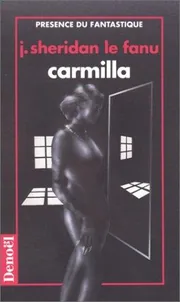
Carmilla
by Sheridan Le Fanu · 1871
Not to be confused with Amy Chu’s book of the same title (2023).
Suited to teens and adults who enjoy classic Gothic fiction.
90 pages, about 1.5 to 2 hours.
A short, strange vampire tale that still unsettles after 150 years. 57% taste match
The story
Carmilla is a Gothic horror novella by the Irish author Sheridan Le Fanu, first issued in installments in The Dark Blue in 1871 and 1872 before appearing in his collection In a Glass Darkly. It sits among the foundational works of English-language vampire fiction and came out some 25 years ahead of Bram Stoker's Dracula. The text frames the story as a manuscript left behind with notes by Doctor Hesselius, who links it to an essay of his own on the subject.
The setting is 19th-century Styria, in Austria, with Gratz among the places named. A young woman tells of the visitor who comes into her life, a female vampire called Carmilla, who is later revealed to be Mircalla, Countess Karnstein. The name Carmilla is an anagram of Mircalla. The vampire's affection for the narrator is romantic in tone, and the story treats it without casting it as a mark of villainy, which has made Carmilla a literary forerunner of the lesbian vampire in fiction. Short at about 90 pages, it has been widely anthologised and adapted for film and other media.
Sobre una hoja de papel adherida a la narración que sigue, el doctor Hesselius ha escrito una nota bastante elaborada, nota que acompaña con una referencia a un ensayo suyo sobre el extraño tema iluminado por el presente manuscrito.
Characters
Carmilla
Setting
GratzStyriaStyria (Austria)
Period
19th century
Themes
LesbiansVampiresHorrorPr4879.l7 c3 2013823/.8Pr4879.l7 c3 2009Horror tales
- Want to read 626
- Reading now 32
- Read 114
Most people shelving it are saving it for later.
Of 772 readers who put it on a shelf, 81% want to read it, 4% are reading it now, 15% have finished it and 0% stopped before the end.
By the numbers
- The median edition runs 90 pages. Counting about 275 words a page and an adult reading pace of 250 words a minute, that is about 1.6 hours of reading.
- Open Library tracks 571 editions from 74 publishers, the earliest dated 1871 and the latest 2025, across 6 languages.
- On reader demand it ranks in the top 1% of the classic books in our catalog (8,749 of them).
- Libraries shelve it under Dewey [Fic] and Library of Congress class PR-4879.00000000.L7 C3 2009b.
 BookWard’s take
A short, strange vampire tale that still unsettles after 150 years
Carmilla is a Gothic novella of about 90 pages, and its brevity is the point. It predates Dracula by 25 years and gives the vampire story one of its founding shapes, told through a young woman's account of the visitor who enters her life. The short form leaves no room to sag, and the framing manuscript with Doctor Hesselius gives the strangeness an orderly shell, so the logic of the thing holds together. It relies more on mood than on momentum, though, and the pace is slow and the prose ornate, which some readers will find heavy going. Its treatment of Carmilla's romantic pull, never framed as villainy, keeps the moral picture ambiguous. A compact classic worth an evening.
At about 90 pages it is as tight as a book gets, which suits BookWard's preference for short, lean reading.
It moves at a measured nineteenth-century gait, quicker than a long Gothic novel but slower than BookWard's preferred pace.
As a foundational vampire story that predates Dracula, it set patterns rather than following them, which BookWard rewards.
The nineteenth-century diction runs ornate and formal, richer than the plain style BookWard leans toward.
The visitor's effect on the narrator drives events, so character and plot are closely entwined.
This is a tale of predation and dread, and it leans toward the bleak.
The found-manuscript frame with Doctor Hesselius gives it a mildly unconventional shape for its time.
It is a serious Gothic horror with no comic aim.
Its subject of predation is dark, though the telling is restrained by period convention.
Longing and fear run through the narrator's account, giving it real feeling under the formal surface.
See all 50 dialsEvery position, side by side with this book
Where it lines up
- LengthBookWard 1 · book 1
- Story or ideasBookWard 3 · book 3
- Sagging middleBookWard 8 · book 8
Where it pulls apart
- OpeningBookWard 10 · book 4
- Familiar tropesBookWard 10 · book 6
- Internal logicBookWard 10 · book 7
At about 90 pages it is as tight as a book gets, which suits BookWard's preference for short, lean reading.
It opens with a framing note about a manuscript rather than a jolt, so the pull builds gradually instead of arriving at once.
Its tropes became the genre's clichés later, though here they are the originals, so they read fresher than the copies that followed.
The framed manuscript and its steady, ordered unfolding give the uncanny events a consistent internal footing.
It moves at a measured nineteenth-century gait, quicker than a long Gothic novel but slower than BookWard's preferred pace.
As a foundational vampire story that predates Dracula, it set patterns rather than following them, which BookWard rewards.
The narrator and her visitor are drawn with enough shading to intrigue, though the form keeps them somewhat archetypal.
Feeling is expressed in the period's heightened, romantic register, so it reads as more emotive than restrained.
The horror comes from dread and implication within the plot rather than gore, so its darkness feels earned.
This is a work of fiction, so rigor does not apply.
The period narration and the framing device give it a recognizable Gothic voice, if one shared with its era.
It is a story-led tale of a visitor and her narrator, with the ideas carried by the plot rather than argued.
The framing note and the narrator's account explain a fair amount, though much of the unease is left to scenes.
At novella length there is little room for a middle to slacken, so the tension holds from start to finish.
The nineteenth-century diction runs ornate and formal, richer than the plain style BookWard leans toward.
The visitor's effect on the narrator drives events, so character and plot are closely entwined.
This is a tale of predation and dread, and it leans toward the bleak.
The found-manuscript frame with Doctor Hesselius gives it a mildly unconventional shape for its time.
It is a serious Gothic horror with no comic aim.
It is short and readable, though period prose asks a little patience from a modern reader.
The story is told by a single young woman, so it holds one viewpoint throughout.
Events are recounted in order by the narrator, with the framing note as the only departure.
Vampirism sits at the center of the story, so the supernatural is front and center.
It keeps a small circle of characters, which fits the intimate scale of the telling.
The drama plays out in a confined domestic sphere rather than across a wide stage.
The tale lives in the narrator's perceptions and unease more than in outward action.
Conversation between the narrator and her visitor carries a good share of the story.
The vampire's affection for the narrator is romantic in tone and gives the story much of its charge.
The Styrian setting in Austria is distant from most readers' lives and adds to the story's strangeness.
First published in 1871 and set in the nineteenth century, it comes from well in the past.
Its influence on vampire fiction and its many adaptations show it has outlasted its moment.
The narrator tells her own story as a recollection, and what she makes of her visitor deserves scrutiny.
The story does not cast the vampire's romantic desire as villainy, leaving the moral picture subtle and ambiguous.
Atmosphere and setting are rendered in rich period detail that builds the Gothic mood.
It stands alone as a single novella, though it also appears in the collection In a Glass Darkly.
The reveal of Carmilla as Mircalla is a notable turn, but the story is not built on a string of surprises.
It unsettles without being hard going, offering more eeriness than real difficulty.
Its subject of predation is dark, though the telling is restrained by period convention.
Longing and fear run through the narrator's account, giving it real feeling under the formal surface.
Romantic and erotic charge is present but subtle, with little explicit content.
The story is concerned with the uncanny rather than any political argument.
The nineteenth-century phrasing is formal and dense in places, a step up from plain modern prose.
The narrator tells the tale without pressing a view on the reader.
The story is steeped in an old Gothic past and looks backward rather than forward.
Review written by BookWard, dial version 1, November 2026.
Who is Carmilla right for?
Suited to teens and adults who enjoy classic Gothic fiction. It contains themes of predation and a romantic tension between women handled subtly, with little graphic content.
It is short and readable, though period prose asks a little patience from a modern reader.
Its subject of predation is dark, though the telling is restrained by period convention.
Longing and fear run through the narrator's account, giving it real feeling under the formal surface.
Book CompanionCarmilla: ideas, characters, themes
A young woman recounts the visitor who enters her life, a female vampire whose affection is both intimate and predatory.
- The framing note. The story opens with Doctor Hesselius's note on a manuscript, presenting it as a documented account.
- A foundational vampire. It came out some 25 years before Dracula and shaped the vampire tale in English.
- The setting. The action takes place in 19th-century Styria, in Austria, giving it a remote and foreign feel.
- A hidden identity. Carmilla is later revealed to be Mircalla, Countess Karnstein, and the name is an anagram.
- Romantic tone. The vampire's affection for the narrator is romantic, and the story does not cast it as a mark of villainy.
Characters
Carmilla
The vampire
A female vampire who enters the narrator's life and is later revealed to be Mircalla, Countess Karnstein.
The narrator
The teller
A young woman who recounts the story of the visitor who preys upon her.
Doctor Hesselius
The framing figure
The writer of the note attached to the manuscript, who links it to his own essay on the subject.
Themes
The pull between the narrator and her visitor, treated without condemnation.
The way affection and danger are intertwined in the vampire's attention.
Carmilla's hidden name shows how a self can be disguised.
Dread built from mood and implication rather than spectacle.
Discussion questions
- How does the framing note from Doctor Hesselius change the way you read the account that follows?
- Why might the story avoid casting the vampire's romantic desire as villainy?
- What does the anagram of Carmilla's name suggest about disguise and identity?
- How does the Styrian setting add to the atmosphere of the tale?
- How does reading it now compare with the vampire stories that came after it?
Personalize your Book Companion
This is the general edition. In BookWard, the Companion is written for you: your reading profile, your notes, and spoiler-safe to the page you are on.
Buy, listen or borrow Carmilla
Each link opens a search for this book on that store, in a new tab.
Read on a device
Borrow
Reviews and community
If you liked Carmilla
A slim 1895 horror collection built around a play that ruins its readers
MarinaCarlos Ruiz ZafónA gothic Barcelona mystery that blends ghosts, memory and first love
My Darling Dreadful ThingJohanna van VeenA queer gothic haunting with a seance table and a murder
The Woods All BlackLee MandeloA short, haunted Appalachian novella with a queer nurse at its center
Sources: Open Library.
Track Carmilla and find your next favorite
Add it to your shelf, rate what you have read, and BookWard will recommend what fits you.
Free to start. No credit card needed.