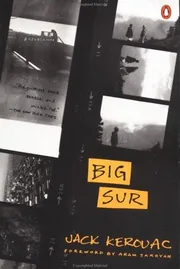
Big Sur
by Jack Kerouac, Tom Parker · 1962
Best for adult readers or mature older teens, since it deals openly with heavy drinking and mental breakdown.
232 pages, about 3.5 to 5.5 hours.
Kerouac's short, raw account of fame, drink and retreat. 50% taste match
What is inside
Big Sur is a 1962 novel by Jack Kerouac, part of the autobiographical fiction he built around the Beat generation. The narrator is Jack Duluoz, a stand-in for the author, who is now a published writer with a public name. Wanting distance from the attention that comes with it, he plans a quiet return to San Francisco and a stay at a cabin in the Big Sur woods, with chopping wood, hauling water, writing and hiking on the agenda.
The book follows his three short stays at the cabin in Bixby Canyon, California, a place belonging to a friend from the Beat circle. Alongside the retreat runs a harder story of heavy drinking and a failing state of mind. Kerouac wrote it in the fall of 1961 over about ten days, typing onto a teletype roll. It differs from his earlier novels in this series, which usually cast him as a wandering bohemian, by showing its central figure as a known author. The edition runs to roughly 232 pages and has been reissued in many printings.
Characters
Jack Kerouac
Setting
Big SurSanfransico
Period
1950
Themes
Alcoholic psychosesBeat generationBeats (Persons)Psicosis alcohólicasFicciónNovela autobiográficaLiterary collectionsAmerican literature
- Want to read 39
- Read 26
Readers are split between finishing it and saving it for later.
Of 65 readers who put it on a shelf, 60% want to read it, 0% are reading it now, 40% have finished it and 0% stopped before the end.
By the numbers
- The median edition runs 232 pages. Counting about 275 words a page and an adult reading pace of 250 words a minute, that is about 4.3 hours of reading.
- Open Library tracks 50 editions from 31 publishers, the earliest dated 1962 and the latest 2023, across 5 languages.
- On reader demand it ranks in the top 18% of the classic books in our catalog (8,749 of them).
- Libraries shelve it under Dewey 823.91 and Library of Congress class PS-3521.00000000.E735 B5 1981.
 BookWard’s take
Kerouac's short, raw account of fame, drink and retreat
Big Sur is Kerouac at his most exposed. Jack Duluoz, now a famous author, escapes to a cabin in Bixby Canyon, and the quiet he wanted turns into a slow unraveling. It was written in about ten days on a teletype roll, and it reads that way: the prose runs plain, then bursts into ornate, long rolling sentences, and the voice is unmistakable. It is also a confessional book rather than a restrained one, and the sentiment spills over instead of being held in check. The pace comes in waves rather than a steady drive, and the outlook is bleak where I tend to lean hopeful. It rewards readers who want character depth through one raw, unreliable mind rather than plot. The ending is open and unresolved, a mood more than a verdict.
At 232 pages it is compact, close to BookWard's taste for tight books.
Three short stays move in surges and lulls, a little slower overall than BookWard likes.
A confessional novel built on Kerouac's own breakdown feels distinctive, though it stays within his familiar autobiographical series.
Long, spilling sentences lean ornate, richer than BookWard's middle-of-the-road taste.
Everything flows from one man's inner state, even more character-driven than BookWard's lean.
Despair and decline dominate, well below BookWard's leaning toward hope.
The loose, spontaneous teletype-roll style departs from conventional shaping, a little more than BookWard favors.
A few wry moments surface, but the book is serious at heart, short of BookWard's humor.
Heavy drinking and collapsing mental health give it a dark core, darker than BookWard's midpoint.
Feeling runs high and unfiltered throughout, more intense than BookWard's mid-range taste.
See all 50 dialsEvery position, side by side with this book
Where it lines up
- Character depthBookWard 8 · book 8
- Authorial voiceBookWard 9 · book 10
- Story or ideasBookWard 3 · book 4
Where it pulls apart
- Internal logicBookWard 10 · book 4
- OpeningBookWard 10 · book 6
- Familiar tropesBookWard 10 · book 6
At 232 pages it is compact, close to BookWard's taste for tight books.
The retreat premise draws you in, though the book builds as much through mood as through a sharp opening.
The famous-writer-seeks-solitude setup is familiar, but Kerouac's candid handling keeps it from feeling stock.
The narrative follows a drinker's fraying mind, so events blur and loosen, short of BookWard's airtight ideal.
Three short stays move in surges and lulls, a little slower overall than BookWard likes.
A confessional novel built on Kerouac's own breakdown feels distinctive, though it stays within his familiar autobiographical series.
Duluoz is drawn from the inside with unflinching honesty, matching BookWard's appetite for deeply drawn people.
It closes on a state of mind rather than a clean resolution, more open than BookWard prefers.
Raw feeling pours out with little restraint, running warmer than BookWard's preferred reserve.
The darkness comes from real alcoholic decline and earns its weight rather than serving as spectacle.
This is a novel, so the rigor dial does not apply.
Kerouac's rolling, spontaneous voice is unmistakable, squarely where BookWard places its highest value.
It is led by lived experience and a single unraveling arc more than by an argument, close to BookWard's story lean.
Duluoz narrates his state of mind outright, so more is explained than BookWard likes.
The three-stay structure mostly sustains tension, though quieter stretches can drift.
Long, spilling sentences lean ornate, richer than BookWard's middle-of-the-road taste.
Everything flows from one man's inner state, even more character-driven than BookWard's lean.
Despair and decline dominate, well below BookWard's leaning toward hope.
The loose, spontaneous teletype-roll style departs from conventional shaping, a little more than BookWard favors.
A few wry moments surface, but the book is serious at heart, short of BookWard's humor.
The dense, rushing prose and mental fog ask some effort, a touch more than BookWard prefers.
Everything is filtered through Duluoz alone, narrower than BookWard's taste for multiple viewpoints.
The three stays run in order, keeping the timeline mostly linear, in line with BookWard's tolerance.
Grounded entirely in real events, woods and drinking, below BookWard's mild fantastical lean.
A few Beat friends orbit one central figure, a small cast that suits BookWard's middle taste.
A cabin, a canyon and one mind keep it intimate, more so than BookWard's balanced scale.
Almost all the action happens in thought and perception, far inward of BookWard's balance.
Conversation among friends appears but the narration carries most weight, a bit lighter than BookWard's dialogue preference.
Relationships matter in the background, but romance is not the center, near BookWard's middle.
Bixby Canyon and 1950s San Francisco Beat circles feel distinct, fitting BookWard's liking for unfamiliar settings.
Set around 1960 and rooted in that era, well behind BookWard's present-day lean.
Fame, addiction and the wish to escape still land, close to BookWard's staying-power taste.
Duluoz's drink-clouded account asks you to question what he sees, matching BookWard's taste for unreliable narrators.
Duluoz is neither excused nor condemned, leaving its judgments murky in a way BookWard welcomes.
The canyon and the woods are rendered richly, more than BookWard's moderate preference.
This is fiction, so the nonfiction-style dial does not apply.
A first-person, deeply intimate view, more personal than BookWard's balanced stance.
It belongs to Kerouac's linked autobiographical novels, more series-tied than BookWard's standalone lean.
The arc is a slide rather than a plot of turns, fewer surprises than BookWard enjoys.
It confronts addiction and breakdown without comfort, in step with BookWard's taste for challenge.
Heavy drinking and collapsing mental health give it a dark core, darker than BookWard's midpoint.
Feeling runs high and unfiltered throughout, more intense than BookWard's mid-range taste.
What humor exists is dry and rueful, leaning toward BookWard's middle.
The harm is internal and self-directed, with little violence on the page, below BookWard's midpoint.
Intimacy appears in passing but is not the focus, lower than BookWard's midpoint.
Fame and society frame the story but politics stays in the background, below BookWard's midpoint.
The rushing, run-on prose and slang can be dense, moderate against BookWard's midpoint.
Duluoz states his feelings and judgments openly, more opinionated than BookWard's slightly opinionated lean.
The mind turns on what has already happened to him, looking back more than BookWard's forward lean.
The Beat dream has soured here, far more cynical than BookWard's idealistic lean.
Review written by BookWard, dial version 1, November 2026.
Who is Big Sur right for?
Best for adult readers or mature older teens, since it deals openly with heavy drinking and mental breakdown. It suits those drawn to confessional, voice-driven writing.
The dense, rushing prose and mental fog ask some effort, a touch more than BookWard prefers.
Heavy drinking and collapsing mental health give it a dark core, darker than BookWard's midpoint.
Feeling runs high and unfiltered throughout, more intense than BookWard's mid-range taste.
The harm is internal and self-directed, with little violence on the page, below BookWard's midpoint.
Book CompanionBig Sur: ideas, characters, themes
A famous writer retreats to a cabin to escape the madness of fame and drink, and finds his troubles come with him.
- The retreat. Duluoz plans a quiet stay in a Big Sur cabin to get distance from the attention fame brings.
- Three short stays. The story follows three brief visits to the cabin in Bixby Canyon, owned by a friend from the Beat circle.
- The drinking. Heavy drinking runs alongside the retreat, wearing down his health and judgment.
- A failing mind. His mental state declines as the book goes on, and the writing follows that slide closely.
- A different Duluoz. Unlike earlier books where he is a bohemian traveler, here he is a published author known to the public.
Characters
Jack Duluoz
Narrator and protagonist
A stand-in for Kerouac, now a published writer trying to escape the pressures of fame.
Themes
Success brings attention that the narrator wants to flee.
Drinking drives his decline and shapes the whole account.
His state of mind frays as the stays go on.
The woods and canyon promise calm, but cannot cure him.
Discussion questions
- Why does Duluoz expect the cabin to fix what is wrong?
- How does the writing style mirror his state of mind?
- Does fame or drink do more damage to him?
- Is the Beat dream still alive in this book?
- How does this Duluoz differ from the traveler in Kerouac's earlier novels?
Personalize your Book Companion
This is the general edition. In BookWard, the Companion is written for you: your reading profile, your notes, and spoiler-safe to the page you are on.
Buy, listen or borrow Big Sur
Each link opens a search for this book on that store, in a new tab.
Read on a device
Borrow
Reviews and community
If you liked Big Sur
A short memory play that aches in every scene
The Virgin SuicidesJeffrey EugenidesA haunting chorus of boys circles five sisters they never knew
John BarleycornJack LondonJack London's candid, argumentative memoir of drink and his long struggle
RebeccaDaphne du MaurierA Gothic classic where a dead woman outshines the living
Sources: Open Library.
Track Big Sur and find your next favorite
Add it to your shelf, rate what you have read, and BookWard will recommend what fits you.
Free to start. No credit card needed.